
Blue Duck / Whio
Scientific name:
Hymenolaimus malacorhynchos
Alternative names:
Whio, Mountain duck, Blue mountain duck, Soft-billed duck
Measurements
| Feature | Range |
|---|---|
| Length | 53 cm (21 in) |
| Weight (male) | 820–970 g (29–34 oz) |
| Weight (female) | 680–870 g (24–31 oz) |
Status
The blue duck is listed as Endangered by the IUCN and Nationally Endangered in New Zealand. Fewer than 3,000 individuals remain, mostly in fragmented populations across the North and South Islands. Their decline is primarily due to predation by introduced mammals like stoats, habitat loss from river damming, and competition for invertebrate prey with introduced trout. Ongoing conservation programs, including the Whio Forever Project, aim to restore stable, self-sustaining populations through predator control and captive breeding.
Identification
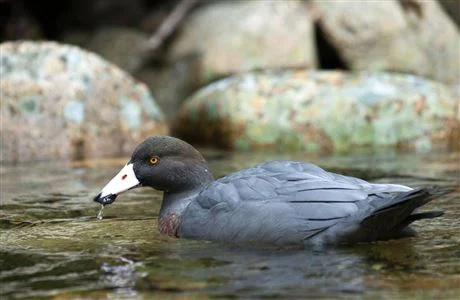
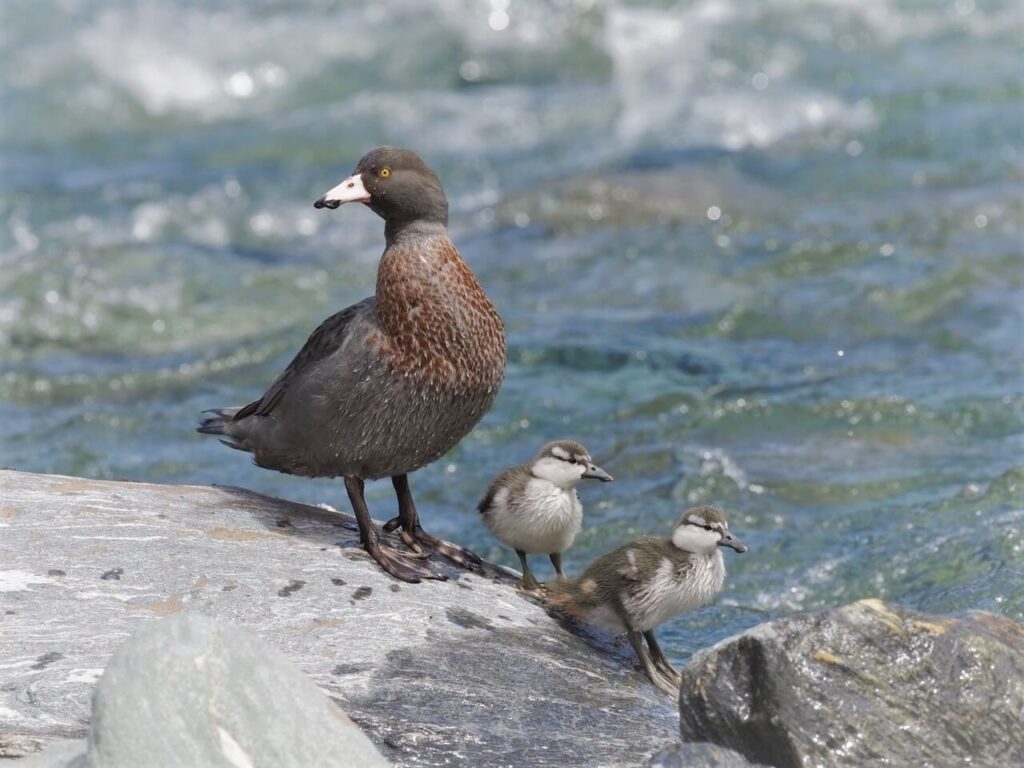
The blue duck is a distinctive river specialist, unlike any other waterfowl in New Zealand. Its plumage is a deep slate-grey with a subtle greenish sheen on the head and chestnut-flecked breast. Both sexes look similar, though females tend to show less chestnut coloring. A key feature is the pinkish-white bill with soft, fleshy flaps hanging from the tip — a unique adaptation for scraping aquatic larvae off rocks in fast-flowing rivers. Their eyes are dark brown, and they have compact, muscular bodies built for swimming rather than flying. The whio’s forward-facing eyes enhance visual foraging, while their strong webbed feet allow them to hold steady against swift currents.
Voice
Males produce a clear, high-pitched whistling call — “whio,” which gives the species its Māori name. Females respond with a harsher rattling growl or low grating note. Their duets often echo over mountain rivers, serving as contact calls and territory signals.
Diet
Blue ducks feed almost entirely on aquatic invertebrates, especially larvae of midges, caddisflies, crane flies, and mayflies. They may occasionally eat berries or small fruits but rely mainly on river-dwelling insects. Their diet reflects the health of mountain streams, making them valuable ecological indicators for freshwater ecosystems.
Behavior
Whio are territorial, monogamous, and strong swimmers that spend nearly all their lives in fast-flowing rivers. They are reluctant to fly, preferring to dive and paddle powerfully through rapids. Pairs defend stretches of river year-round, often covering 0.5 to 1.5 km. Territorial disputes involve whistling, head-bobbing, and aggressive posturing, especially during the breeding season. They are active mostly in early mornings and evenings, resting during midday in shaded riverbanks or under boulders.
Distribution
The blue duck is endemic to New Zealand, found in isolated river systems on both the North and South Islands. Northern populations occur in the central and eastern regions, while southern populations are concentrated on the western slopes of the Southern Alps. Historically, they were widespread, but now they are confined to remote, predator-managed river catchments.
Habitat
They inhabit clear, fast-flowing mountain rivers and streams surrounded by native forest. Whio prefer stretches with alternating pools and rapids, where submerged rocks support abundant insect life. They rely on clean, oxygen-rich water — an essential feature of their specialized feeding ecology. Habitat degradation, sedimentation, and river modification have severely reduced suitable sites.
Breeding
Nesting occurs between August and October in secluded sites such as riverbank crevices, caves, hollow logs, or dense vegetation near water. The female lays 4–9 creamy white eggs and incubates them for about 31–32 days, while the male guards the territory. Ducklings fledge at around 70 days old. Breeding success varies widely due to floods and high predation pressure, particularly from stoats.
Wintering
Blue ducks are largely sedentary and do not migrate, though they may shift slightly along river systems in response to water levels or food availability. Pairs remain on their territories throughout the year, maintaining strong pair bonds and defending their stretches even outside the breeding season.
Conservation
Conservation actions include intensive predator control, habitat protection, and captive rearing programs. The Whio Forever Project—a partnership between the New Zealand Department of Conservation and Genesis Energy—aims to double the number of secure breeding sites. Captive breeding and the use of trained “whio dogs” to locate nests have improved survival rates. Despite ongoing threats, the blue duck is one of New Zealand’s most iconic species, symbolizing the country’s commitment to protecting its unique freshwater wildlife.