
Smew
Scientific Name
Mergellus albellus
Alternative Names
White Nun, Panda Duck, Redhead Smew (female)
Measurements
| Feature | Male | Female |
|---|---|---|
| Length | 38–44 cm (15–17 in) | 38–44 cm (15–17 in) |
| Weight | 450–650 g (16–23 oz) | 450–650 g (16–23 oz) |
| Wingspan | 56–69 cm (22–27 in) | 56–69 cm (22–27 in) |
Status
A small diving duck found across northern Europe and Asia, breeding in forested regions of the taiga. It is listed as Least Concern on the IUCN Red List, but its population is slowly declining. The species is protected under the Agreement on the Conservation of African-Eurasian Migratory Waterbirds (AEWA).
Identification
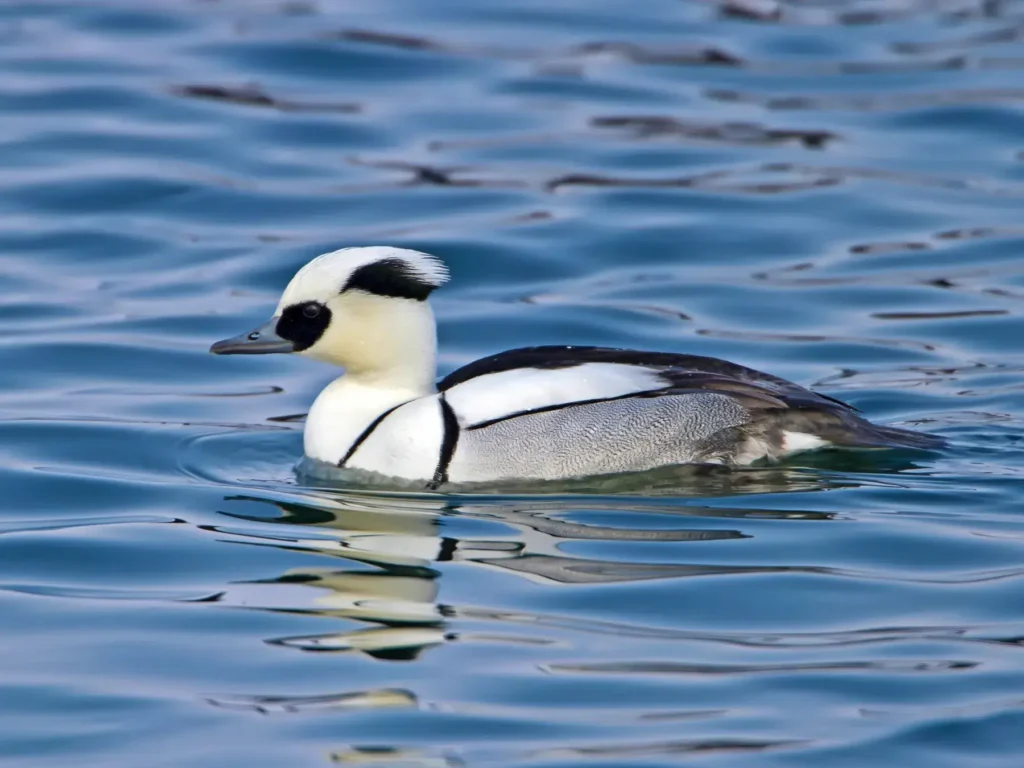
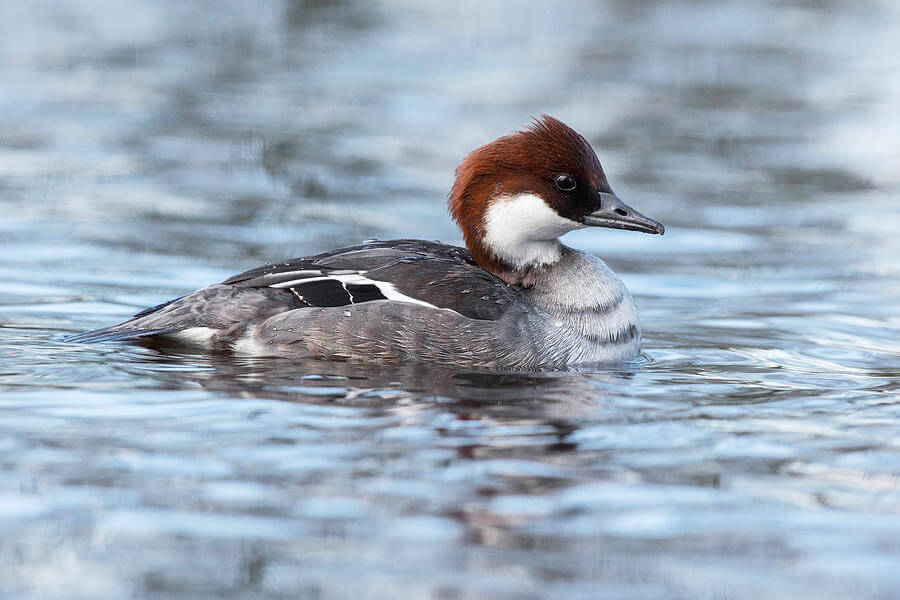
The male smew is strikingly black and white, often described as having a “panda” or “cracked ice” pattern. It has a white body with fine black lines and a black patch around the eyes. The female and young males are gray with a chestnut-brown head, white cheeks, and dark markings near the bill, earning them the nickname “redhead smew.” In flight, both sexes show oval white patches on the wings. The bill is narrow, with small serrations and a hooked tip that help it catch slippery fish.
Voice
Generally quiet, but may produce soft whistling or rasping sounds, especially during the breeding season.
Diet
Mainly eats small fish, which it catches by diving underwater. It may also take aquatic insects, crustaceans, and small invertebrates when fish are less available.
Distribution
Breeds across the northern taiga zone from northern Scandinavia to eastern Siberia (Chukotka). In winter, it migrates south to the Baltic Sea, Black Sea, northern Germany, the Netherlands, Great Britain, the Caspian Sea, Japan, Korea, and eastern China. Occasional visitors are recorded in North America (Alaska, Canada) and North Africa (Egypt, Algeria).
Habitat
Prefers fish-rich lakes, slow-moving rivers, and forest ponds with tree cover for nesting. In winter, it stays on sheltered coasts, estuaries, and large inland lakes that remain unfrozen.
Breeding
Breeds in May in tree holes—often old woodpecker nests—close to water. The female lays 7–11 cream-colored eggs and incubates them for 26–28 days. The ducklings leave the nest soon after hatching and can fly after about 10 weeks. Both parents guard the brood, but only the female incubates.
Wintering
Migrates to milder regions in winter, forming small flocks on unfrozen lakes and coastal lagoons. It is shy and easily frightened, often diving quickly when disturbed.
Conservation
Although not currently threatened, the smew’s numbers are slowly decreasing due to loss of nesting trees, pollution, and habitat disturbance. Conservation efforts focus on protecting breeding woodlands, preserving old trees with nest holes, and maintaining clean freshwater habitats.