Baer’s Pochard
Scientific Name
Aythya baeri
Alternative Names
Eastern White-eye, Siberian White-eye, Baer’s White-eye, Green-headed Pochard
Measurements
| Feature | Male | Female |
|---|---|---|
| Length | 41–47 cm (16–19 in) | 41–47 cm (16–19 in) |
| Wingspan | 70–79 cm (28–31 in) | 70–79 cm (28–31 in) |
| Weight | 500–730 g (18–26 oz) | 590–655 g (21–23 oz) |
| Wing Length | 18.6–20.3 cm (7.3–8 in) | 19.1–20.5 cm (7.5–8.1 in) |
| Tail Length | 53–60 mm (2.1–2.4 in) | 51–64 mm (2–2.5 in) |
| Culmen | 38–44 mm (1.5–1.7 in) | 40–44 mm (1.6–1.7 in) |
| Tarsometatarsus | 33–34.7 mm (1.3–1.37 in) | 33–34.7 mm (1.3–1.37 in) |
Status
Baer’s Pochard is critically endangered. Its population is estimated at fewer than 1,000 mature individuals, declining due to hunting, habitat loss, and wetland degradation. It is listed as a first-class protected species in China.
Identification
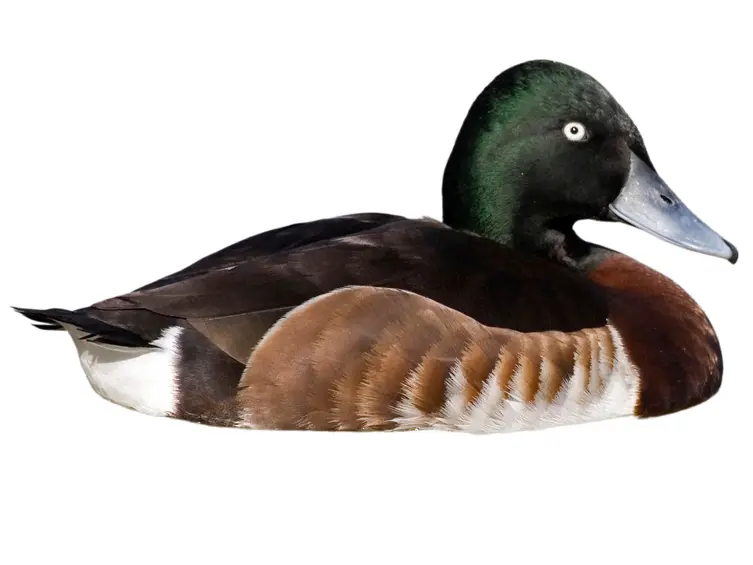
The breeding male has a black head and neck with green gloss, pale yellow eyes, a dark chestnut breast, blackish-brown back, and white flanks. In poor light, it may appear completely black.
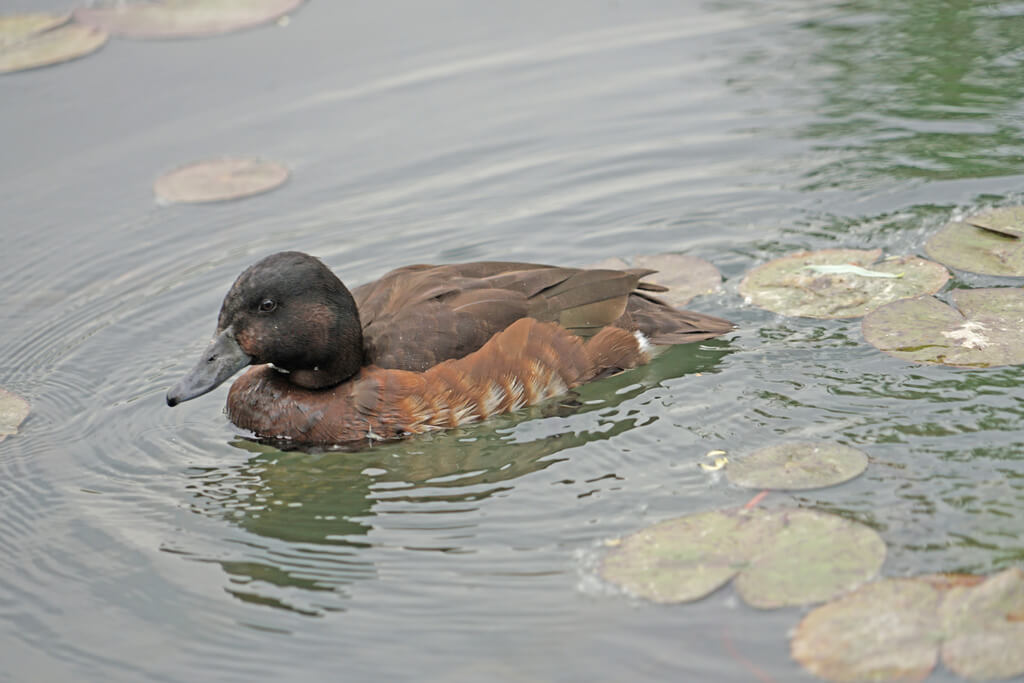
The female has a dark brown head and neck blending into a chestnut-brown breast and flanks. Both sexes have white speculum feathers, white vent-side, dark-grey bills, black nails, and dark-grey legs.
Baer’s Pochard is larger than the closely related ferruginous duck, with a longer, more rounded head and larger white area on the flanks visible when floating.
Voice
Generally quiet. During courtship, both sexes give a harsh “graaaak” sound. Females may utter “kura kura kura,” and males sometimes give “kuro kuro” calls.
Diet
Little is known in detail, but they feed mainly on aquatic plants, grass seeds, and molluscs.
Distribution
Traditionally bred in the Amur and Ussuri basins of Northeast China and southeastern Russian Far East. Recent breeding sites are in North and Central China. Wintering occurs in southern China, Taiwan, Japan, Bangladesh, India, North Korea, Laos, Myanmar, Nepal, Thailand, and Vietnam, with occasional vagrants in Bhutan, South Korea, the Philippines, or Pakistan.
Habitat
Shy species inhabiting open, slow-flowing lakes, swamps, and ponds with rich aquatic vegetation. They build their nests among dense grass or reeds in shallow water or small islands. In winter, they form large flocks on freshwater lakes and reservoirs.
Breeding
Monogamous during the breeding season. Males perform courtship by swimming around the female and nodding their heads, driving off other males without violent fights.
- Nest: Cylindrical, made from sedges and reeds, lined with down.
- Clutch size: 5–14 eggs (average 9–10).
- Incubation: 23–26 days by the female, males guard the nest from nearby.
- Chick survival: 20–30% hatch successfully; main threats include predation, flooding, and nest desertion.
Wintering
Baer’s Pochard migrates south in winter, leaving by mid-March and returning by mid-October or early November. Recent trends show populations are increasingly staying in central and eastern China year-round.
Conservation
Populations have plummeted due to hunting, habitat loss, and wetland degradation. Efforts include first captive populations in Beijing Zoo, species protection under Chinese law, and international coordination through the East Asian–Australasian Flyway Partnership. Only 5–10% of habitats fall within protected areas, making cross-border conservation critical.