
Wood Duck
Scientific name:
Aix sponsa
Alternative names:
Wood Duck, Carolina Duck
Measurements
| Feature | Range |
|---|---|
| Length | 47–54 cm (19–21 in) |
| Wingspan | 66–73 cm (26–29 in) |
| Weight | 454–862 g (16–30 oz) |
Status
The Wood Duck is listed as Least Concern and has made a strong recovery from past population declines. Thanks to habitat protection, hunting limits, and the use of nesting boxes, its numbers have increased greatly since the early 1900s.
Identification
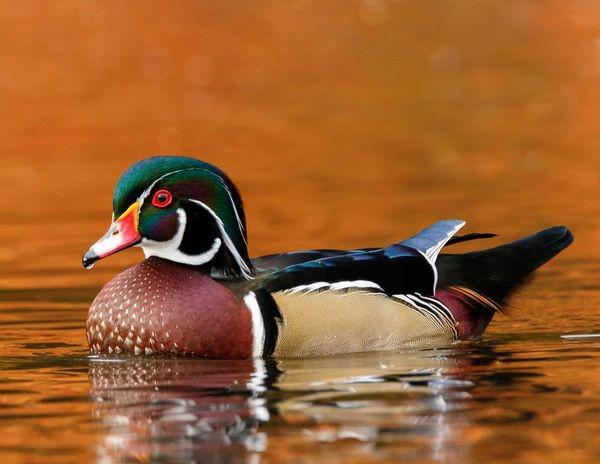
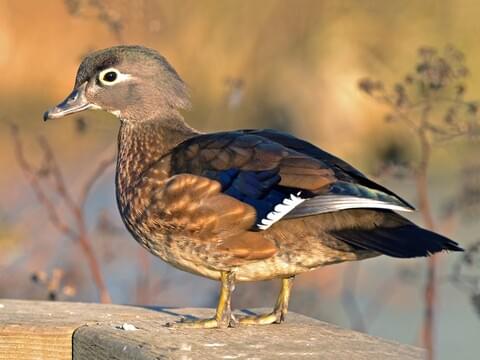
The male Wood Duck is one of North America’s most colorful ducks, showing an iridescent mix of green, blue, chestnut, and white. It has a red eye, a white line curving down its neck, and a glossy green crest. The female is brown with a white eye-ring and a pale throat patch. Both have crested heads and blue-green wing patches with white edges.
Males are easily spotted by their striking plumage, while females rely on their camouflaged colors for nesting. The species is medium-sized and shares its genus with the Mandarin Duck of Asia.
Voice
Males give a high, rising whistle that sounds like jeeeeee. Females make a longer squeal, do weep do weep, and a sharp cr-e-ek when alarmed.
Diet
Wood Ducks feed mainly by dabbling or grazing. They eat acorns, seeds, fruits, berries, and insects. Their strong gizzard allows them to crush acorns easily. Being omnivores, they change their diet with the seasons—more insects in spring and more seeds and nuts in fall and winter.
Behavior
These ducks are agile flyers and strong perchers, often resting on tree branches near water. They are shy but social, sometimes forming small flocks outside breeding season. They are also known for their quick, direct flight and graceful swimming.
Distribution
Wood Ducks live throughout North America. They breed across the eastern United States, southern Canada, and along the U.S. west coast. Northern populations migrate south for winter, while many southern and Pacific Coast birds remain year-round residents. Escaped birds are sometimes seen in Europe, but wild populations there are rare.
Habitat
Wood Ducks prefer wooded swamps, slow-moving rivers, ponds, and forested wetlands. They are one of the few duck species that nest in trees, using natural cavities or nest boxes near water. Beaver-created wetlands have also helped expand their ideal breeding habitat.
Breeding
Wood Ducks nest in tree holes near water or in man-made boxes. Females use feathers and soft materials to line the nest. They usually lay 7–15 eggs, which hatch after about 30 days. In the south, females can raise two broods in one season—the only North American duck to do so.
A day after hatching, ducklings leap from the nest—sometimes from as high as 15 meters (50 feet)—landing safely on the ground or in water. The mother leads them to the nearest pond, where they can swim and feed on their own.
Wintering
Northern Wood Ducks migrate south to the southern U.S. and Mexico during winter, staying in forested wetlands, rivers, and swamps. Populations in warmer regions stay year-round, especially along the Pacific Coast.
Conservation
Once close to extinction due to overhunting and habitat loss, the Wood Duck’s comeback is a major conservation success story. Legal protection in the early 1900s, along with wetland preservation and nesting box programs, helped populations rebound. Beavers also indirectly support them by creating new wetlands.
Today, they remain common and widespread, though continued habitat management is essential. Hunting is regulated, with daily limits depending on the flyway.
