Pacific Black Duck
Scientific Name
Anas superciliosa
Alternative Names
Pacific Black Duck, Grey Duck (New Zealand), Pārera (Māori name), Island Black Duck (subspecies A. s. pelewensis)
Measurements
| Feature | Male | Female |
|---|---|---|
| Length | 54–61 cm (21–24 in) | 54–61 cm (21–24 in) |
| Wingspan | Approx. 90–100 cm (35–39 in) | Approx. 90–100 cm (35–39 in) |
| Weight | Around 1 kg (2.2 lb) | Slightly lighter than male |
Status
The Pacific Black Duck is widespread across the Australasian and southwestern Pacific regions, from Indonesia and New Guinea to Australia, New Zealand, and the islands east to French Polynesia. While globally common and adaptable, its New Zealand population—known as the Grey Duck—has declined sharply due to hybridisation and competition with the introduced mallard.
Identification
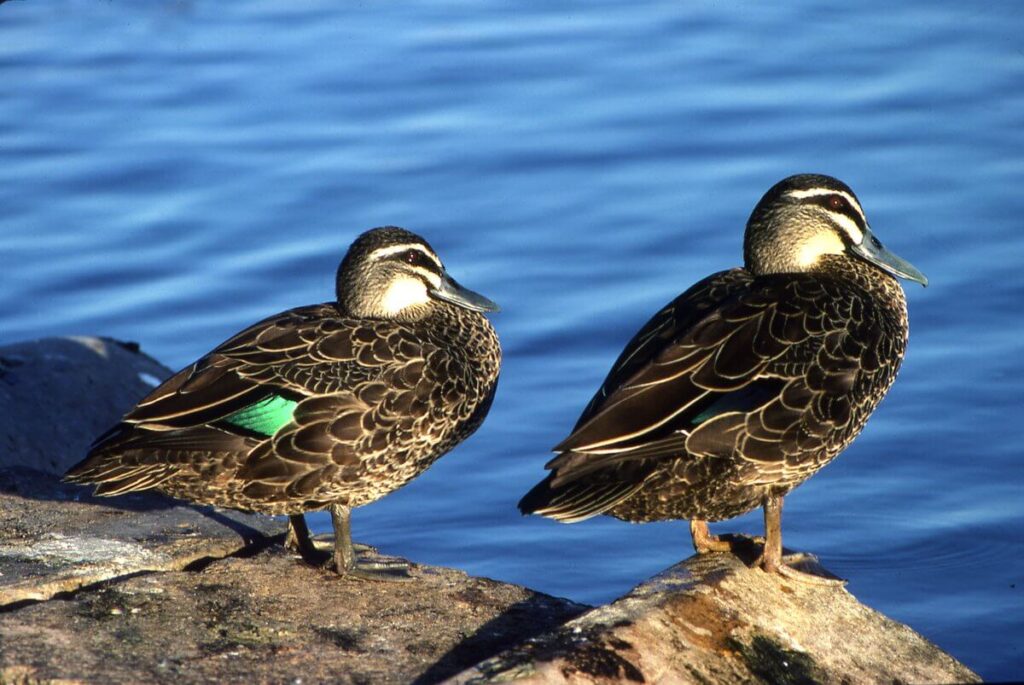
This duck has a dark brown body with pale-edged feathers, giving a softly scalloped appearance. The head is lighter, marked by a dark crown and bold dark eye-stripes, which stand out against its buff face. In flight, it shows a green speculum bordered with black and buff, and pale underwings that contrast with the darker body. Both sexes look similar, though males are slightly larger.
Voice
The female’s call is a loud, rapid series of quacks, similar to the mallard’s but slightly higher-pitched and faster. Males give quieter, rasping notes.
Diet
Primarily herbivorous, feeding on the seeds and roots of aquatic plants, but also eats insects, snails, and small crustaceans. It feeds by dabbling—upending in shallow water—or by grazing along grassy banks and wetlands.
Distribution
Found throughout Australia, New Zealand, New Guinea, Indonesia, and many Pacific islands including the Caroline Islands and French Polynesia. It is a common resident in most areas but occurs only seasonally or as a vagrant on some smaller islands.
Habitat
Prefers freshwater wetlands, rivers, lakes, swamps, and estuaries, but is also seen in urban parks and farm dams. Its adaptability allows it to thrive in both natural and human-modified environments.
Breeding
Usually nests in tree holes, but may also use old bird nests or ground sites hidden in vegetation. The female lays 8–10 pale cream eggs, incubating them alone for about 26–32 days. The ducklings are precocial, leaving the nest soon after hatching to follow their mother to water. They are capable of flight at around 58 days.
Behaviour
A social and adaptable dabbling duck, often seen in pairs or small groups, though large flocks may form where food is plentiful. It feeds mainly during the day and rests or preens near the water’s edge. Its movements are generally local or nomadic, following rainfall and changing water levels.
Conservation
The Pacific Black Duck is listed as Least Concern globally, but the New Zealand Grey Duck population is in serious decline due to hybridisation with mallards, habitat loss, and past overhunting. In many regions, pure Grey Ducks are now rare, with hybrids dominating the population. Conservation efforts focus on habitat protection, monitoring hybridisation, and maintaining genetic integrity through managed breeding programs.