
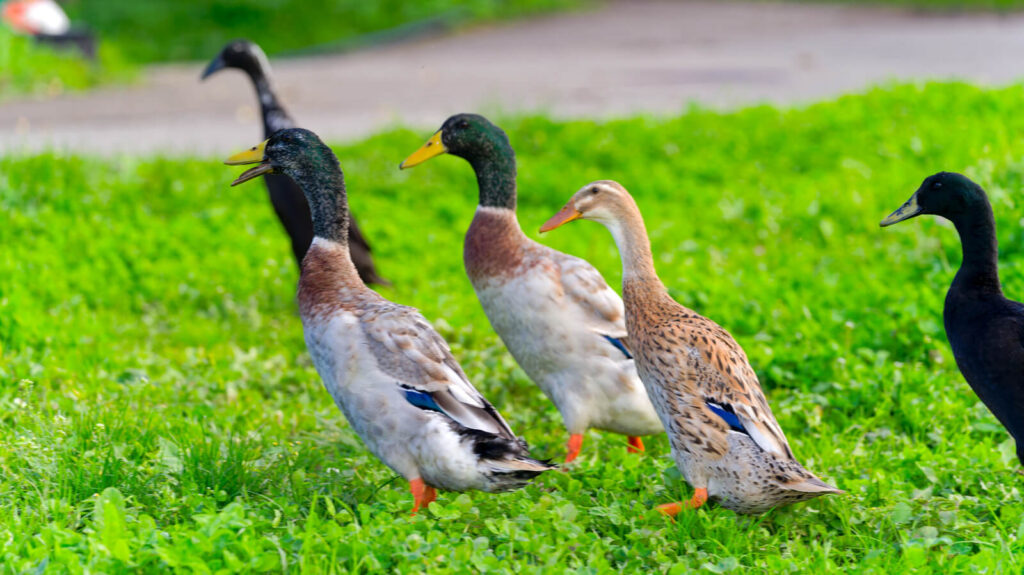
Indian Runner Duck

Scientific Name

Anas platyrhynchos domesticus

Alternative Names

Runner Duck, Penguin Duck (historically), Baly Soldier

Measurements:

FeatureMaleFemale
HeightUp to 76 cm (30 in)Around 50–60 cm (20–24 in)
Weight1.8–2.3 kg (4–5.1 lb)1.4–2 kg (3.1–4.4 lb)
Egg Production173–250+ eggs per year

Status

Domesticated breed originally from Indonesia (Java, Bali, Lombok). Now kept worldwide for eggs, pets, and ornamental use.

Identification

Indian Runners are famous for their upright, penguin-like posture. Instead of waddling like most ducks, they walk or run due to their pelvic bones being positioned further back. They have long, slim bodies, long necks, and a smooth, straight head shape. Plumage comes in many colors—such as fawn, white, black, chocolate, or penciled.

Voice

Females are quite vocal with typical loud quacks. Males are quieter with soft, raspy sounds.

Diet

They eat grass, grains, insects, small invertebrates, and love foraging in rice fields. They are excellent natural pest controllers.

Distribution

Originally from the Indonesian islands of Bali, Java, and Lombok. Now found on farms, homesteads, and backyard flocks around the world.

Habitat

Domesticated, but thrive in areas with open land, rice paddies, ponds, and grassy fields. They prefer land more than deep water.

Breeding

Highly productive egg layers. A healthy female can lay 173 to over 250 eggs per year. Eggs are usually white or light green. They rarely go broody, so eggs are often hatched using incubators or broody ducks.

Wintering

Do not migrate. They handle mild cold but need shelter in freezing weather due to their slender bodies and lack of heavy feather insulation.

Conservation

Not endangered. Widely kept, but pure bloodlines and traditional colors are preserved by dedicated breeders.

Similar Posts

  • Common Merganser

    Scientific name Mergus merganser Alternative names Goosander (Eurasia), Common Merganser (North America) Subspecies Subspecies Description Distribution M. m. merganser Typical form Northern Europe and northern Asiatic Russia M. m. orientalis Slightly larger, more slender bill Central Asian mountains M. m. americanus Broader-based bill, black bar across inner wing in males North America Measurements Feature Range…

  • Ring-necked Duck

    Scientific name: Aythya collaris Alternative names: Ringbill, Ring-necked pochard Measurements Feature Range Length 39–46 cm (15.3–18.1 in) Weight 490–910 g (17.3–32.1 oz) Wingspan 62–63 cm (24.4–24.8 in) Status The ring-necked duck’s population is stable and has even expanded in parts of its range since the early 20th century. It is now a common breeding bird…

  • Pink-headed Duck

    Scientific Name Rhodonessa caryophyllacea. Measurements Measurement Range Body Length 41–43 cm Egg Length 1.71–1.82 inches Egg Width 1.61–1.70 inches Status This species is currently listed as Critically Endangered by the IUCN and is widely believed to be extinct, although unconfirmed reports from remote wetlands in northern Myanmar have left open the possibility that a small…

  • Perching Ducks: 17 Arboreal Duck Species You Should Know

    Perching ducks are a group of waterfowl historically recognized for their ability to perch in trees and wooded habitats. Most species were formerly placed in the Cairinini tribe within the duck family Anatidae, though some are now classified in other groups based on more recent taxonomic studies. These ducks vary widely in size and appearance,…

  • Fuegian Steamer Duck

    Scientific Name Tachyeres pteneres Alternative Names Fuegian steamer duck, Magellanic steamer duck Measurements Measurement Male Female Length 65–84 cm (26–33 in) Slightly smaller Weight 3.5–7 kg (7.7–15.4 lb), average 5.34 kg (11.8 lb) Around 4.2 kg (9.3 lb) Wingspan 85–110 cm (33–43 in), flightless Slightly smaller Status / Origin Native to southern Chile, Chiloé, and…

  • Pacific Black Duck

    Scientific Name Anas superciliosa Alternative Names Pacific Black Duck, Grey Duck (New Zealand), Pārera (Māori name), Island Black Duck (subspecies A. s. pelewensis) Measurements Feature Male Female Length 54–61 cm (21–24 in) 54–61 cm (21–24 in) Wingspan Approx. 90–100 cm (35–39 in) Approx. 90–100 cm (35–39 in) Weight Around 1 kg (2.2 lb) Slightly lighter…

Leave a Reply

Your email address will not be published. Required fields are marked *