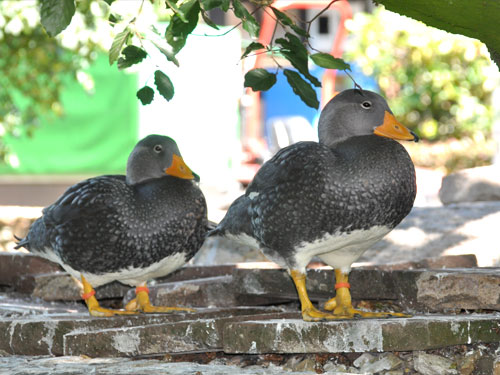
Fuegian Steamer Duck

Scientific Name

Tachyeres pteneres

Alternative Names

Fuegian steamer duck, Magellanic steamer duck

Measurements

MeasurementMaleFemale
Length65–84 cm (26–33 in)Slightly smaller
Weight3.5–7 kg (7.7–15.4 lb), average 5.34 kg (11.8 lb)Around 4.2 kg (9.3 lb)
Wingspan85–110 cm (33–43 in), flightlessSlightly smaller

Status / Origin

Native to southern Chile, Chiloé, and Tierra del Fuego. A flightless marine duck, it lives mainly along rocky coasts and coastal islands. Moves to calm bays and inland lakes during the breeding season.

Identification

The largest steamer duck. Strong, heavy body with small wings used for paddling, not flying. Males have blue-grey heads and necks, pale foreheads, a narrow white eye-ring, and a reddish-brown throat. Their underparts are white with grey tails. Females are darker grey-brown with a reddish throat and may show brown or wine-colored feathers. Juveniles look like females but are duller.

Voice

Generally quiet but during breeding season, males make low grunts and harsh calls when defending territory.

Diet

Feeds mainly on saltwater mollusks, crustaceans, small fish, snails, insect larvae, amphipods, and isopods. Dives or upends in shallow water to find food. Uses a salt gland above the eyes to remove excess salt.

Distribution

Chile, Chiloé Island, Tierra del Fuego, and nearby coastal regions of Argentina.

Habitat

Rocky sea coasts, offshore islands, sheltered bays, and inland lakes during breeding.

Breeding

Breeds from September to December. Nests in dense vegetation near water or in abandoned penguin burrows. Lays 4–11 ivory eggs, average 9. Eggs are about 8.2 × 5.6 cm and weigh around 167 g. Incubation lasts 28–40 days. Young fledge at 120–130 days and are then driven away to form flocks. They become fully mature at 2–3 years.

Wintering

Non-migratory. Stays in its home range year-round.

Threats

Eggs and ducklings are preyed on by foxes, caracaras, gulls, skuas, petrels, and sometimes marine otters. Adults have few predators, except sea lions.

Conservation

Not globally threatened. Most numerous of all steamer ducks. Known for extremely aggressive behavior; males may kill other waterbirds, even larger ones, especially during breeding season. Needs isolated enclosures in captivity due to aggression.

Similar Posts

  • Tufted Duck

    Scientific name: Aythya fuligula Alternative names: Tufted Pochard Measurements: Feature Male Female Length 40.6–45.7 cm (16–18 in) 40.6–45.7 cm (16–18 in) Weight 753–1026 g (1.6–2.3 lb) 629–907 g (1.4–2.0 lb) Wingspan 51–54 cm (20–21 in) 49–53 cm (19–21 in) Status Listed as Least Concern under the IUCN. With a population nearing one million, the Tufted…

  • Surf Scoter

    Scientific name Melanitta perspicillata Common name Surf Scoter Measurements Feature Average Length 44–48 cm (17–19 in) Wingspan 76–77 cm (30 in) Weight 900–1,050 g (2.0–2.3 lb) Status The surf scoter is a large, migratory sea duck native to North America. Though its population has declined by an estimated 50–70% over the past four decades, it…

  • Wandering Whistling Duck

    Scientific Name Dendrocygna arcuata Alternative Names Whistling Tree-Duck, Water Whistling Duck, Red Whistler Measurements Feature Male & Female Length 54–60 cm (21–24 in) Weight Around 750 g (1.65 lb) Status / Origin This species is native to tropical and subtropical regions of Australia, Indonesia, the Philippines, Papua New Guinea, Timor-Leste, Borneo, and nearby Pacific Islands….

  • Northern ‘Borealis’ Eider

    Scientific Name Somateria mollissima borealis Alternative Names Common Eider, Northern Eider, Borealis Eider, St. Cuthbert’s Duck, Cuddy’s Duck Measurements Measurement Range Imperial Length 500–710 mm 20–28 in Weight 0.81–3.04 kg 1.8–6.7 lb Wingspan 800–1100 mm 31–43 in Status Least Concern globally, though the borealis subspecies is considered rare in Britain and under review by the…

  • Baer’s Pochard

    Scientific Name Aythya baeri Alternative Names Eastern White-eye, Siberian White-eye, Baer’s White-eye, Green-headed Pochard Measurements Feature Male Female Length 41–47 cm (16–19 in) 41–47 cm (16–19 in) Wingspan 70–79 cm (28–31 in) 70–79 cm (28–31 in) Weight 500–730 g (18–26 oz) 590–655 g (21–23 oz) Wing Length 18.6–20.3 cm (7.3–8 in) 19.1–20.5 cm (7.5–8.1 in)…

  • Lake Duck

    Scientific Name Oxyura vittata Alternative Names Argentine Blue-bill, Argentine Blue-billed Duck, Argentine Lake Duck, Argentine Ruddy Duck Measurements Feature Male Female Length 36–46 cm (14–18 in) 36–46 cm (14–18 in) Weight 600–850 g (21–30 oz) 510–700 g (18–25 oz) Status Native to South America, the Lake Duck is found across Argentina, Brazil, Chile, Paraguay, and…

Leave a Reply

Your email address will not be published. Required fields are marked *