
Ruddy Duck
Scientific name
Oxyura jamaicensis
Common name
Ruddy Duck
Measurements
| Feature | Average |
|---|---|
| Length | 34–43 cm (13.5–17 in) |
| Wingspan | 47 cm (18.5 in) |
| Weight | 560 g (1.23 lb) |
Status
The ruddy duck is a compact, stiff-tailed diving duck native to North and South America. It has also established populations in Europe after being introduced to the United Kingdom in the 1940s. While it is widespread and abundant in its native range, it is considered a serious invasive species in parts of Europe, where it threatens the endangered white-headed duck through hybridization. Globally, however, it remains listed as Least Concern by the IUCN.
Identification
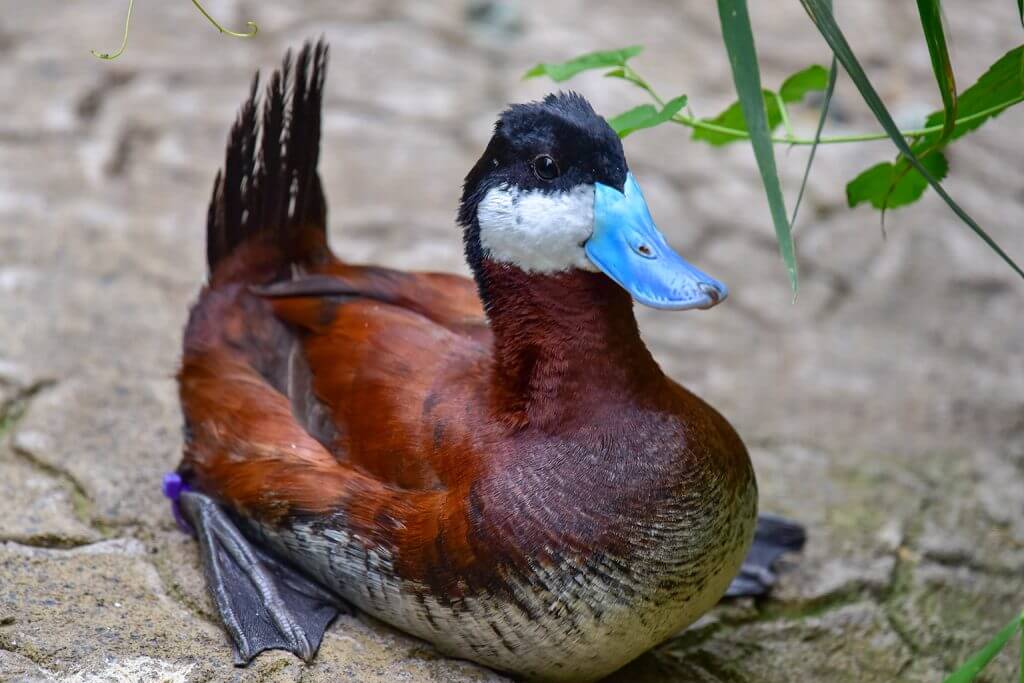
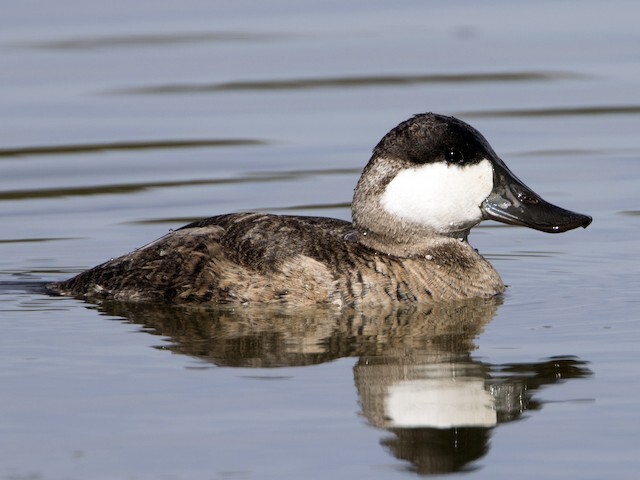
This small, round-bodied duck is easily recognized by its long, stiff tail—often held upright—and its broad, flat bill. Breeding males are striking with bright chestnut bodies, white cheeks, glossy black caps, and vivid blue bills. In winter, males lose their bright colors, becoming dull brownish-gray, while females and juveniles remain brown year-round, with a darker cap and a faint horizontal stripe across their pale cheeks. Their tails and compact build give them a distinct silhouette even from afar.
Voice
Ruddy ducks are generally quiet but become more vocal during the breeding season. Males produce short “aa-anh” grunts and a drumming sound on their chests that creates bubbles in the water—a behavior known as “bubbling.” Females make higher-pitched “raanh” calls to their ducklings and hiss or squeak when disturbed.
Distribution
Native populations of the ruddy duck are found across North America, from Canada and the U.S. to Mexico and the Caribbean, with some extending into South America. In winter, they migrate to coastal bays, estuaries, and unfrozen inland lakes. Introduced populations in the U.K. and parts of Europe have spread widely, though many have been culled due to conservation concerns.
Habitat
Ruddy ducks prefer freshwater lakes, ponds, and marshes with dense emergent vegetation, which provides shelter and nesting sites. They are often seen on still or slow-moving water bodies, avoiding fast-flowing rivers or open seas. In winter, they move to larger unfrozen lakes and sheltered coastal waters.
Behaviour
These ducks are strong divers but clumsy flyers, spending most of their time swimming or diving for food. Their short wings and compact bodies make takeoff laborious, often requiring a long running start across the water. Males are territorial and aggressive during the breeding season, using bubbling displays and tail-raising to assert dominance. Despite their combative courtship, pairs often rest side by side peacefully moments later.
Breeding
Breeding takes place in dense marshes near water, where females construct nests from grasses hidden among vegetation. A typical clutch consists of 5–15 eggs. Females incubate the eggs for about 23–26 days, and the ducklings become independent quickly—able to dive soon after hatching and fledge within a month or two. Males do not participate in raising the young. Occasionally, females lay eggs in the nests of other ducks, a behavior known as brood parasitism.
Diet
Ruddy ducks feed mainly underwater, using their broad bills to strain food from the mud and sediment. Their diet consists of aquatic plants, seeds, roots, and small invertebrates, including larvae, pupae, mollusks, and crustaceans. In winter, they consume more animal matter, especially crustaceans. They locate prey by touch rather than sight, aided by sensory cells at the tips of their bills.
Invasive species and culling
Introduced to the United Kingdom in the 1940s, the ruddy duck quickly established a population that spread across Europe. However, their tendency to hybridize with the endangered white-headed duck led to widespread culling campaigns, particularly in Spain and the U.K. By 2014, Britain’s ruddy duck population had fallen from about 5,500 to fewer than 100 individuals. Since 2016, the species has been listed as an invasive alien species of Union concern in the European Union, making it illegal to import, breed, transport, or release it within EU member states.
Wintering
Ruddy ducks winter in coastal bays, estuaries, and large unfrozen lakes across the southern United States, Mexico, and parts of Central America. They are commonly seen in small groups or flocks, diving frequently in calm waters where they forage for crustaceans and aquatic insects.
Conservation
In North America, ruddy duck populations remain healthy and stable, supported by extensive wetland habitats and protected areas. However, habitat loss due to wetland drainage and pollution poses potential risks to local populations. In contrast, in Europe, conservation efforts focus on eradicating the species to protect native white-headed ducks from hybridization. The ruddy duck’s dual status—thriving native species in the Americas and harmful invader in Europe—makes it a unique case in global waterfowl conservation.