
Chubut Steamer Duck
Scientific Name
Tachyeres leucocephalus
Alternative Names
Chubut steamer duck, white-headed flightless steamer duck
Measurements
| Measurement | Male | Female |
|---|---|---|
| Length | About 65–75 cm (estimated, similar to other steamer ducks) | Slightly smaller |
| Weight | Around 4–6 kg (estimate, similar species data) | Slightly lighter |
| Wingspan | Flightless, wings short and paddle-like | Same |
Status / Origin
A flightless duck species found only along the coast of Argentina. It was officially described in 1981 and has a very limited range along the shores of southern Chubut and northern Santa Cruz Provinces.
Identification
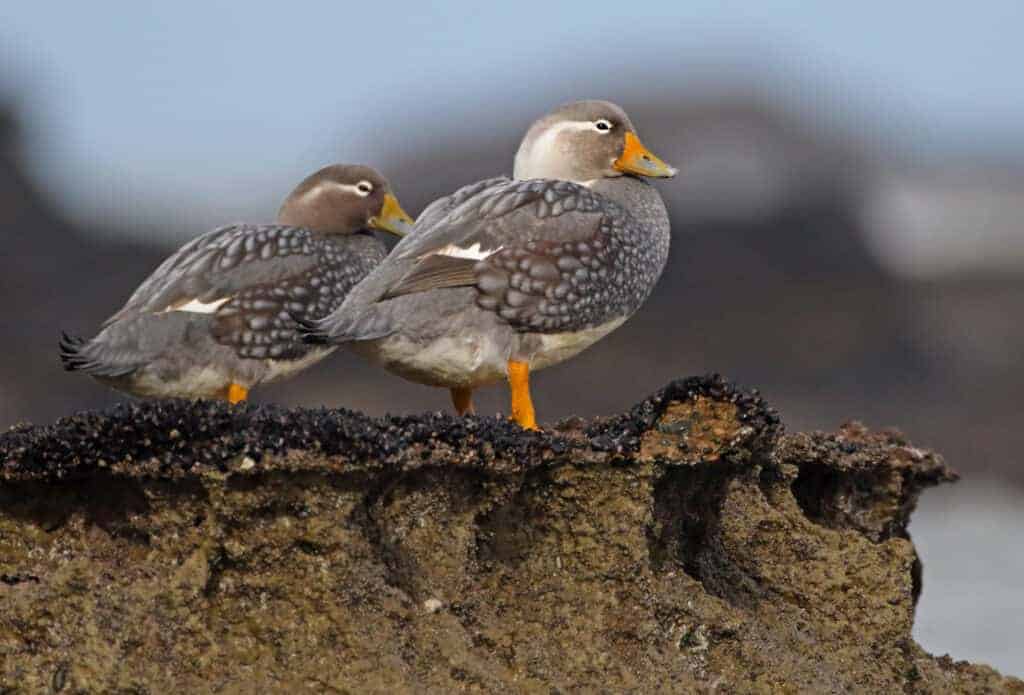
Males have white heads, bright yellow to orange bills with black tips, grey bodies, white bellies, and orange feet with black claws. Females have brown heads and necks with a thin white line from behind the eye to the neck, and greenish-yellow bills. Juveniles look similar to females.
Voice
Not well documented, but like other steamer ducks, they produce grunts and rasping sounds, especially during territorial or breeding behaviour.
Diet
Feeds mainly on mollusks and crustaceans. They dive, upend, and dabble in shallow waters and may search for food on land near the coast.
Distribution
Coastal Argentina, from the southern San Matías Gulf to Islote Chato. Most of the population is found around Bahía San Gregorio, Bahía Melo, and Caleta Malaspina in the San Jorge Gulf.
Habitat
Shallow coastal waters, sheltered bays, rocky shores, and small islands or islets. Prefers calm waters protected from strong waves and winds.
Breeding
Breeding season runs from October to February. Nests are built on the ground using grasses, sticks, and washed-up sea material. Nest sites are usually on islands, in shallow bays with shrub cover, and often grouped close together. Typical clutch size is 5–6 eggs.
Wintering
Non-migratory, remains in the same coastal area year-round.
Threats
Main threats include oil spills, coastal development, habitat loss, invasive species like green crabs, Asian kelp, and acorn barnacles, predation by kelp gulls and crested caracaras, and marine predators such as South American sea lions and orcas.
Conservation
Listed as Vulnerable since 2012 due to its small population and limited range. Estimated 5,300–5,600 individuals, with around 3,400–3,700 mature birds. Nearly half the population lives in protected areas like the Interjurisdictional Marine Park in the San Jorge Gulf and the UNESCO Biosphere Reserve. Conservation efforts include limiting oil-tanker activity and reducing human disturbance in breeding areas.