
7 Types of Pintail Ducks You Should Know
One of the defining features of the Northern Pintail is its long central tail feathers, especially in the drake. In fact, both its English and scientific names come from this distinctive trait. But did you know the name “pintail” isn’t exclusive to the Northern Pintail? It’s actually a descriptive term used for several duck species that share the same pointed tail shape. Some of these “pintails” aren’t even closely related to the Northern Pintail and can be found in completely different parts of the globe, sharing little more than that elegant, pointed tail silhouette.
So, how many pintail ducks do you know? Here are the most well-known types of pintail ducks, along with a few quick, insightful facts about each one.
1. Northern Pintail
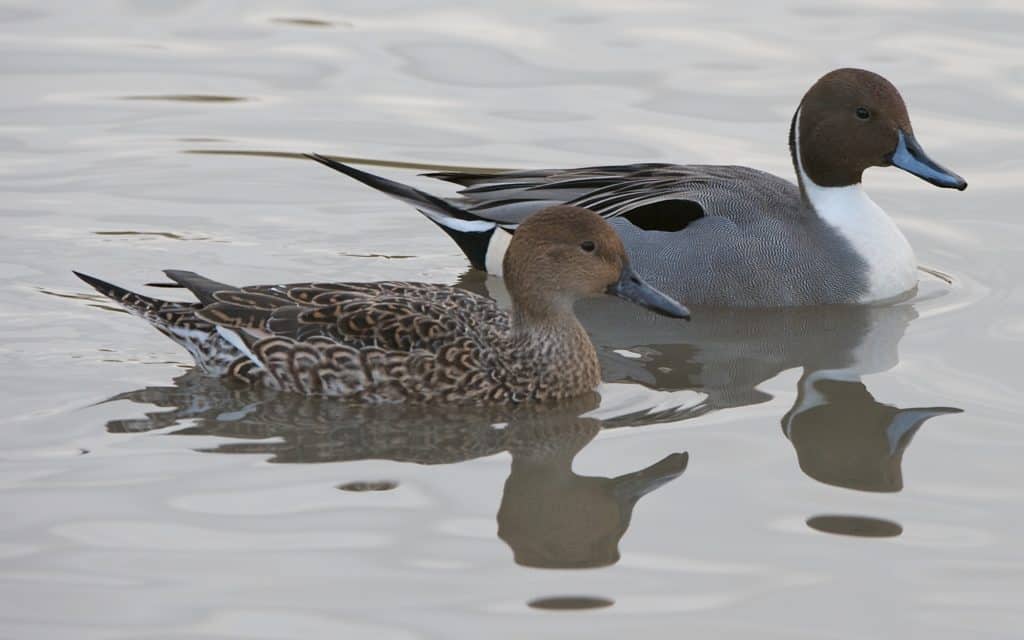
Let’s start with the most familiar pintail: the Northern Pintail.
Both males and females have grey legs and feet, along with blue-grey bills. The male is the more eye-catching of the two. He has a chocolate-brown head with a slim white stripe that runs down the neck, and most of his body is pale with soft grey, brown, and black patterns on the back and sides. The female is much more plain, with brown feathers that help her blend into her surroundings, like many other female dabbling ducks.
Northern Pintails breed in the northern parts of the world, including areas of Europe and Asia, as well as North America. They prefer open, treeless wetlands such as grasslands near water, lake edges, and tundra. In winter, they move to a wider variety of watery habitats like coastal lagoons, estuaries, and sheltered marshes.
Outside the breeding season, they are very social birds and often gather in large flocks, sometimes mixing with other duck species.
2. Eaton’s Pintail
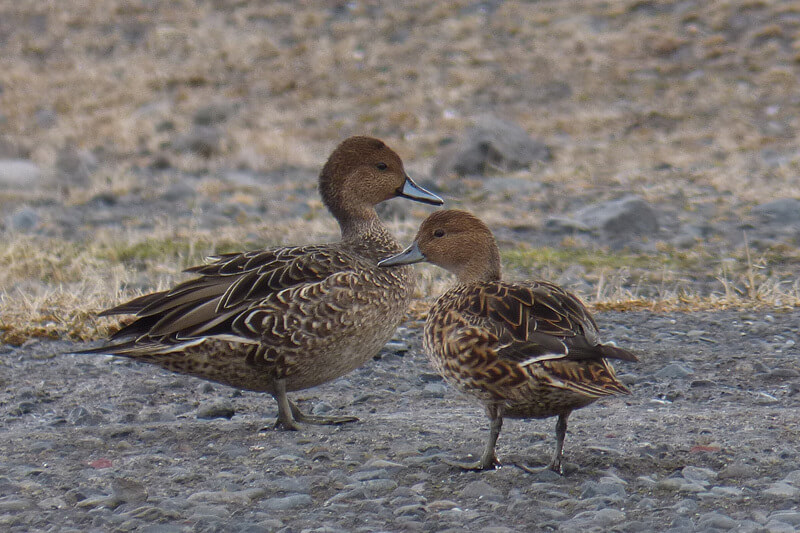
The Eaton’s Pintail, also called the southern pintail, is a small dabbling duck found only in a very remote part of the world—the islands of Kerguelen and Crozet in the southern Indian Ocean.
This pintail weighs 430-502g, so it is much small than the Northern Pintail and can even look a bit like a small female Northern Pintail at first glance. In fact, the male is not as brightly coloured or strongly patterned as you might expect; instead, both males and females are mostly brown overall with warm cinnamon tones on the body.
The two sexes look quite similar, but there are still a few differences. Males have a green speculum (the shiny patch on the wing) and slightly longer central tail feathers, while females have a brown speculum and shorter tail feathers.
Unlike many ducks where males and females look very different, Eaton’s Pintails are quite subtle and similar in appearance, which makes them a more understated member of the pintail group.
Discover other smaller ducks that weigh below 700g: Top 21 Small Duck Species (Below 700g)
3. White-cheeked Pintail
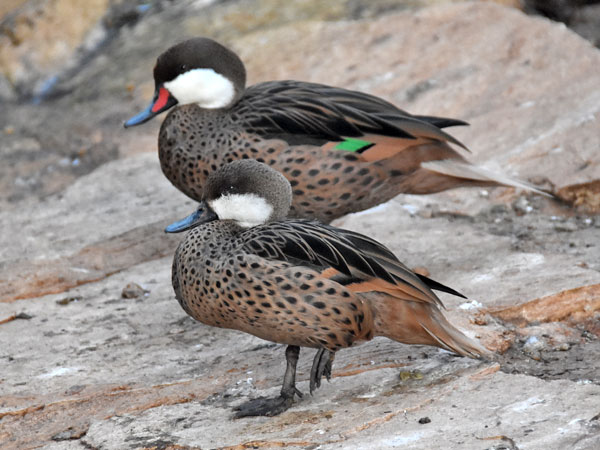
The White-cheeked Pintail is another dabbling duck found in parts of South America and the Caribbean, and it is also known as the Bahama pintail or Bahama duck.
As its name suggests, it has noticeable white cheeks and a grey bill with a reddish base. The rest of its body is mostly brown, giving it a simple but distinctive look. Like other pintails, it also has a slim, pointed tail, although it is not as long or dramatic as in the Northern Pintail.
Males and females look quite similar, with females being a little smaller and slightly duller in colour. Both sexes also show a shiny green patch on the wing, known as a speculum.
This species tends to prefer watery habitats that are slightly salty or brackish, such as mangrove swamps, estuaries, and coastal lagoons, but it can also be found on freshwater lakes and ponds.
4. Yellow-billed Pintail
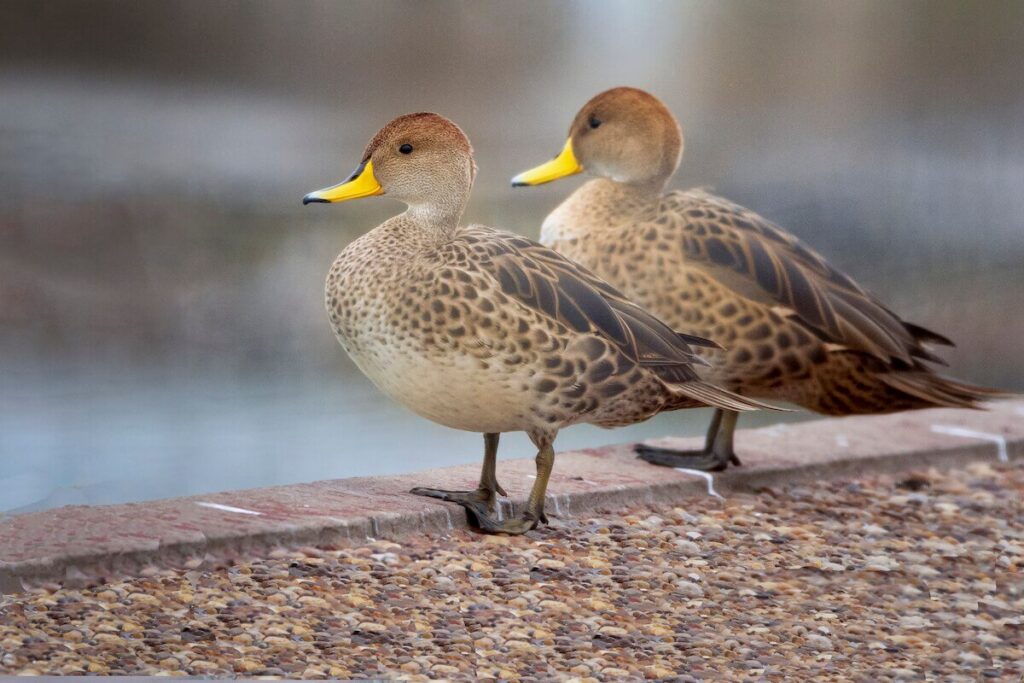
The final pintail in our list is the Yellow-billed Pintail, a dabbling duck found across much of South America, as well as the Falkland Islands and South Georgia.
This species has a brown head and neck, along with a yellow bill that has a black tip and a dark stripe running through the middle. Its body is mostly buff-brown, marked with different-sized black spots. The wings are greyish-brown, while the secondary feathers show a darker greenish-black tone. It also has a brown, pointed tail like other pintails.
It is sometimes confused with the yellow-billed teal, but it is generally larger, has clearer markings on its bill, and is less likely to gather in large flocks.
Duck Identification Posters/Charts
Celebrate the beauty of ducks with detailed, high-resolution identification posters designed for both learning and decor. Each chart features vibrant colors, sharp details, and a smooth premium finish that’s perfect for classrooms, study spaces, living rooms, or offices.

The 3 Subspecies of Yellow-billed Pintail
The Yellow-billed Pintail has three recognized subspecies, and when discussing the different types of pintail ducks, it’s worth taking a moment to highlight them as well.
I. South Georgia Pintail
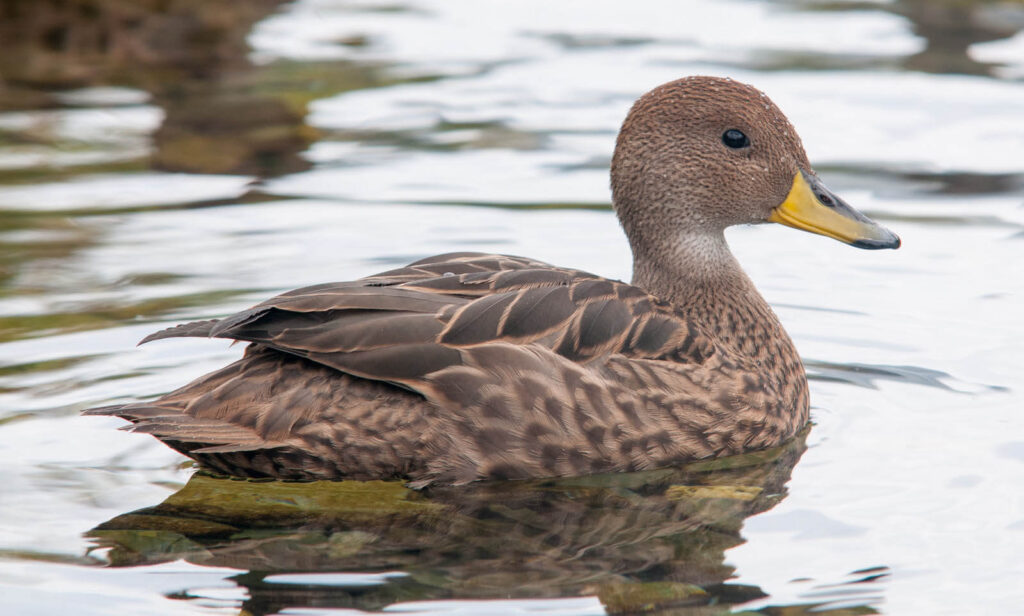
The South Georgia Pintail is found only on the subantarctic island of South Georgia and its surrounding islands, with rare sightings in the nearby South Sandwich Islands.
This is a small, sturdy-looking pintail with mostly brown, mottled plumage. Compared to mainland forms, it is smaller, stockier, and generally darker in colour. It has a reddish crown, light brown face and throat, and a pointed tail. The body shows a mix of buff and brown tones, with patterned markings on the back, breast, and sides, while the underparts are pale with brown spotting. Its bill is yellow with dark markings along the top and tip, and its legs are greenish-grey.
Unlike many other duck species, males and females look very similar, although males are slightly larger. Overall, this subspecies has a tough, compact appearance that helps it survive in its cold, remote island environment.
II. Chilean Pintail
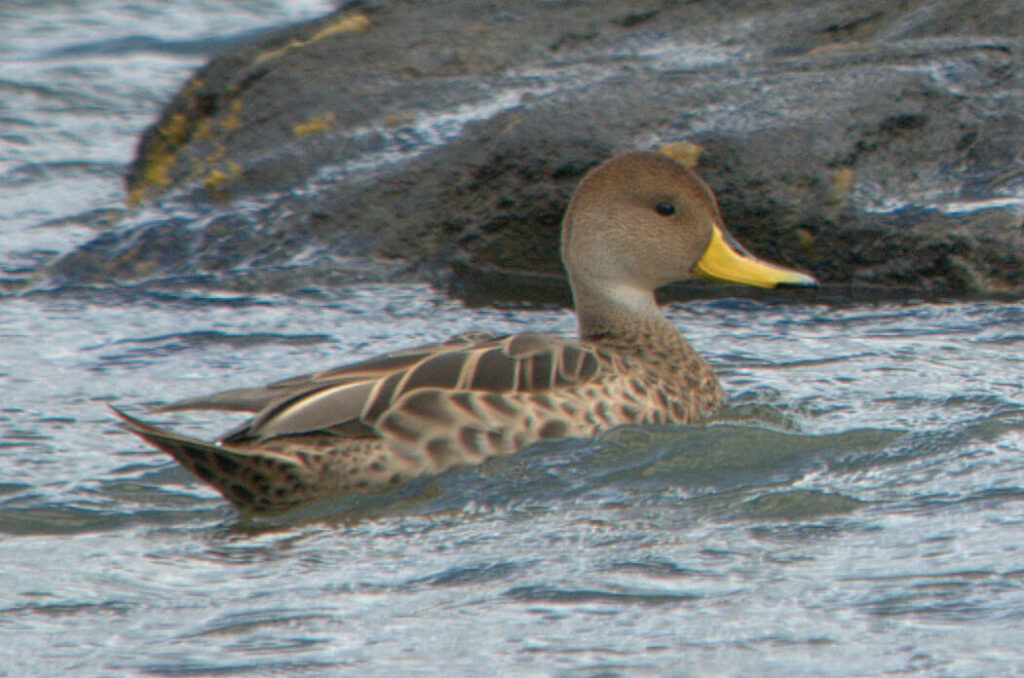
The Chilean Pintail, also known as the brown pintail or golden peck duck, is the most widespread and numerous subspecies of Yellow-billed Pintail.
It is found across a large part of South America, from southern Colombia all the way down to Tierra del Fuego, and it also occurs in the Falkland Islands. This makes it the most commonly seen form of pintail in the region.
In appearance, it is mostly buff-brown with darker markings that give it a lightly speckled or spotted look, especially on the chest. The head and neck are brown with fine dark mottling, while the throat is a bit paler. The wings are grey-brown with darker feathers and pale edges, and it also shows a glossy dark wing patch. Females look very similar to males, though usually a little less bold in colour.
This subspecies is very adaptable and can be found in many types of wet habitats, including lakes, rivers, marshes, lagoons, and even high-altitude wetlands in the Andes.
III. Niceforo’s Pintail
The final subspecies of the Yellow-billed Pintail is Niceforo’s Pintail.
It is now extinct but was known for having a darker and richer overall colour compared to the Chilean Pintail. Its head and neck were more heavily streaked, with a dark brown crown, and it also had a slightly less pointed tail than its close relatives.
This subspecies once lived in the highland regions of north-central Colombia, including areas such as the upper Cauca Valley, the Cordillera Oriental, and the Bogotá savanna, at elevations between about 1,000 and 3,000 metres above sea level.
Sadly, Niceforo’s Pintail is no longer found today, making it a lost member of the pintail group.


