
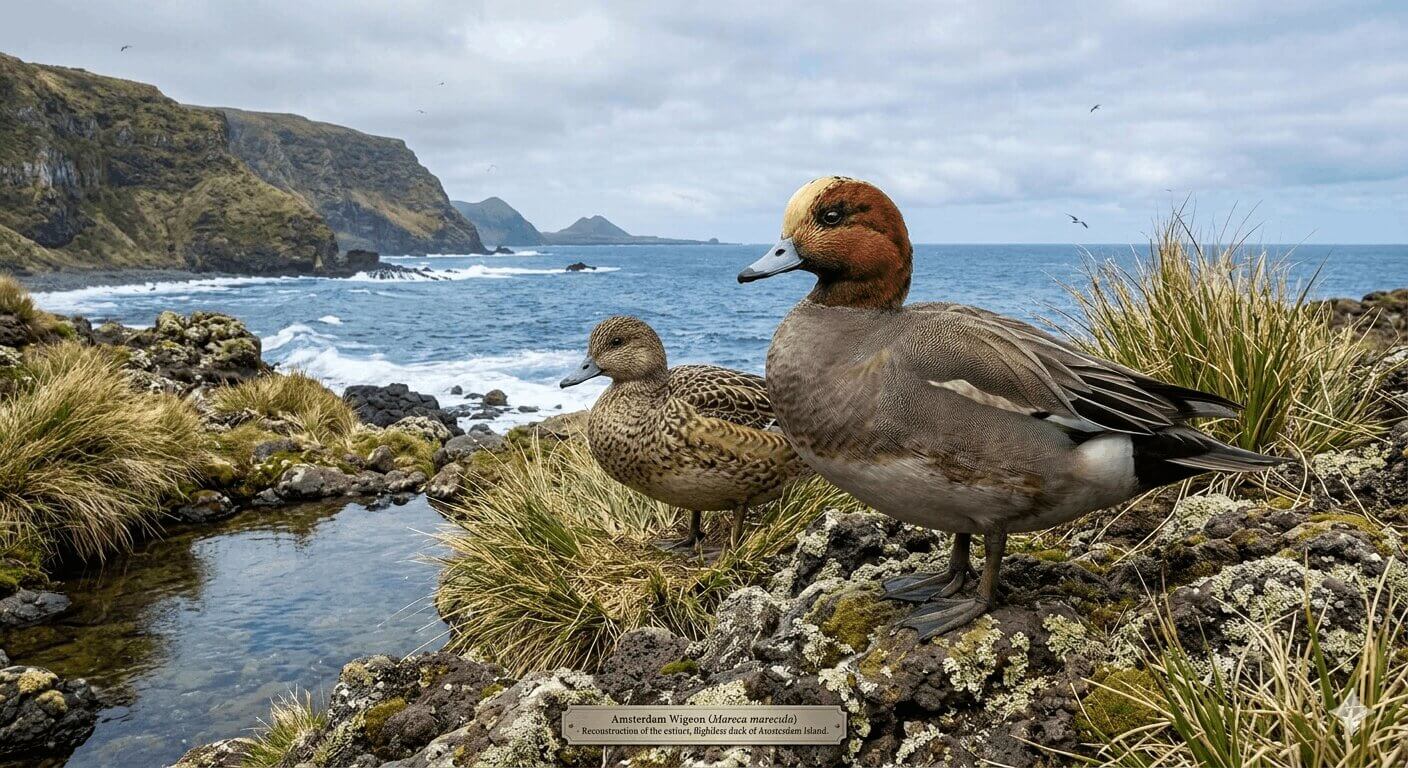
Amsterdam Wigeon

Scientific Name:

Mareca marecula

Alternative Names:

Amsterdam Wigeon, Amsterdam Island Duck, Amsterdam Duck

Measurements:

FeatureMaleFemale
LengthAbout size of a thrush (approx. 20–22 cm / 8–9 in)*Same
WeightVery small, exact unknown (smaller than most ducks)*Same
WingspanNot recorded (flightless species)Not recorded

*Based on historical description: “not much larger than a thrush”.

Status

Extinct. Disappeared by the late 18th century due to hunting by sealers and predation by introduced rats.

Identification

A very small, flightless duck with strong legs, reduced breastbone and wings, and a short, rounded bill similar to wigeons. It likely had brown plumage. It did not live along the coast and probably stayed inland on Amsterdam Island.

Voice

No voice records exist.

Diet

Unknown, but likely fed on freshwater plants, grasses, and small invertebrates found inland.

Distribution

Endemic to Amsterdam Island in the southern Indian Ocean. It may also have lived on nearby Saint Paul Island, but this is uncertain.

Habitat

Inland areas such as wetlands, grasses, and possibly freshwater ponds. Bones were found from sea level up to 500 m above sea level.

Breeding

Unknown. No breeding records exist, but it likely nested on the ground like other wigeons.

Wintering

Non-migratory. Stayed on the island year-round as it was flightless.

Conservation

Went extinct before it could be scientifically studied alive. Causes include overhunting by sealers, habitat damage, and introduced rats. Bones were first discovered in the 1950s and fully described in 1996.

Similar Posts

  • Harlequin Duck

    Scientific Name Histrionicus histrionicus Alternative Names Painted Duck, Rock Duck, Glacier Duck, Mountain Duck, White-eyed Diver, Lords and Ladies, Blue Streak Measurements Feature Measurement Length 38–43 cm (15–17 in) Weight Around 600 g (1.3 lb) Wingspan 66 cm (26 in) Wing 188–202 mm (7.4–8.0 in) Tail 77–101.5 mm (3.03–4.00 in) Culmen 25–27 mm (0.98–1.06 in)…

  • White-winged Duck

    Scientific name Asarcornis scutulata Alternative names Also known as the White-winged Wood Duck. Measurements Feature Range Length 66–81 cm (26–32 in) Weight Males: 2.9–3.9 kg (6.5–8.6 lb); Females: 2–3 kg (4.3–6.7 lb) Wingspan 116–153 cm (46–60 in) Status Listed as Endangered on the IUCN Red List and included in CITES Appendix I. The population is…

  •  Mallard

    Scientific name Anas platyrhynchos Alternative names Commonly called the Mallard or Wild Duck Measurements Feature Range Length 50–65 cm (20–26 in) Wingspan 81–98 cm (32–39 in) Weight 0.7–1.6 kg (1.5–3.5 lb); males slightly heavier than females Bill 4.4–6.1 cm (1.7–2.4 in) Status The Mallard is considered Least Concern by the IUCN due to its very…

  • Ring-necked Duck

    Scientific name: Aythya collaris Alternative names: Ringbill, Ring-necked pochard Measurements Feature Range Length 39–46 cm (15.3–18.1 in) Weight 490–910 g (17.3–32.1 oz) Wingspan 62–63 cm (24.4–24.8 in) Status The ring-necked duck’s population is stable and has even expanded in parts of its range since the early 20th century. It is now a common breeding bird…

  • Common Shelduck

    Scientific name Tadorna tadorna Alternative names None widely used Subspecies Monotypic – no subspecies recognized Measurements Feature Range / Note Length ~58–70 cm Wingspan ~110–133 cm Weight 0.9–1.6 kg Male vs Female Males slightly larger, brighter in breeding plumage Status Widespread and common in the Euro-Siberian region. Protected under the Agreement on the Conservation of…

  • Greater Scaup

    Scientific Name Aythya marila Alternative Names Scaup, Bluebill (North America) Measurements Length: 39–56 cm (15–22 in)Wingspan: 71–84 cm (28–33 in)Weight: 726–1,360 g (1.6–3.0 lb) Status Listed as Least Concern by the IUCN, though populations have been declining since the 1980s due to habitat loss, pollution, and reduced female survival rates. Identification A medium-sized diving duck…

Leave a Reply

Your email address will not be published. Required fields are marked *