
Common Eider
Scientific name
Somateria mollissima
Common name
Common Eider (also called St. Cuthbert’s Duck or Cuddy’s Duck)
Measurements
| Feature | Average |
|---|---|
| Length | 50–71 cm (20–28 in) |
| Wingspan | 80–110 cm (31–43 in) |
| Weight | 0.81–3.04 kg (1 lb 12 oz – 6 lb 11 oz) |
Status
The common eider is a large sea duck found along the northern coasts of Europe, North America, and eastern Siberia. It breeds in Arctic and northern temperate regions, wintering farther south in coastal waters. Populations are abundant across much of its range, estimated at around 1.5–2 million birds in both North America and Europe. Despite regional declines linked to climate change, oil spills, and overharvesting of shellfish, the species is classified as Least Concern by the IUCN.
Identification
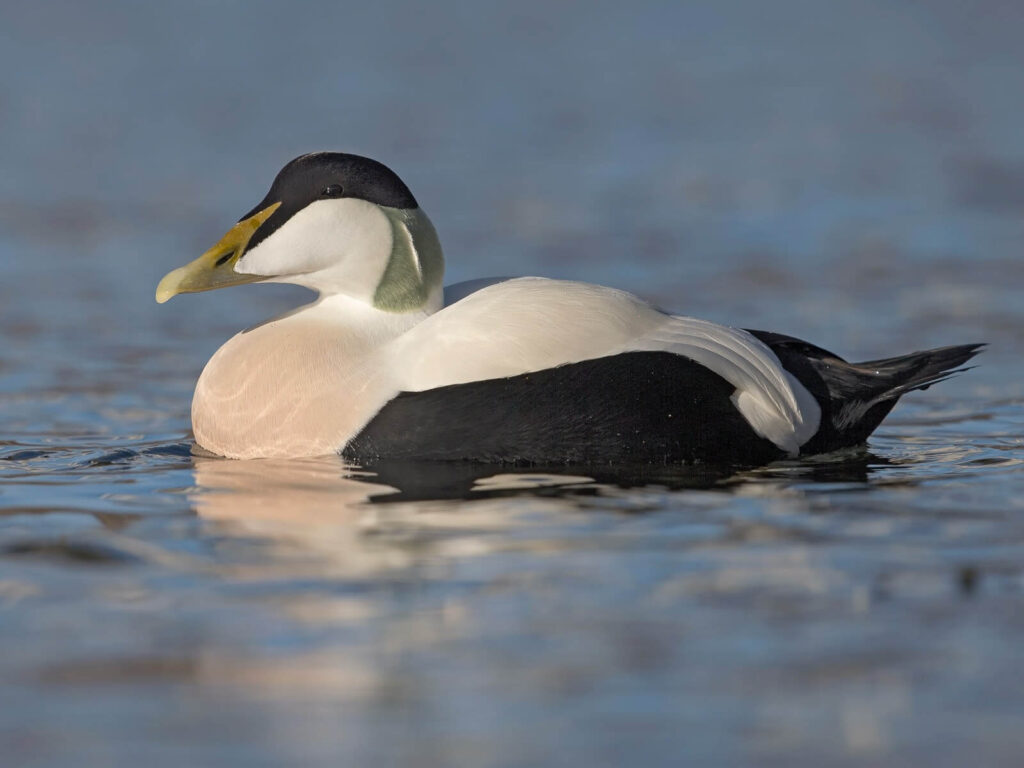
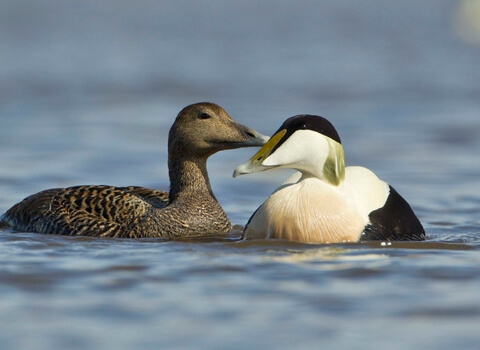
The common eider is Europe’s largest duck, instantly recognizable by its bulky body and long, sloping wedge-shaped bill. Males are striking with black and white plumage, a greenish nape, and pale pinkish breast during breeding season. Females are brown with fine dark barring, providing excellent camouflage among coastal vegetation. The drake’s call is a mellow, almost human-sounding “ah-ooo,” while females give hoarse quacks.
Voice
Males produce deep, cooing or “ah-ooo” calls during courtship, often in chorus within colonies. Females are quieter, using gruff quacks to communicate with ducklings or during alarm.
Distribution
The species breeds across Arctic and sub-Arctic coasts from Alaska and Canada to northern Europe and Siberia. Six subspecies are recognized, differing slightly in plumage and bill color. During winter, eiders migrate southward to temperate coasts, forming large flocks in bays and estuaries.
Habitat
Common eiders prefer marine environments—rocky shores, coastal islands, and inlets near shallow seas. They nest close to the water on coastal islands, often in large colonies protected from land predators. In winter, they remain in coastal waters where mussel beds and shellfish are abundant.
Behaviour
Eiders are highly social and colonial, especially during breeding and wintering seasons. Females show strong natal site fidelity, often returning to the same island where they hatched. Related females may cooperate to raise broods together—a behavior known as “crèching.” These ducks are powerful divers, feeding primarily on shellfish such as mussels, clams, and crustaceans. They swallow prey whole, crushing shells in their muscular gizzards.
Breeding
Breeding begins in spring when females construct nests from seaweed and grass, lined with soft eiderdown plucked from their breasts. Clutches typically contain 4–6 olive-colored eggs. The female incubates for 25–28 days and cares for the ducklings after hatching. Males generally leave soon after incubation begins. The ducklings are precocial, able to swim and feed within hours of hatching.
Diet
Their diet consists mainly of marine invertebrates—especially blue mussels, sea urchins, crustaceans, and snails. They dive to depths of 3–20 meters to forage on the seafloor, using their strong bills to pry open shells.
Wintering
Common eiders winter along ice-free coasts and sheltered bays across northern temperate regions. They form dense flocks, sometimes numbering in the thousands, where food is plentiful. During this period, they rely heavily on mussel beds and may adjust feeding depths according to ice coverage.
Conservation
Though globally secure, common eider populations face regional challenges. Habitat loss from coastal development, oil pollution, and changing sea-ice patterns in the Arctic have led to local declines. Eiderdown collection continues but is sustainable when practiced after nesting. In parts of Canada’s Hudson Bay, die-offs linked to shifting ice flows have prompted ongoing research and monitoring. Conservation efforts under the Agreement on the Conservation of African-Eurasian Migratory Waterbirds (AEWA) help protect migratory populations and key breeding colonies.