
Comb Duck
Scientific Name
Sarkidiornis sylvicola
Alternative Names
Comb Duck, American Comb Duck
Measurement
| Measurement | Male | Female |
|---|---|---|
| Length | 56–76 cm | 56–76 cm |
| Wingspan | 116–145 cm | 116–145 cm |
| Weight | 1.03–2.9 kg | Slightly lighter than males |
Status and Origin
Found in tropical wetlands of South America, especially near the Paraguay River region in eastern Paraguay, southeastern Brazil, and northeastern Argentina. Occasionally appears as a vagrant in Trinidad. It is generally not migratory but may disperse during wet seasons.
Identification
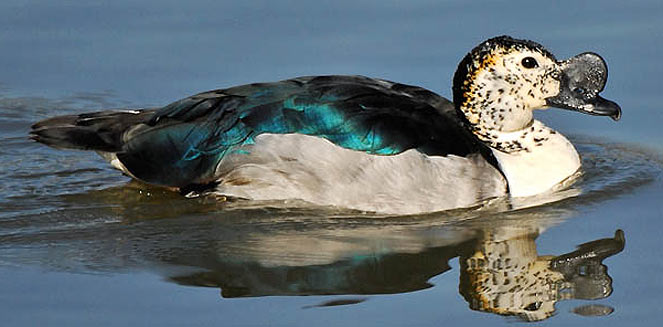
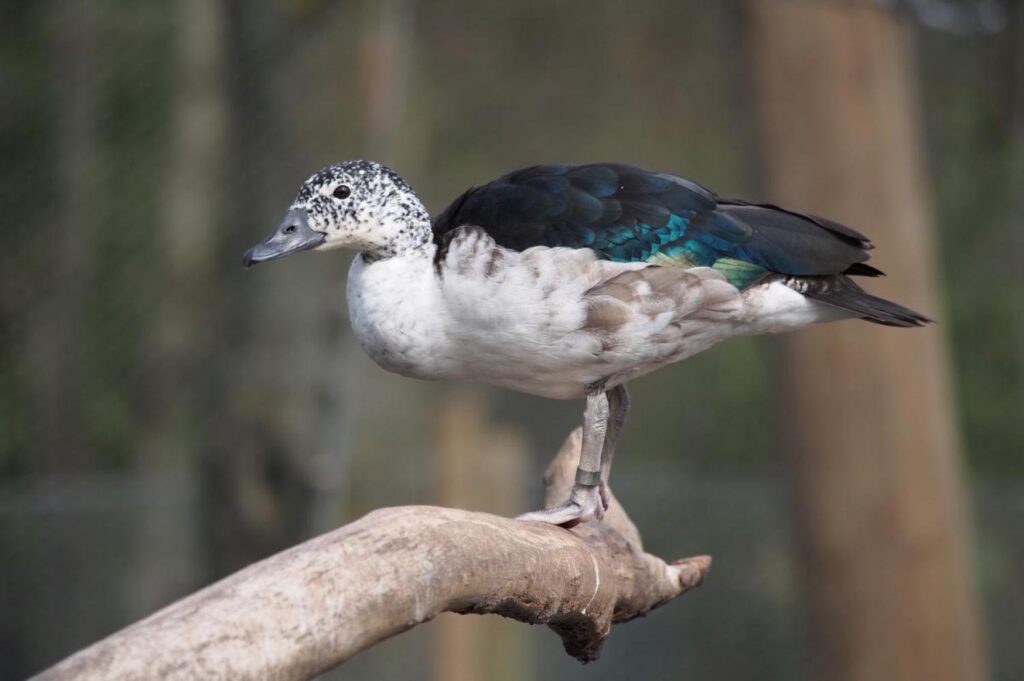
A large and unmistakable duck with a white head covered in black speckles, a white neck and underparts, and glossy blue-black upperparts with green and blue iridescence on the wings. Males are larger and have a prominent black knob on the bill. Females are smaller with a reduced bump. Flanks are darker — black in males, medium grey in females. Juveniles may resemble fulvous whistling ducks from a distance but are usually accompanied by adults.
Voice
Both sexes are mostly silent. They produce sounds mainly when alarmed or during display. Vocal activity is minimal compared to other duck species.
Diet
Feeds on aquatic vegetation by grazing and dabbling. Also eats seeds, invertebrates, and occasionally small fish. Known to feed in rice fields, sometimes causing issues for farmers.
Distribution
Native to continental South America, especially Brazil, Paraguay, northeastern Argentina, and nearby regions. Also seen rarely on Trinidad.
Habitat
Prefers still freshwater wetlands, swamps, and lakes in tropical regions. Often perches in trees and seen in small groups during the wet season and larger flocks of up to 100 during the dry season.
Wintering
This species is largely resident and does not undertake long-distance migrations. Instead, it disperses locally during the wet season in search of suitable feeding and breeding wetlands. In the dry season, they gather in larger flocks around permanent water bodies.
Breeding
Nests mainly in tree cavities or tall grasses. Nests are lined with reeds, feathers, or grass but not down. Females lay 7–15 yellowish-white eggs. Several females may share a nest, creating “dump nests” with up to 50 eggs. Males may mate with two females at once or up to five in succession. They defend females and ducklings but not nesting sites. Males help with raising the young.
Behaviour
Often seen perching in trees. Forms harems, with a dominant male and multiple females. Tends to separate by sex outside the breeding season. Calm but can be territorial during breeding. In captivity, usually kept as trios to reduce aggression — one male with two females.
Conservation
Currently not considered globally threatened. Populations remain stable in many regions, though habitat loss, wetland drainage, and hunting can affect local numbers. They may be viewed as pests in rice-growing areas, which can lead to conflict with farmers. Protection of wetland habitats supports long-term survival.
