Common Scoter vs Black Scoter: Identification Guide
There are five types of scoters: the Surf Scoter, White-winged Scoter, Velvet Scoter, Common Scoter, and Black Scoter. Among these, three species—the Surf, White-winged, and Velvet Scoters—are relatively easy to identify due to their obvious differences in plumage and facial markings.
The remaining two, the Common Scoter and Black Scoter, are also fairly easy to separate from the other three species. Both lack white anywhere on the drake, and their females show more extensive pale areas compared to other scoters. However, the real identification challenge begins when you try to distinguish these two from each other.
At first glance, they look almost identical in both size and appearance. In fact, for a long time, they were considered the same species. The North American Black Scoter was once treated as simply a regional form of the Common Scoter. Today, however, they are recognized as separate species due to consistent differences in bill structure, vocalizations, and range.
So, what exactly sets the Common Scoter apart from the Black Scoter? And how can you confidently tell them apart in the field?
We’ve broken it down for you below.
General Appearance
As hinted above, both species appear very similar. Adult males in both species are almost entirely black, lacking the bold white patches seen in other scoters such as the Surf Scoter. Females of both species are also alike, being brown overall with paler areas on the cheeks. This similarity is one of the reasons they were historically grouped together.


Despite this shared “dark sea duck” appearance, there are consistent differences that help separate them, including:
Bill Differences
The bill is one of the most reliable features for distinguishing these two species.
The Common Scoter has a more bulbous bill with yellow coloration concentrated around the nostrils and along the upper surface of the bill. The yellow can sometimes extend further in younger males, occasionally spreading across the basal knob. However, a key feature remains constant: there is always some black visible on the sides of the bill’s basal knob. This creates a more patterned and less uniform appearance.
In contrast, the Black Scoter has a noticeably more dramatic bill structure. It is often described as extremely bulbous, with a striking “globe-like” shape at the base. The bill is usually dominated by yellow or orange, forming a more solid and uniform patch without black interruptions on the sides. Because of this bold appearance, Black Scoters are sometimes colloquially called “butterbill” or “coppernose,” reflecting the bright, rounded look of the bill.
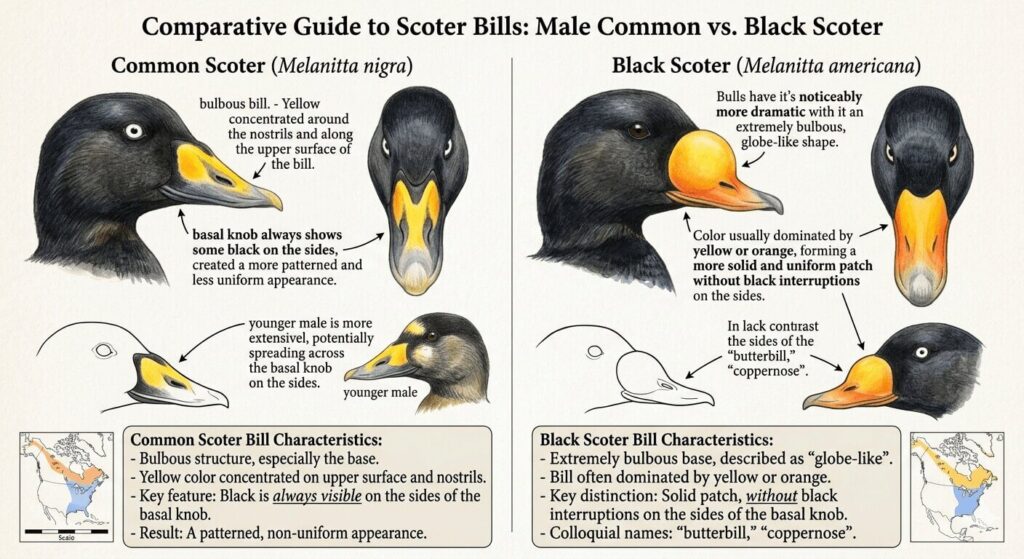
These differences, although subtle at distance, become very useful in good viewing conditions or with binoculars.
Vocalizations
Calls or vocalization is another useful distinction between the two species, especially during breeding.
The Black Scoter is known for its distinctive whistled calls. These vocalizations are often heard during courtship displays and when birds are gathered in flocks, giving it a more audible and expressive presence compared to many sea ducks.
The Common Scoter, while also vocal, is best known for its distinctive slurred whistle. Its call is often described as a plaintive “pee-oo” or “peep,” a clear, drawn-out sound that is frequently heard from males in flight or during migration. This gives it a more noticeable acoustic presence than many other sea ducks, especially in open coastal environments.
Range and Distribution
Geography is another strong clue for distinguishing these species.
The Common Scoter is primarily an Old World species. It breeds across northern Europe and Asia and winters along coastal waters from Europe down to North Africa, including regions as far south as Morocco.
During winter, it often gathers in large, tightly packed flocks on coastal waters. These flocks are highly coordinated, with birds frequently diving and taking off in unison, creating an impressive synchronized movement on the sea.
The Black Scoter, on the other hand, is a New World species. It breeds in far northern parts of North America, including Labrador, Newfoundland, and regions around Hudson Bay, with additional populations extending into parts of Siberia near the Bering Strait.
During winter, it migrates south along the coasts of the United States, reaching both the Atlantic and Pacific shores, and even extending into the Gulf of Mexico. In Asia, it can winter as far south as China.
Because of this strong geographic separation, the two species are rarely, if ever, encountered together in the wild.
Other Differences
Beyond bill shape, vocalization, and range, there are other smaller but noticeable physical differences between the two species.
For instance, the Black Scoter tends to look bulkier in the water, and tend to sit slightly higher and appear more solid in body shape. It also typically has a thicker neck and a slightly shorter tail, contributing to its compact and robust appearance.
The Common Scoter generally looks a bit slimmer in comparison, with a more streamlined neck and a less heavy-set posture on the water. While these differences are subtle, they become more apparent when the birds are observed side by side or in mixed flocks (in captivity or rare overlap situations).
Interesting Facts About the Two Scoters
One fascinating historical fact about the Common Scoter is that in parts of France during the nineteenth century and earlier, it was accepted by the Roman Catholic Church as a substitute for fish during Friday fasting traditions.
Both species share a strong preference for shellfish, especially mussels. This dietary habit often bring them into conflict with commercial shellfish farming, as large wintering flocks are capable of significantly impacting cultivated beds. Their feeding behavior is impressive: scoters are powerful divers with strong gizzards capable of crushing hard-shelled prey that many other birds cannot handle.
Duck Identification Posters/Charts
Celebrate the beauty of ducks with detailed, high-resolution identification posters designed for both learning and decor. Each chart features vibrant colors, sharp details, and a smooth premium finish that’s perfect for classrooms, study spaces, living rooms, or offices.