
Merganser vs Loon: Complete Comparison Guide

Mergansers are among the duck species most often confused with loons due to the many similarities they share. For example, both loons and mergansers have elongated bodies and sharply pointed bills, and both are excellent swimmers that can look very similar when diving or feeding. Unlike grebes and coots, which have distinctly different types of feet, both loons and mergansers have webbed feet set far back on the body to support efficient swimming, so this feature alone is also not enough to tell them apart. They also share a similar take-off style, which usually requires a “running start” across the water before becoming airborne, which can add even more to the confusion.
So how can you actually tell the two apart? First, it’s important to note that loons are not ducks. They belong to the genus Gavia, family Gaviidae, and order Gaviiformes, while ducks are part of the family Anatidae, which includes mergansers and other waterfowl species. For experienced birders, mergansers and loons are usually easy to separate once you know what to look for, as there are several consistent differences between them. For beginners, however, here are some of the key features to focus on when trying to tell these two birds apart.
1. Plumage
The first attribute you can rely on to differentiate mergansers from loons is plumage as the overall look and patterning of these birds are quite different.

The common loon has a bold and striking black-and-white pattern, especially in breeding plumage. Their backs show a distinctive checkered or spotted pattern, while the head and neck are deep black with a glossy sheen. A white-banded collar stands out on the neck, and the underparts (including the chest and belly), are clean white. The contrast between the dark upperparts and bright white areas gives the loon a very crisp, high-contrast appearance. Notably, male and female loons look very similar, so there is little difference between the sexes.

Mergansers, on the other hand, show much more variation between males and females, and their patterns are less uniform compared to the loon. In the common merganser, the male has a dark green head paired with a mostly white body, creating a clean and elegant look. The female looks quite different, with a warm brown head, a noticeable shaggy crest, and a white patch under the bill, along with a pale chest.

The red-breasted merganser also shows clear differences between the sexes. The female has a brown crested head similar to the female common merganser, but the male stands out with a dark green head, red eyes, a spiky “punk-like” crest, and a distinct white collar that breaks up the darker tones.
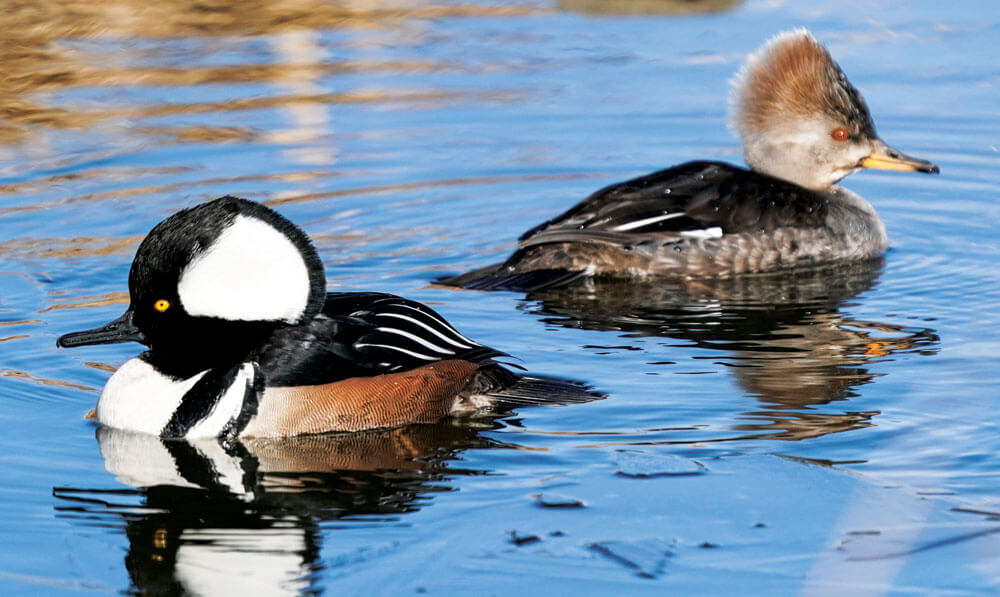
Hooded mergansers are perhaps the most distinctive of the group due to their dramatic crests. The male has a bold black-and-white fan-shaped crest that can be raised or lowered, making it very striking. The female, in contrast, has a rich chestnut-red crest that gives her a softer but still recognizable appearance.
So, loons have a more uniform and sharply patterned black-and-white look with little difference between sexes, while mergansers show greater variation, more subdued body patterns, and clear differences between males and females, which are highlighted by unique head colors and crests.
2. Bills
The bill shape and color is another reliable way to tell a merganser from a loon, especially when their plumage details are hard to see.
Loons have strong, pointed, dagger-like bills that look thick and sturdy. On a common loon, the bill appears quite hefty and straight, giving the bird a powerful, spear-like profile. This solid, robust bill often stands out even at a distance and adds to the loon’s overall heavy appearance.
Mergansers also have narrow, pointed bills, but they are noticeably slimmer and more delicate compared to a loon’s. Many mergansers also show a bright red bill, which can be an immediate giveaway. However, at a distance or in poor lighting, color is often hard to make out, so shape becomes more important.

Another useful detail is how the bill is positioned. Mergansers typically hold their bills straight and level with the body, giving them a sleek, streamlined look on the water. There is one potential point of confusion with red-throated loons, which have thinner bills than common loons and can look more like merganser at a distance. However, a key difference is posture: red-throated loons often hold their bills slightly angled upward, rather than straight ahead. This subtle tilt can be a helpful clue when trying to separate them from mergansers.
3. Size
Size is another noticeable differences between mergansers and loons, especially when the birds are seen side by side or in open water.
Loons, particularly the common loon, are significantly larger and heavier birds. They can reach lengths of up to about 80 cm and weigh as much as 4.1 kg. This gives them a strong, bulky appearance on the water, with a long body and a relatively low, heavy profile. Their size alone often makes them stand out as more substantial and powerful compared to most diving ducks.
Mergansers, in contrast, are much smaller and lighter overall. Even the largest species, the common merganser, typically grows to around 65 cm in length and weighs up to about 1.5 kg, which is still far less than a loon. The red-breasted merganser is slightly smaller, reaching around 60 cm and about 1 kg, while the hooded merganser is noticeably compact at roughly 45 cm in length and weighing around 0.6 kg.
Because of this size difference, mergansers tend to look slimmer and more streamlined, whereas loons appear broader, heavier, and more imposing on the water. In most situations, if a bird looks especially large and solid, you’re likely looking at a loon rather than a merganser.
4. Calls
The calls of loons and mergansers are different and can also be useful way to tell them apart, even when you can’t see the birds clearly.
The common loon is famous for its haunting, otherworldly calls that carry far across lakes. These vocalizations include eerie wails, yodels, and tremolos that sound almost unearthly, especially in quiet, remote settings. The call of a loon is hard to forget and is often considered one of the most distinctive sounds in the natural world.
Mergansers, in contrast, sound much more like typical ducks. Their calls are generally softer, simpler, and less dramatic. Think of low croaks, grunts, or quacking notes. They lack the haunting, echoing quality that makes loon calls so recognizable.
So, if you hear a loud, eerie, far-carrying call, you’re almost certainly hearing a loon. If the sound is more subdued and duck-like, it’s far more likely to be a merganser.
Duck Identification Posters/Charts
Celebrate the beauty of ducks with detailed, high-resolution identification posters designed for both learning and decor. Each chart features vibrant colors, sharp details, and a smooth premium finish that’s perfect for classrooms, study spaces, living rooms, or offices.

5. Feeding Behaviors
Feeding behavior is another difference between loons and mergansers, especially when it comes to diving ability and how long they stay underwater.
Loons are exceptional divers and are built for deep underwater hunting. A common loon can reach impressive depths of up to around 200 feet, far deeper than most diving ducks are capable of. Once submerged, loons can also remain underwater for extended periods, even for more than five minutes at a time. When they finally resurface, they frequently appear far from the original diving point, which can make them surprisingly difficult to track and observe.
Mergansers are also strong divers, but they operate at a much more moderate level compared to loons. Most diving ducks struggle to reach depths beyond about 10 feet, while mergansers can typically dive deeper, reaching around 40 feet in favorable conditions. However, they still fall well short of the extreme diving capability of loons. Even the deepest-diving ducks in general, such as eiders, only reach just over 60 feet, highlighting just how exceptional loons really are in comparison.
6. Breeding and Nesting Habits
Breeding behavior is another distinction you can leverage to tell loons and mergansers apart, especially when you have time to study these birds.

Loons typically nest on the ground right at the edge of a lake, placing their nests very close to the water for easy access. They often choose sites that are well-protected and ideally surrounded by water, such as small islands or areas of emergent vegetation. Mating also takes place on land, usually on or near the future nest site, reinforcing their strong connection to a specific territory during the breeding season. Loon pairs are generally very consistent in their breeding pattern and almost always raise just two chicks, which is a useful clue when observing family groups on the water.
Mergansers, in contrast, have a very different nesting strategy. Rather than building open ground nests, they mostly rely on tree cavities or sheltered rock crevices located near large lakes or along rivers. These hidden nesting sites provide better protection from predators and the elements. Because of this cavity-nesting behavior, mergansers are more closely tied to available nesting holes than to shoreline territories in the same way loons are.

Another helpful difference appears in brood size and chick appearance. Mergansers often have larger broods, and their ducklings can appear more varied in number and behaviour compared to loons. Loon ducklings, on the other hand, are typically fewer (almost always one or two) and they are uniformly dark in color when very young, which can help distinguish them from other waterfowl families at a distance.
7. Movement on Land
Another difference between loons and mergansers is how they move on land, which is directly linked to where their legs are positioned on the body.

Loons have legs set far back on their bodies, an adaptation that makes them incredibly powerful and fast swimmers underwater. However, this same feature comes at a cost as they are almost completely unable to walk. A loon on land looks awkward and unbalanced, and you will never see one casually standing on a rock or moving comfortably on shore. Instead, if forced onto land, loons can only manage short, clumsy shuffles or a sort of running motion to reach water again. Because of this limitation, they generally avoid land altogether, coming ashore only for nesting and breeding.
Mergansers, on the other hand, have legs positioned further forward on their bodies. This gives them much better balance on land, allowing them to stand, walk, and even move around on rocks or shorelines with relative ease. While they are not as specialized for extreme underwater speed and depth as loons, this leg placement gives them more versatility in movement overall.
In short, loons are highly adapted for life in the water at the expense of land mobility, while mergansers strike a more balanced compromise, allowing them to function both in water and on land.


