
Whistling Ducks in Florida: ID, Ranges, and Differences
Mottled Ducks (often called Florida ducks) are among the most familiar species you will find in the state. They show up in just about any freshwater habitat, from rivers and local ponds to lakes and marshes. But while they are Florida’s signature species, they are far from the only ducks you can see here. In fact, the state hosts more than 30 duck species, including year-round residents as well as rare visitors that pass through or arrive from other regions.
So, are whistling ducks part of that list? Yes. In recent years, two species of whistling ducks have expanded their presence in Florida, giving both birders and hunters a chance to observe ducks that quite literally whistle. Before getting into those species, it helps to understand what makes whistling ducks unique.
Whistling ducks are a small group of ducks known for their distinctive calls, which sound very different from the familiar quack of most ducks. Instead of quacking, they produce clear, high-pitched whistles, often in short, repeated notes.
They belong to the genus Dendrocygna and are sometimes referred to as tree ducks, since many species perch or nest in trees, something unusual among ducks. Compared to typical dabbling or diving ducks, they stand more upright and have longer legs and necks, giving them a slightly goose-like appearance. They are also highly social and are usually seen in flocks, especially around wetlands and open water.
The Two Types of Whistling Ducks in Florida
In Florida, the two whistling duck species you are most likely to encounter are the Black-bellied Whistling-Duck and the Fulvous Whistling-Duck. Both have become increasingly familiar sights across the state, turning up in wetlands, ponds, lakes, and even agricultural fields where they feed and gather in groups.
Black-bellied Whistling-Duck
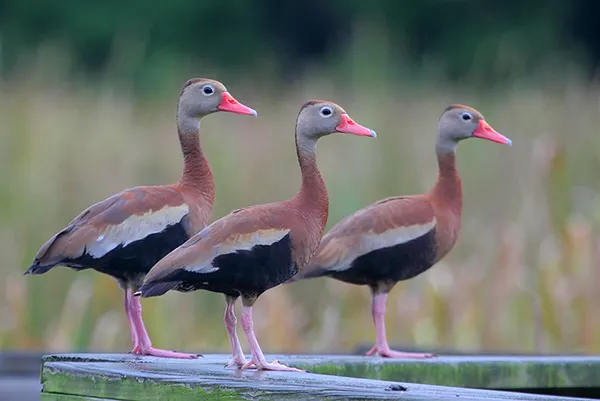
The Black-bellied Whistling-Duck is one of only two whistling duck species native to North America and has become an increasingly familiar sight across Florida in recent decades.
This is a tall, long-legged duck with a distinctive upright posture that immediately sets it apart from most other species. It shows a striking combination of warm and dark tones, with a rich chestnut-brown body, a pale gray face and upper neck, and a contrasting black belly and tail.
The long pink bill is especially noticeable and adds to its unique look. In flight, broad white wing patches stand out clearly against the darker wings, creating a bold visual cue.
Males and females look alike, while younger birds appear slightly duller with a grayish bill and less contrast overall. Learn how to tell male and female whistling ducks here: The Key to Identifying Male vs Female Black-bellied Whistling Ducks
Behaviorally, this species is highly social and is usually seen in small to large flocks, especially outside the breeding season. It is known for being relatively approachable compared to many wild ducks.
Unlike most ducks, it frequently nests in tree cavities, including hollow trunks and even palm trees in some areas. It favors shallow freshwater habitats such as ponds, lakes, marshes, and reservoirs, as well as agricultural landscapes with plenty of vegetation. Feeding typically takes place at night, with a diet focused mainly on seeds and other plant material.
Discover other ducks that nest in trees: 23 Ducks That Nest In Trees
One of the most notable aspects of the Black-bellied Whistling-Duck’s presence in Florida is its rapid range expansion. Originally confined to regions from southern Texas through Central and South America, the species has spread dramatically across North America since the late 20th century. Today, it is well established throughout Florida and continues to expand into new areas, making it one of the most successful and dynamic waterfowl species in the region.
Fulvous Whistling-Duck
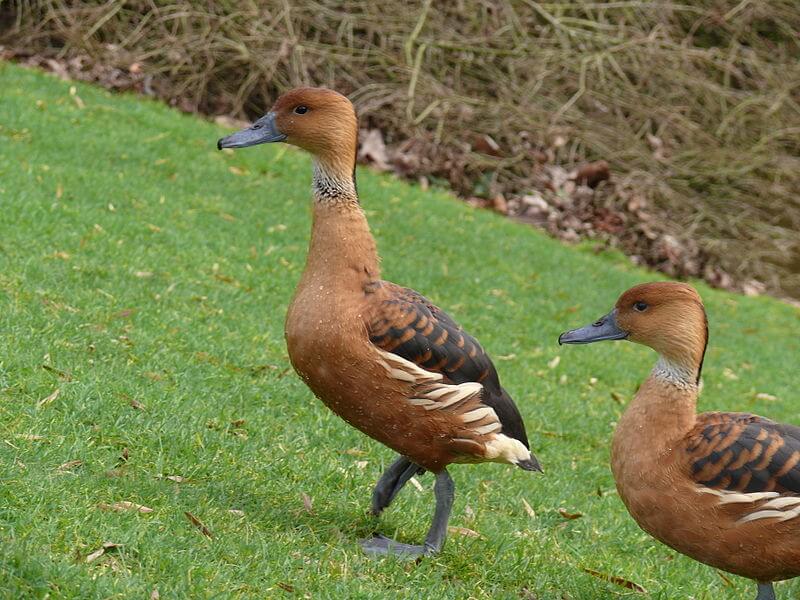
The Fulvous Whistling-Duck is a widespread tropical whistling duck with a broad global distribution, occurring across parts of the Americas, Africa, and the Indian subcontinent. In Florida, it is a regular presence year-round and is most often encountered in suitable wetland habitats.
This is a long-legged, upright duck with a slender build and a warm, reddish-brown plumage that gives it a uniform, earthy appearance. The bill is long and grey, and in flight it reveals a clean white band across the otherwise dark tail, a useful identification feature at a distance. Like other whistling ducks, it produces a clear whistling call that can be heard both in flight and while on the ground.
Fulvous Whistling-Ducks are typically seen in small groups, although they may gather in larger flocks where conditions are favorable. They move comfortably on land, walking rather than waddling, and forage mainly by tipping forward in shallow water to reach submerged food, though they are capable of diving when needed. Unlike many of their relatives, they are less inclined to perch in trees. In flight, they appear light and buoyant, flying in loose groups with steady, slow wingbeats and legs trailing behind.
In Florida, this species is relatively common and can be found throughout the year. It favors freshwater wetlands with dense vegetation, including ponds, marshes, and rice fields, with reliable sightings at locations such as Lake Apopka.
Black-bellied Whistling-Duck vs Fulvous Whistling-Duck
Juvenile Black-bellied Whistling-Ducks are sometimes confused with Fulvous Whistling-Ducks, mainly because both can show grey bills at that stage. The bill is usually one of the quickest ways to tell these two apart: adult Black-bellied Whistling-Ducks have a bright pink to reddish bill, while Fulvous Whistling-Ducks have a darker grey bill. However, younger Black-bellied birds can blur this distinction, so it helps to look beyond just the bill.
The most reliable way to separate them is by overall plumage. The Black-bellied Whistling-Duck has a bold, high-contrast look, with a rich chestnut body, pale grey face, and a clearly defined black belly and tail. The Fulvous Whistling-Duck, by comparison, appears much more uniform, with a warm reddish-brown tone throughout and far less contrast. It lacks the black belly entirely and instead shows a cleaner, more even coloration, with a subtle white band on the tail that is most noticeable in flight.
The wings and belly provide another clear distinction. Black-bellied Whistling-Ducks show prominent white wing patches in flight that stand out sharply against darker feathers. Fulvous Whistling-Ducks do not show this feature; their wings appear darker overall, and the contrast is much less pronounced. Instead, their white tail band becomes the key flight mark.
Up close, Fulvous Whistling-Ducks also tend to look slightly buffier around the head and neck compared to the more clearly defined face pattern of the Black-bellied species.
Behavior can also help with identification. Black-bellied Whistling-Ducks are well known for perching in trees and nesting in cavities, something rarely seen in Fulvous Whistling-Ducks. The Fulvous species spends more time on the ground or in shallow water, walking and feeding in wetlands rather than perching above them.