
5 Black Ducks in Florida: Identification Guide
Among the more than 30 duck species found in Florida, black ducks are easy to overlook, and are often dismissed as plain compared to their more colorful counterparts. But these birds are far from ordinary. Each species has its own subtle beauty and plays an important role in Florida’s subtropical ecosystems.
Spotted a black duck in the state and not sure what it is? Here are five of the most common black ducks in Florida, along with tips to help you identify them and some of the best places in the state where you’re likely to see them in larger numbers.
1. Black Scoter
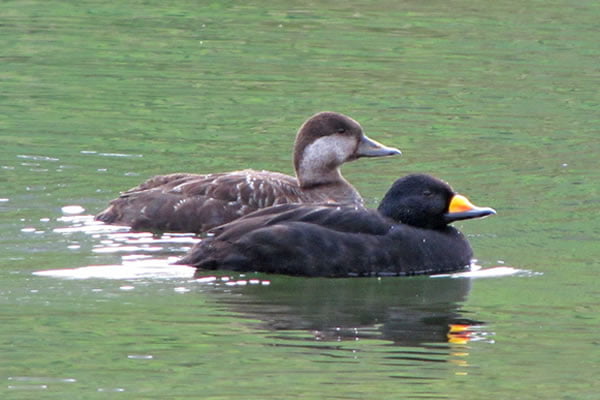
The Black Scoter is one of the most distinctly dark-plumaged ducks you can encounter in Florida, especially along coastal waters. Adult males are entirely black, giving them a clean, uniform appearance. This dark body is paired with a noticeably swollen bill that shows bright yellow tones, creating a striking contrast against the otherwise all-black plumage.
Females present a more subtle look, appearing dark brown rather than black, with pale patches on the cheeks that help with quick identification. While less bold than the males, they still maintain an overall dark impression, especially when seen on open water.
This species is a diving duck that forages underwater, feeding mainly on crustaceans and mollusks in coastal habitats. During the breeding season in freshwater areas, its diet shifts slightly to include insects, larvae, and occasionally plant material. Discover what the diets of other Florida ducks here: What Do Ducks Eat In Florida?
Another worthwhile behavioral clue for identification of these ducks is the male’s characteristic downward head movement when stretching its wings.
In Florida, the Black Scoter is most often seen during winter along coastal waters, where it can be fairly common. Some individuals may remain beyond the winter months. One location you are likely to spot these ducks with ease is the Honeymoon Island State Park, where they gather offshore in search of food.
2. Surf Scoter
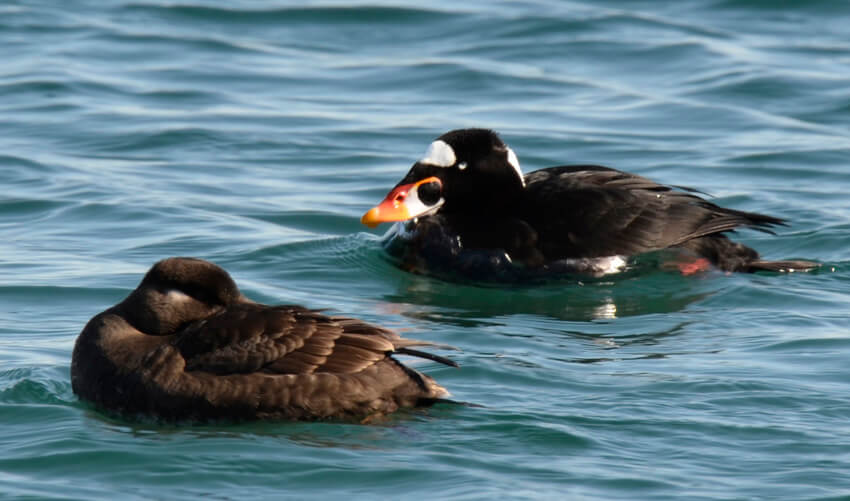
Another dark-plumaged duck you may encounter in Florida is the Surf Scoter, a large sea duck with a bold and somewhat unusual appearance. Adult males are almost entirely velvety black, giving them a sleek, uniform look on the water. This dark plumage is broken only by crisp white patches on the forehead and nape, which serve as key identification marks. The bill is large and swollen, showing a mix of orange, white, red, and yellow tones, with a dark spot near the base.
Females are more subdued in appearance, with a mostly brown plumage that is fairly even overall, though slightly darker above than below. While they lack the striking contrast of the males, they still carry a generally dark profile typical of black ducks.
Among scoters, the Surf Scoter is one of the easiest to recognize, thanks to the male’s bold head patches and uniquely patterned bill. Like other sea ducks, it undergoes a period of simultaneous wing molt in late summer, during which it becomes temporarily flightless for several weeks.
This species breeds in northern regions of North America, particularly across Canada and Alaska, before migrating to more temperate coastal areas for the winter. In Florida, the Surf Scoter is considered uncommon and is mostly seen offshore during the colder months. Coastal sites such as Cape Canaveral National Seashore offer some of the best chances to observe this species.
3. White-winged Scoter
Closely related to the Surf Scoter and the largest of the scoter species, the White-winged Scoter is another dark, heavy-bodied duck you may encounter in Florida, particularly in coastal waters during winter.
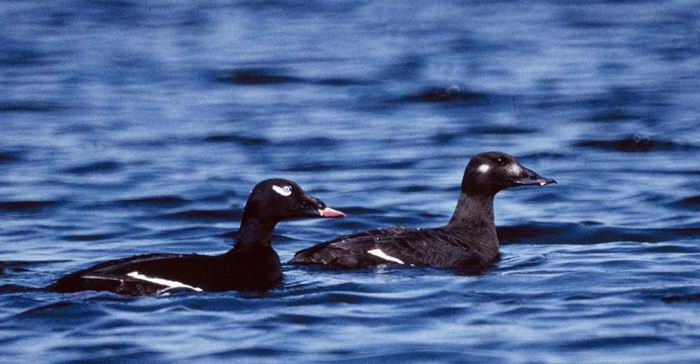
This species has a robust, bulky build and a large bill that helps distinguish it from other scoters. One key feature is the feathering at the base of the bill, which gives it a smoother look compared to the more abrupt, blocky bill base of the Surf Scoter. Its name comes from the white secondary flight feathers, which are clearly visible in flight but can be hidden when the bird is resting on the water.
Adult males appear almost entirely black, maintaining that strong dark profile, but show a small white patch around the eye and a white wing panel. The bill is bold and colorful, with orange and reddish tones and a prominent black knob at the base. Females are more muted, appearing brown overall, but can still be identified by their shape and the feathered gape, which helps separate them from other scoter species.
The White-winged Scoter has a wide breeding range across the boreal forests of Alaska and western Canada, though it becomes less common further east. In Florida, it is considered an uncommon winter visitor, typically found in coastal waters and occasionally on large inland lakes. Locations such as Fort De Soto Park provide good opportunities to observe this species.
4. King Eider
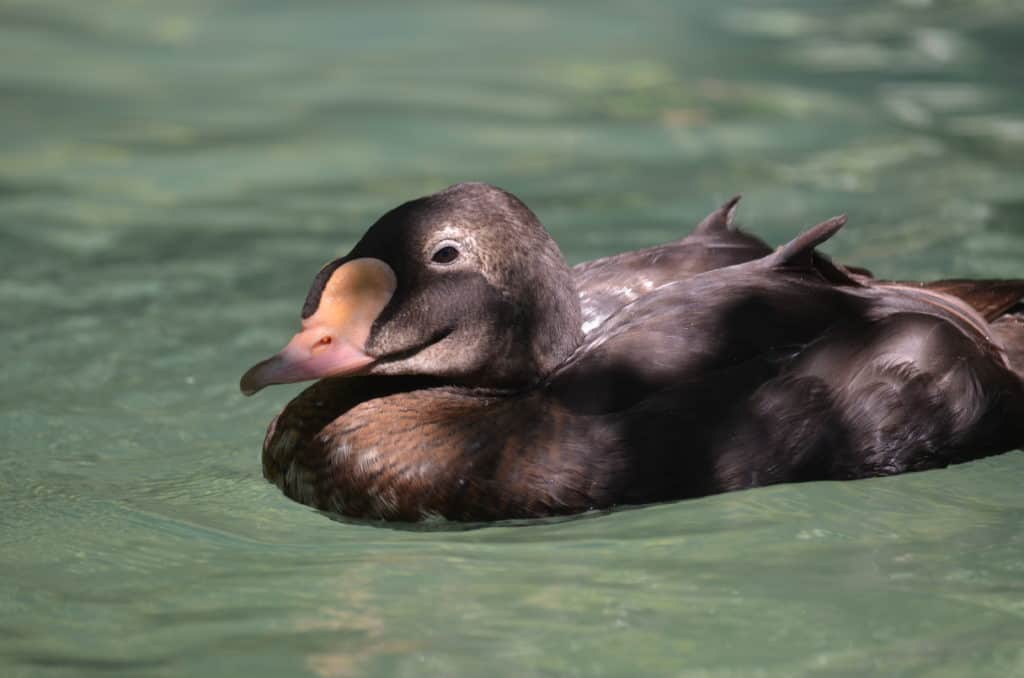
While adult King Eiders are easily identified by their black body with a buff-tinged white breast, juveniles are greyish brown and can appear black from a distance, which is why we have included them in this list of black ducks you may encounter in Florida.
The King Eider is a large Arctic sea duck that breeds along the northern coasts of the Northern Hemisphere, including parts of North America, Europe, and Asia. Adult males are striking and unmistakable with a mostly black body, a contrasting pale breast, and a highly distinctive multicolored head. The head and neck show soft bluish-grey tones, with a subtle green patch on the cheek. Females are much more subdued, displaying a warm brown plumage that becomes slightly paler on the head and neck.
Young birds are far less distinctive. Their grey-brown plumage can look uniformly dark at a distance, especially on the water, making them easy to confuse with other dark sea ducks. As males mature, they gradually develop more complex patterns, but full adult plumage takes up to three years to complete.
In Florida, the King Eider is a very rare vagrant, typically recorded along coastal waters. Sightings are exceptional, with one notable record from Pensacola in 2011. Despite its rarity in the state, it remains a widespread Arctic species globally and is listed as Least Concern due to its large and stable population.
5. American Black Duck
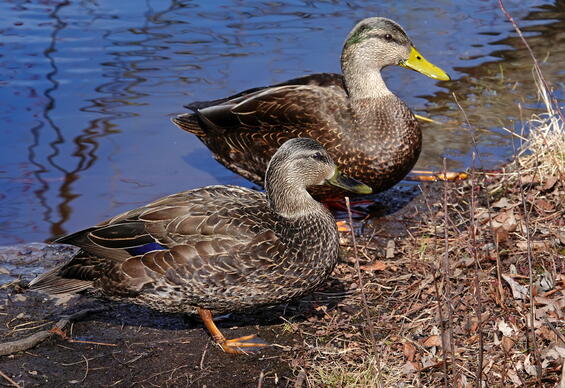
The final black duck you are likely to find in Florida is the American Black Duck, a large dabbling duck in the family Anatidae. It is the heaviest species in the genus Anas, weighing between 720 and 1,640 grams.
At a glance, it can resemble a female or eclipse male Mallard, but its overall plumage is noticeably darker and more uniform, giving it a deeper, sootier appearance. Both sexes look quite similar, which can make identification tricky at distance. The key difference is in the bill: males have a bright yellow bill, while females show a duller greenish bill with darker markings along the upper mandible. Discover other key differences here: How to Identify Drake Vs Hen Black Duck.
This species is closely related to the Mallard and is known to interbreed with it regularly, producing hybrids that can sometimes complicate identification in the field.
Ecologically, the American Black Duck is highly adaptable and is often associated with tidal marshes. It is found year-round in salt marsh systems from the Gulf of Maine down to coastal Virginia.
In Florida, however, it is an uncommon winter visitor, typically occurring in estuaries, salt marshes, ponds, and lakes. One of the more reliable locations to look for this species is Saint Marks National Wildlife Refuge.
Duck Identification Posters/Charts
Celebrate the beauty of ducks with detailed, high-resolution identification posters designed for both learning and decor. Each chart features vibrant colors, sharp details, and a smooth premium finish that’s perfect for classrooms, study spaces, living rooms, or offices.
