
15 Black and White Ducks in Florida (with Pictures & ID Guides)
Among the over 30 duck species found in Florida (ranging from year-round residents to rare seasonal visitors), those with bright, colorful plumage often steal the spotlight among birdwatchers. Their striking patterns are hard to miss, and they tend to attract the most attention.
Yet, Florida is also home to a number of equally fascinating ducks that don’t rely on bold colors to stand out. Species with mostly black-and-white plumage are often overlooked, simply because they appear more subdued or less “showy” at first glance. In reality, many of these birds are just as beautiful, with crisp contrasts, elegant patterns, and subtle details that reward a closer look.
To appreciate these understated species, here are 15 black and white ducks you can spot in Florida. (This list also includes ducks that aren’t strictly black and white, but which feature prominent black-and-white patterns in their overall plumage.)
1. Bufflehead
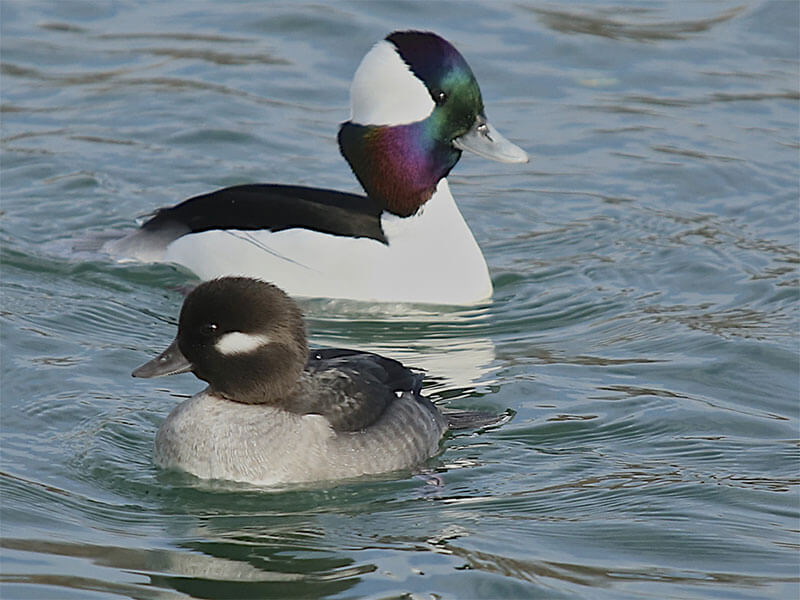
Let’s start off the list with one of the smallest American ducks, yet one that immediately draws attention for its boldly patterned head, which looks oversized for its compact body and gives the bird a distinctive, almost rounded profile on the water.
Adult males are especially striking in black-and-white contrast, with a dark body set against a large white patch behind the eye and iridescent head tones that shift between green and purple in good light. Females are more subdued but still clearly patterned, showing soft grey plumage with a smaller white cheek patch and a pale underside that helps with identification at range.
Buffleheads are monogamous and popular for cavity nesting, typically using old woodpecker holes in aspen or poplar trees located close to water. In Florida, they are a familiar winter visitors and favor sheltered coastal waters such as bays, estuaries, and larger lakes. They are regularly observed in protected coastal areas, including sites like Gulf Islands National Seashore, where they gather in small, mobile flocks.
2. Common Goldeneye
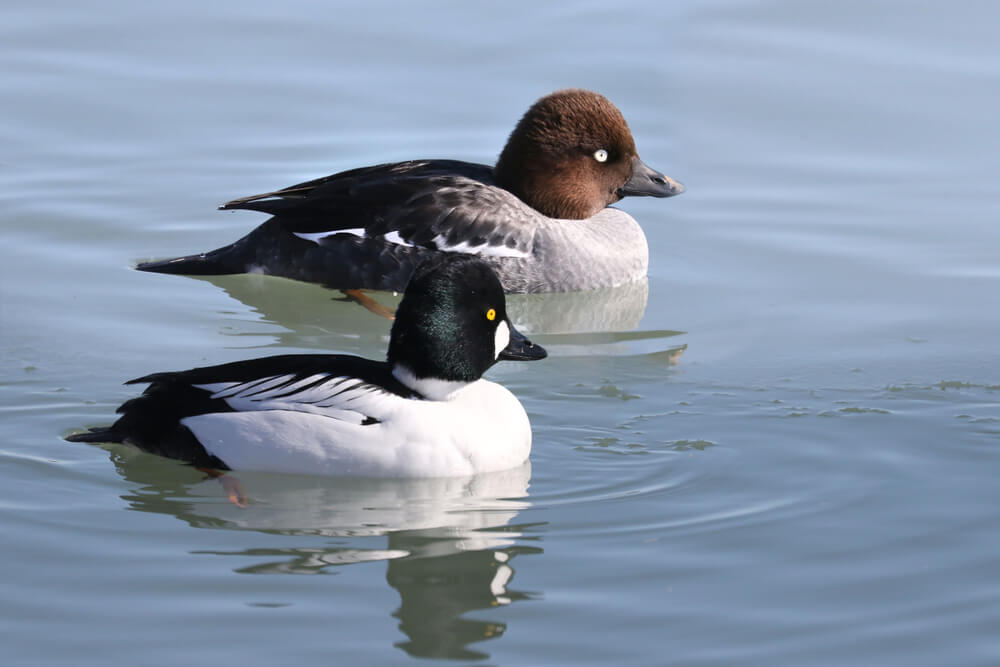
Named for its golden-yellow eyes, the Common Goldeneye is another compact diving duck that stands out due to its sharp black-and-white contrast.
Adult males show a glossy dark head with a green sheen, set off by a crisp circular white patch below the eye. The rest of the plumage reinforces this contrast, with a dark back against a clean white neck and belly. Females are more muted but still patterned, with a chocolate-brown head and a mostly grey body that gives a softer black-and-white appearance at a distance.
This species is known for its bold, territorial nature and elaborate courtship displays, which include head throws and striking postures on the water. Like the Bufflehead, it nests in tree cavities, returning to the same sites year after year.
In Florida, the Common Goldeneye is an uncommon winter visitor. It frequents open waters such as lakes, rivers, bays, and coastal areas, with reliable sightings reported from places like St. Marks National Wildlife Refuge.
Discover other duck species that nest in trees: 23 Ducks That Nest In Trees
3. Hooded Merganser
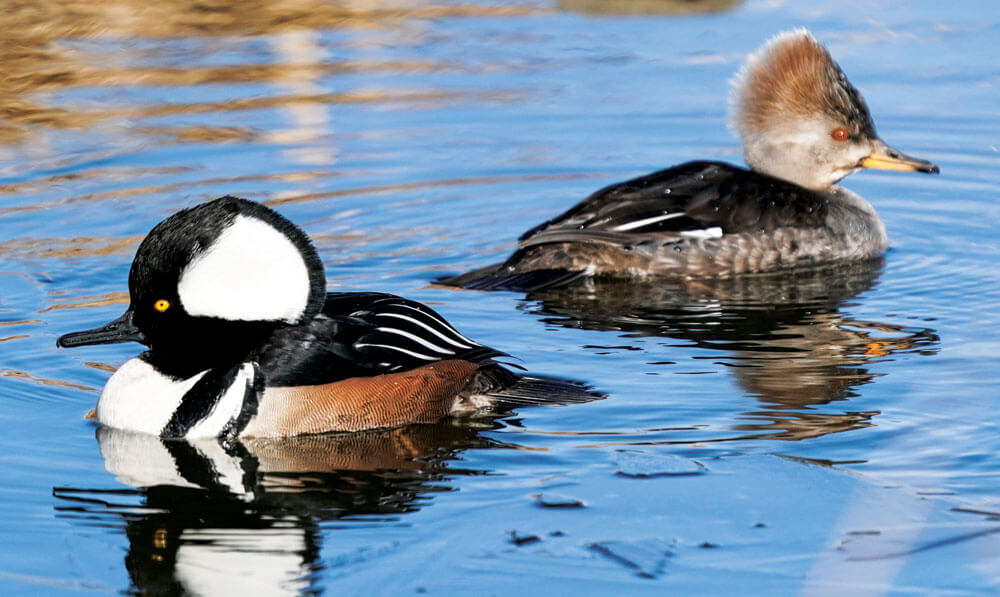
This is the second-smallest species of the mergansers, yet one of the most visually distinctive thanks to its dramatic black-and-white patterning and expressive crest.
In breeding plumage, the adult male is sharply marked, with mostly black upperparts and bold white accents. The most striking feature is the large white patch on either side of the crest, which becomes especially prominent when the bird raises it during courtship, creating a clean, high-contrast black-and-white display. Females present a subdued look, with a greyish-brown body and a narrow white area along the lower breast and belly, giving a subtler take on the same palette.
Hooded Mergansers are short-distance migrants, wintering in regions where waters remain ice-free. In Florida, they are a common winter visitor, favoring calm freshwater habitats such as ponds, lakes, and slow-moving rivers. A reliable place to observe them is Fort De Soto Park, where they can be seen diving and foraging in sheltered waters.
4. Common Merganser
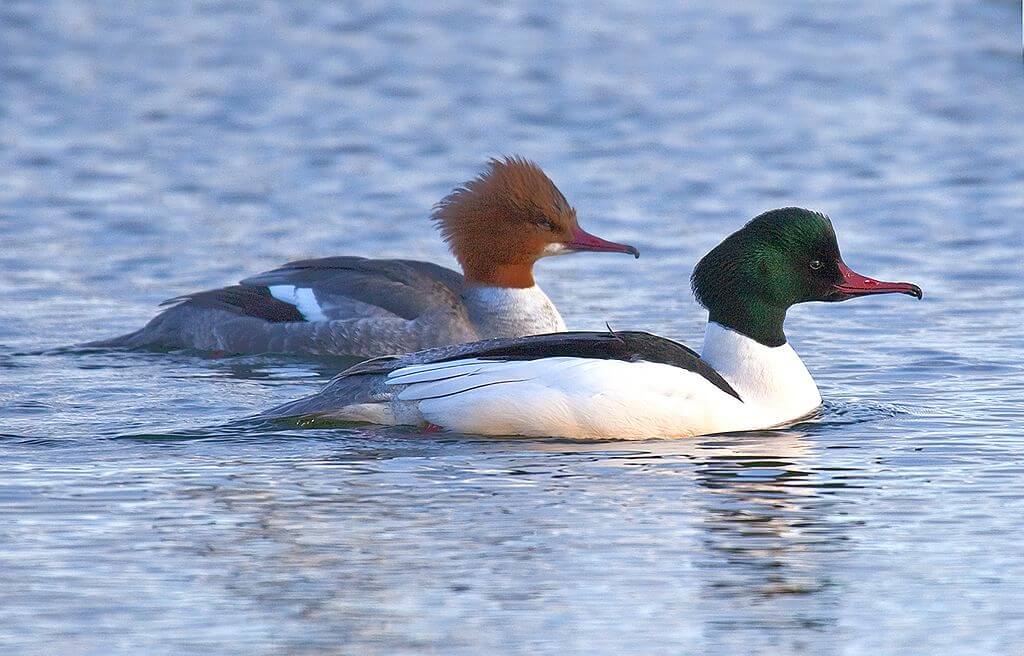
Another merganser that you may also spot in Florida, and can be said to wear black-and-white plumage, especially when viewed at a distance, is the Common Merganser.
This is a large diving duck of rivers and lakes across forested regions of Europe, Asia, and North America. Adult males in breeding plumage show a clean, high-contrast appearance, with a mostly white body that may carry a faint salmon tint, paired with a dark head that shines green in good light. The wings add to the pattern, appearing white on the inner portion and black toward the outer edges. Females and non-breeding males are more subdued, with a grey body and a reddish-brown head, though white areas on the chin and wings still create a noticeable contrast.
Like all mergansers, this species is adapted for catching fish, with narrow bills lined by fine serrations that help grip slippery prey, giving rise to the nickname “sawbill.”
In Florida, the Common Merganser is a rare winter visitor. It is typically found on larger lakes and rivers, with only occasional appearances along sheltered coastal waters. One of the most recent records in the state came from Lake Jackson in 2022.
5. Greater Scaup
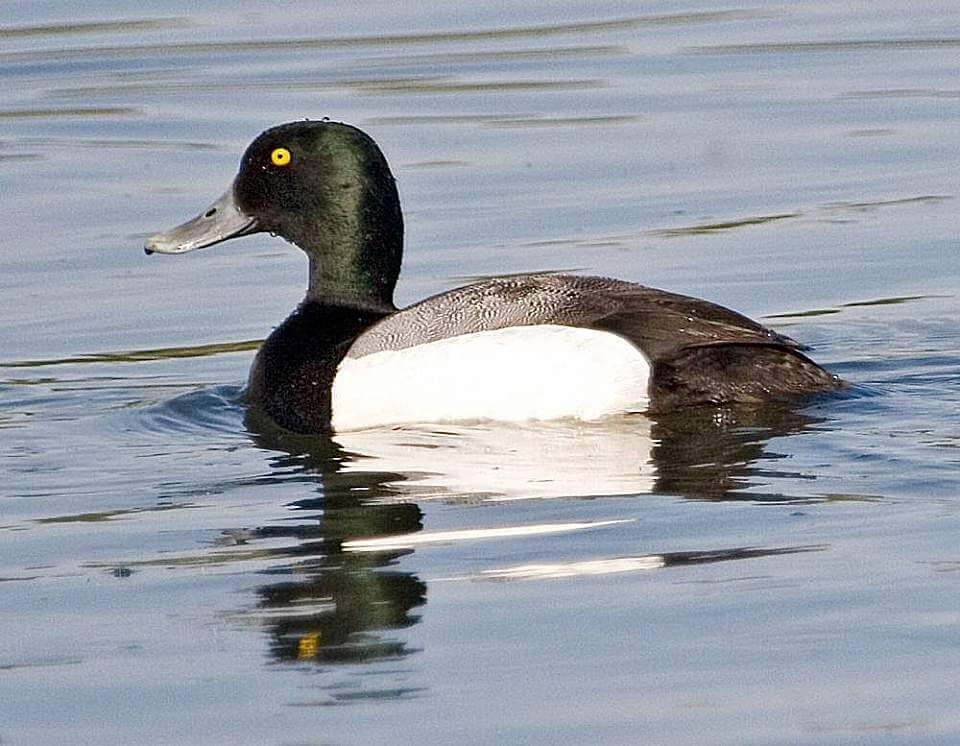
A mid-sized diving duck, the Greater Scaup is larger than its close relatives (such as the Lesser Scaup and Tufted Duck) and shows a clean black-and-white look that stands out on open water.
Adult males present a strong contrast, with a dark head that can appear green or purple depending on the light, paired with a black breast and a bright white belly. The pale grey upperparts soften the pattern slightly, while a bold white wing stripe is visible in flight. Females are mostly brown, though they retain white on the wings, giving a more subdued version of the same overall pattern.
They breed in northern regions, nesting close to water on islands or floating vegetation, which helps reduce the risk of predation.
In Florida, Greater Scaup are seen mainly in winter, with occasional records outside that season. They are more typical of coastal habitats such as bays and sheltered coves, though they do appear on larger lakes. A reliable location to spot them is St. Marks National Wildlife Refuge.
6. Lesser Scaup
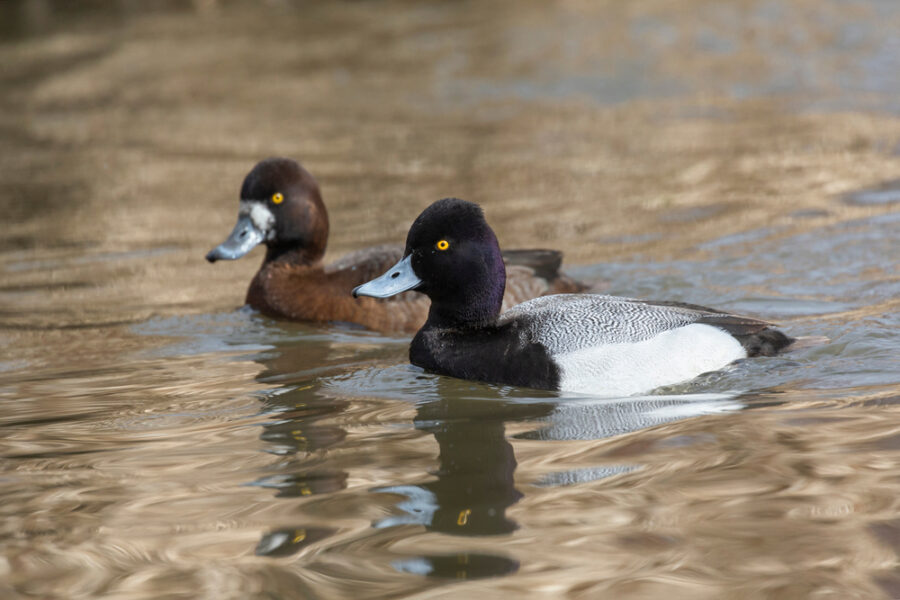
Colloquially known as the little bluebill or broadbill, thanks to its distinctive pale blue bill, the Lesser Scaup is a compact diving duck whose plumage also show some crisp black and white contrast, especially in males.
Adult males in breeding plumage show a dark, iridescent black head with a subtle purple sheen and a small tuft at the rear of the crown. The chest is black, while the sides and back shift into pale grey, creating a soft but clear separation between dark and light tones. The wings are patterned with darker vermiculations and contrasting flight feathers that reinforce the black-and-white impression on the water.
Females are more uniformly dark brown, but still carry defining pale accents, including a white band at the base of the bill and a lighter area around the ear, with the underside fading toward white along the mid-belly.
This is a common wintering species in Florida, with some individuals remaining year-round. It occupies a wide range of aquatic habitats, from freshwater wetlands and ponds to larger lakes and coastal bays. One reliable site for observation is Bald Point State Park, where it can be seen diving in mixed waterfowl flocks.
7. Long-tailed Duck

This species gets its name from the unusually long but striking tail, which gives it one of the most distinctive silhouettes among sea ducks.
A medium-sized diver of Arctic tundra and taiga regions, the Long-tailed Duck winters along northern coastlines of the Atlantic and Pacific Oceans. Adult plumage is highly variable due to seasonal moult, but always shows strong contrast. In winter, males display a mostly white body with a dark breast and a dark cheek patch on a pale head and neck. Their elongated tail streamers, reaching up to 15 cm, extend well beyond the body and are a key identification feature. The bill is dark grey with a subtle pink band. Females are more muted, with a brown back and shorter pointed tail, while their winter plumage shows a pale head and neck with a darker crown.
This is an uncommon winter visitor to Florida. It is typically found in coastal waters, bays, and large inland lakes, where it dives for aquatic prey in open, often windy conditions. One notable location for sightings is Merritt Island National Wildlife Refuge.
8. Ring-necked Duck
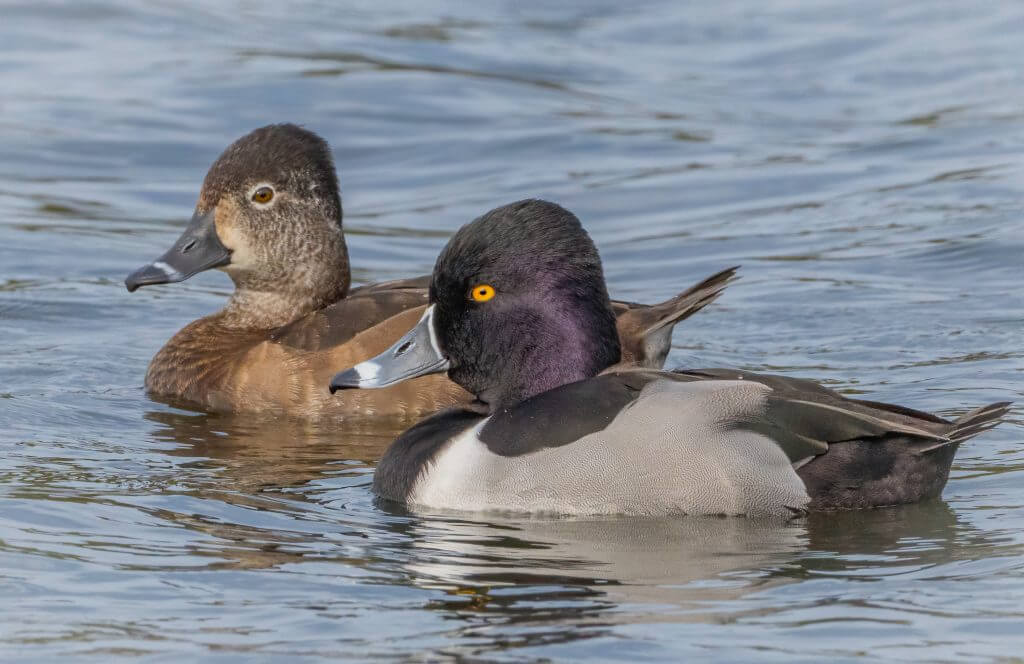
Many people wonder why this duck is called the Ring-necked Duck when no clear ring is visible on its neck. Apparently, the name comes from early ornithologists in the 1800s who worked mainly with preserved specimens; in those conditions, the faint chestnut neck ring appeared much more noticeable, leading to a name that can be misleading in the field.
Adult males show a glossy black, angular head that contrasts with a pale grey bill marked by two crisp white rings. The body is equally bold, with a black back, a clean white breast and belly, and a sharp white stripe along the folded wing that stands out on the water. Females are more subdued, with a grey-brown body and a darker back, but still retain key field marks including a pale face ring around the eye and a subtly banded bill.
They breed on wooded lakes and ponds across northern North America, where cover and freshwater habitats are abundant.
In Florida, Ring-necked Ducks are very common in winter and can be encountered year-round in some areas. They use a wide range of freshwater and brackish habitats, including ponds, marshes, lakes, rivers, and sheltered bays, with reliable sightings at places such as Merritt Island National Wildlife Refuge.
Duck Identification Posters/Charts
Celebrate the beauty of ducks with detailed, high-resolution identification posters designed for both learning and decor. Each chart features vibrant colors, sharp details, and a smooth premium finish that’s perfect for classrooms, study spaces, living rooms, or offices.

9. Canvasback
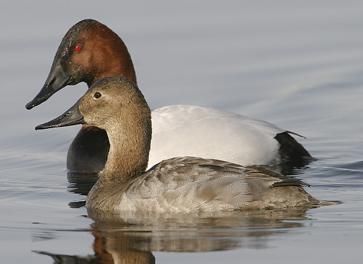
Another Florida duck that can appear black-and-white at a distance is the Canvasback, the largest diving duck in North America.
It is similar in size to a Mallard but noticeably heavier and more compact, with a distinctive wedge-shaped head and long, elegant neck that give it a streamlined profile on the water.
In males, the plumage creates a strong contrast: a chestnut-red head and neck sit above a black bill, black breast, dark tail, and a pale grey back, producing a clear separation between dark and light tones that appears almost black-and-white from afar. Females are more muted but still structured, with a light brown head and neck that gradually deepens into darker brown on the chest and back, along with the same dark bill.
Canvasback populations have fluctuated significantly over time, with past declines leading to conservation concern, though numbers recovered strongly in the 1990s. The species remains sensitive to wetland loss and drought, particularly in North American breeding regions.
In Florida, Canvasbacks are a fairly common winter visitor, using a range of freshwater and brackish habitats including lakes, rivers, marshes, estuaries, and ponds. One of the better-known locations for observing them is Lake Apopka.
10. Common Eider
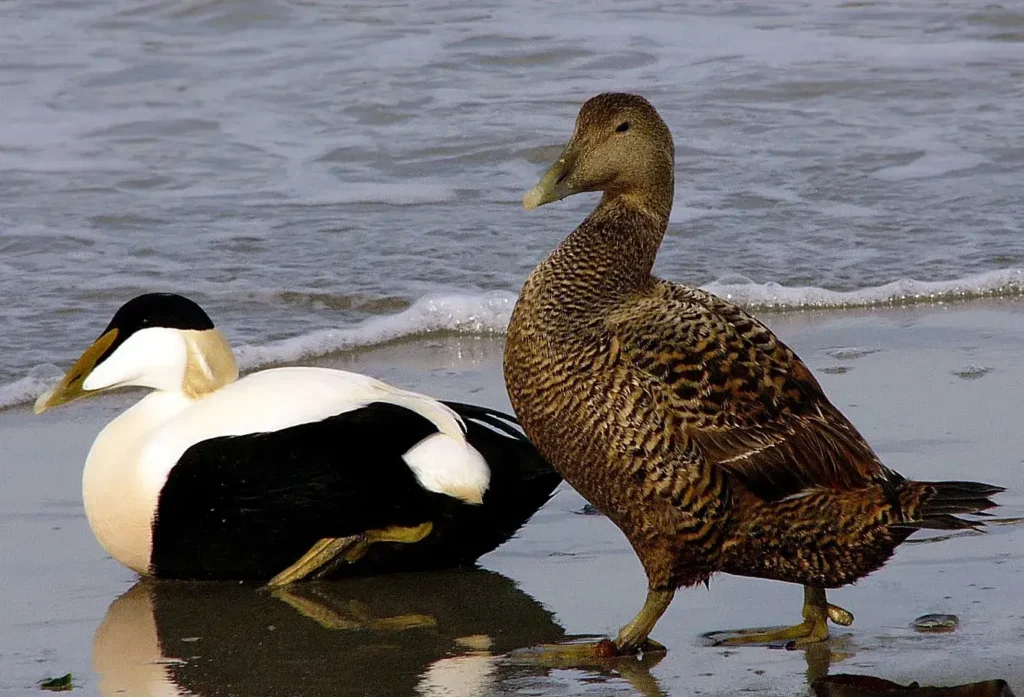
Also referred to as St. Cuthbert’s Duck or Cuddy’s Duck, the Common Eider is a large sea duck that can occasionally appear along Florida’s coasts as a rare visitor.
It is immediately recognizable by its bulky body and large, wedge-shaped bill, giving it a heavy, powerful profile on the water. The adult male shows one of the most striking black-and-white patterns among sea ducks, with clean white plumage across much of the body, contrasted by black areas on the sides and belly, and a soft green tint on the nape that adds subtle color without breaking the overall contrast. Females are entirely brown, but still stand out due to their size, head shape, and robust build compared with other ducks in similar habitats.
Common Eiders feed primarily by diving for crustaceans and molluscs, with mussels forming an important part of their diet. They are highly social breeders, nesting in dense colonies on coastal islands that can range from a few dozen to thousands of pairs.
In Florida, the species is an uncommon vagrant recorded at various times of the year, usually along exposed rocky shorelines. One known location for sightings is Cape Canaveral National Seashore.
11. Surf Scoter
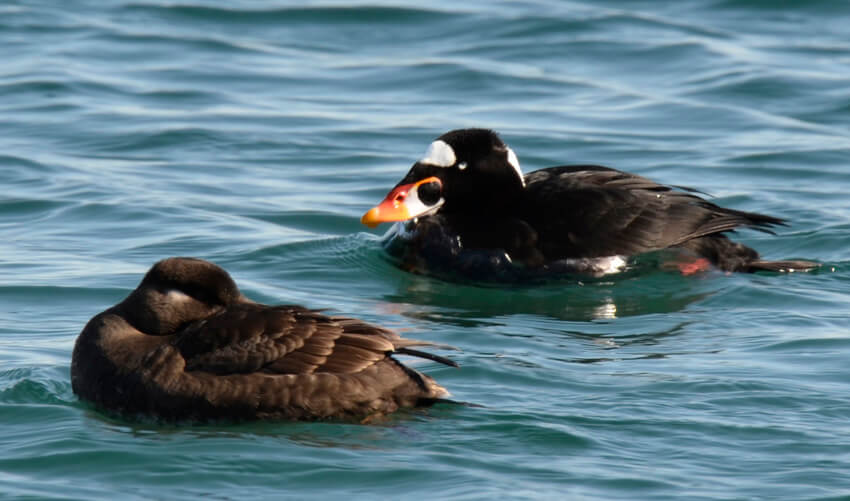
This is one of the most strange-looking ducks you may encounter in Florida, immediately recognizable by its heavily shaped bill and bold contrast between dark plumage and pale facial markings.
Adult males are almost entirely black, but stand out through distinctive white patches on the forehead and nape that break up the otherwise uniform body. The bill is large and swollen in appearance, giving the species a distinctive profile on the water; at a distance it can appear orange, but up close it reveals a complex pattern of white, red, and yellow tones with a dark spot near the base. Females are more subdued, with a generally brown plumage that is slightly darker above than below, yet still retains the same compact, diving-duck structure.
Surf Scoters feed mainly on benthic invertebrates, with mussels forming a key part of their diet, which they obtain by diving in coastal waters.
In Florida, this is an uncommon winter visitor, typically found in nearshore marine environments rather than inland waters. One reliable area for sightings is Cape Canaveral National Seashore, where they may be seen riding waves and diving in open coastal conditions.
12. White-winged Scoter
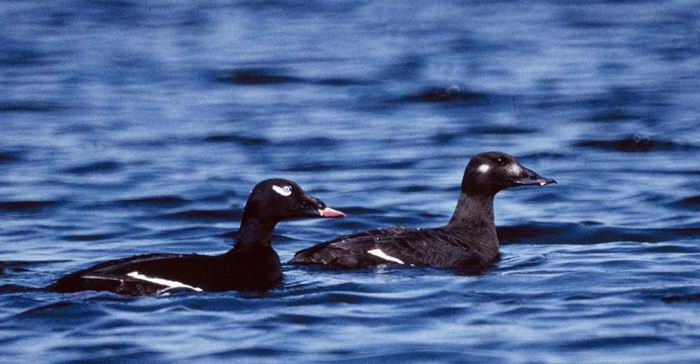
Another unusual black-and-white duck you may encounter in Florida is the White-winged Scoter, a bulky sea duck with a heavy body and a large, distinctive bill that helps separate it from similar scoters.
The adult male appears almost entirely black, but subtle white markings around the eye and a pale wing patch (speculum) provide key contrast when the bird is on the water or in flight. Its bill is particularly striking, showing orange and red tones with a prominent black knob at the base, and the feathering at the gape gives the head a softer outline compared with the more blocky-billed Surf Scoter. Females are brown overall and more difficult to distinguish at a glance, though their body shape and feathered gape remain useful field marks.
White-winged Scoters form long-term pair bonds, with monogamous pairs often forming in late summer before migration.
In Florida, this is an uncommon winter visitor, typically observed in coastal waters and occasionally on large inland lakes. A dependable location for sightings is Fort De Soto Park, where they can be seen diving in open, wave-exposed conditions.
13. King Eider
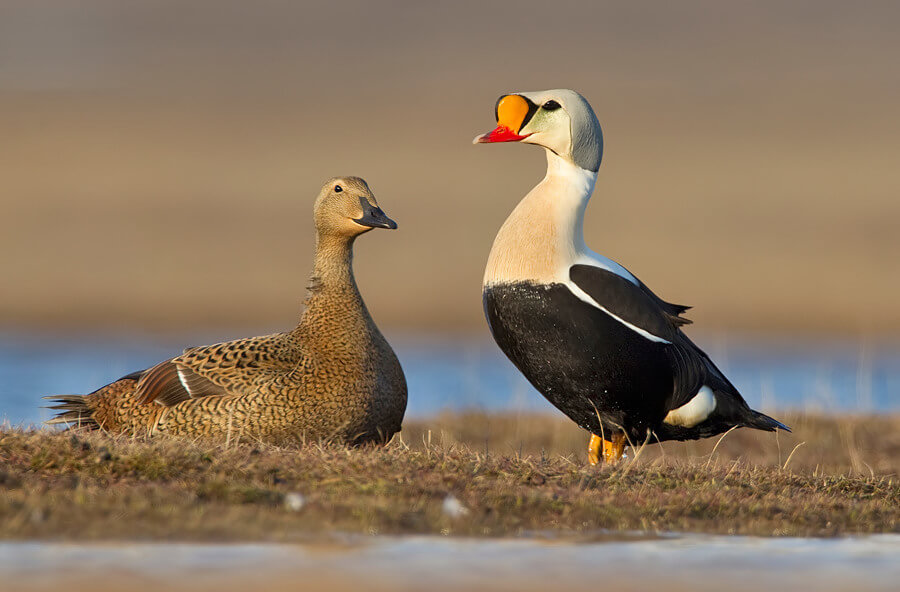
The male King Eider is unmistakable, with its mostly black body, buff-tinged white breast, and vividly multicolored head that gives this species one of the most ornate appearances among sea ducks. The head, nape, and neck are washed in pale bluish-grey tones, creating a soft contrast against the darker body and lighter chest.
Females, sometimes informally referred to as “queen eiders,” are more uniform in appearance, showing a warm brown plumage overall that becomes slightly paler on the head and neck. While less striking than the male, the female still retains the robust structure and sea-duck profile typical of the species.
The King Eider is a circumpolar breeder of the Arctic, nesting across coastal tundra regions in Alaska, Canada, Greenland, Svalbard, and Russia, where it uses a range of low-lying tundra habitats.
In Florida, it is an extremely rare vagrant from the far north, appearing only sporadically along coastal waters. One notable record involved an individual observed in 2011 in downtown Pensacola.
14. Harlequin Ducks

Male Harlequin Ducks are highly patterned birds, though not strictly black and white; from a distance, their slate-blue body and bold markings can appear dark and high-contrast, especially on rough coastal water.
Up close, the male reveals an intricate mix of slate-blue, chestnut-brown, black, and clean white markings arranged in sharp, flowing patterns across the body. The white facial and neck stripes stand out strongly against darker surrounding plumage, giving the bird a detailed, almost painted appearance. Females are far more subdued, with overall brown plumage and small white facial patches that provide the main contrast in their appearance.
This species breeds in fast-flowing, cold streams across northwestern and northeastern North America, as well as Greenland, Iceland, and eastern Russia, where turbulent water conditions shape its strong swimming ability.
In Florida, Harlequin Ducks are rare winter visitors that typically stay along rocky coastlines. One of the most recent records came from Fernandina Harbour Marina in 2018.
15. Muscovy Duck
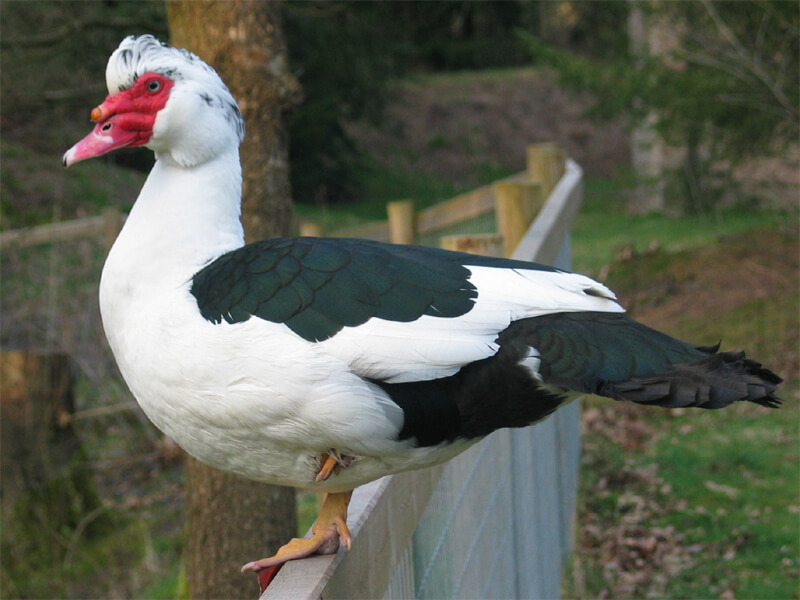
Finally, one of the most commonly encountered ducks with black-and-white plumage in Florida is the Muscovy Duck.
In Florida, this species is widespread in urban and suburban settings, but it is not native to the region. Instead, it is considered an introduced, feral population derived largely from escaped or released domestic birds, originally descended from wild populations in South America.
Muscovy Ducks show highly variable plumage, but many individuals feature a strong mix of black and white patterning, ranging from clean white patches on the wings to bold black body feathers that can appear glossy in good light. Some birds are heavily pied, with irregular white markings that create a striking contrast, while others are darker overall with smaller white accents. This variation makes them one of the more visually diverse ducks in the state, even within a single flock.
They are highly adaptable and commonly found around lakes, canals, parks, golf courses, and residential ponds, where they often coexist closely with people.
Discover other black and white ducks from around the world: 27 Black And White Ducks (Wild Species & Domestic Breeds)