
10 Florida Ducks with Red Beaks (Including Pictures & ID Guides)
Florida is home to a wide range of colorful bird species, thanks to its subtropical climate, which creates ideal real estate for many bird families to thrive. Among these are over 30 duck species, some being year round residents, while others are rare visitors that arrive from other regions.
If you look a little closer, you will notice that duck species are not all created equal when it comes to appearance. They differ in many aspects including overall plumage, bill color, feet color, feeding behavior, and habitat preferences. These differences are exactly what birders rely on to tell species apart.
In this post, we will narrow things down to Florida ducks with red beaks and explore which of these species show this striking bill color. If you have landed here after spotting a duck in Florida with a red beak and probably wondering which species it might be , you are in the right place. Below is a list of some of the most common Florida duck species with red bills along with quick ID guides to help you figure out what you saw.
1. Black-bellied Whistling-duck

Black bellied Whistling duck is one of the most familiar duck species in Florida and often the first that comes to mind when discussing ducks with red bills in the state. It is one of only two whistling duck species native to North America, and it has become a regular and widespread resident across much of Florida.
One of its most distinctive features is its long pink to reddish bill, which stands out clearly against the softer tones of its head and body. The bird also has a relatively elongated head profile and noticeably long legs, giving it a tall, upright stance compared to most dabbling ducks. The head and upper neck are pale gray, contrasting with the darker gray brown body, while a thin but well defined white eye ring adds a subtle but important facial detail.
As its name suggests, this species is highly vocal, producing a clear whistling call often described as “waa chooo,” which helps birders identify it fast even when it is not easily seen. Behaviorally, it is quite adaptable and often feeds in shallow freshwater habitats such as ponds, lakes, marshes, and even cultivated areas or reservoirs with dense vegetation. Feeding typically takes place at night, with seeds and other plant material forming the bulk of its diet.
It commonly nests in natural tree cavities, including hollow trunks and sometimes palms in warmer regions. In Florida, it is especially common and can be found across many suitable wetland habitats throughout the state. Populations are resident year round and tend to be most noticeable and abundant during the summer months.
NOTE: Male and female Black bellied Whistling ducks closely resemble each other. Do you know how to tell them apart? Check this post for tips and this one for quick facts about this amazing duck species.
2. Red breasted Merganser
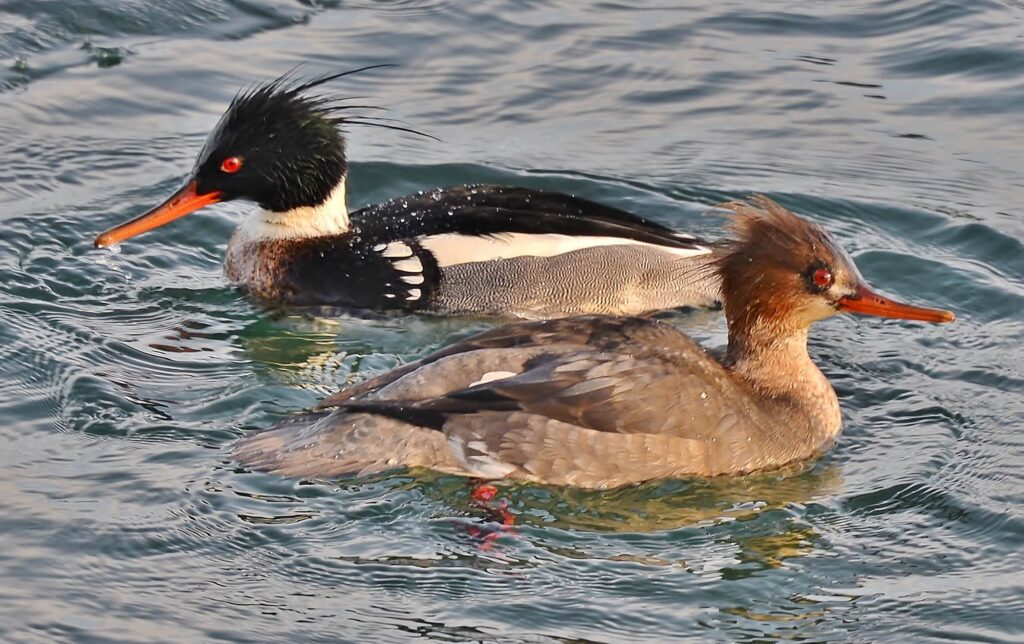
This species derives its name from the rich rusty red breast that is shown by males in breeding plumage, a feature that gives it its striking and unmistakable appearance.
The Red breasted Merganser is a regular seasonal visitor to Florida, mainly occurring during autumn and winter, although individuals can occasionally be seen into spring and summer. In the state, it is typically found along coastal waters, rivers, and larger lakes, including well-known sites such as Everglades National Park, where it may be observed both on open water and along sheltered river systems.
In terms of structure, this is a sleek and fast swimming diving duck with a distinctive long, thin red bill that has fine serrated edges, perfectly adapted for catching fish. The bill is one of its most important identification features and stands out clearly against the head and neck. Both sexes also show a spiky, somewhat untidy crest that adds to their angular profile.
Males in breeding plumage are particularly striking, with a dark head that shows a green sheen, a clean white neck, a rusty red breast, black upperparts, and contrasting white underparts. Females are more subdued, showing a rusty toned head and a greyish brown body, but they retain the same slender bill and crested head shape.
This species breeds across northern freshwater systems, including lakes and rivers throughout northern North America, Greenland, Europe, and parts of the Palearctic region. In Florida, it is best regarded as a wintering and passage species rather than a resident, and sightings are always of interest to birdwatchers.
3. Common Merganser
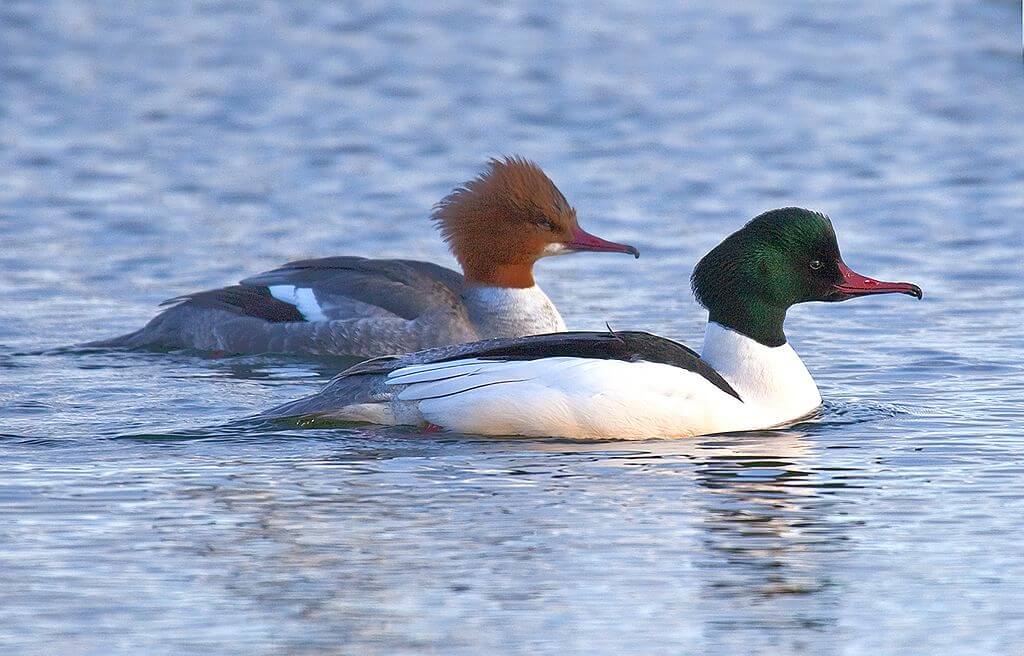
The next Florida duck with a red beak, and one that also shares a broadly overlapping range with the Red breasted Merganser, is the Common Merganser, a large and elegant diving duck that is considered a rare visitor to the state.
In North America, it is known as the Common Merganser, while in Eurasia it is referred to as the Goosander. Although it is more typical of northern regions, it occasionally appears in Florida during winter, usually on larger lakes, rivers, and sometimes sheltered bays. Sightings are uncommon and often notable, such as records from places like Lake Jackson in recent years.
One of its most important identification features is its long, narrow red bill, which is sharply pointed and highly adapted for catching fish. The head is topped with a smooth crest of elongated feathers, but unlike more pronounced crested species, this usually lies neatly along the back of the head, giving the bird a sleek profile rather than a spiky appearance.
Adult males in breeding plumage are striking, with a clean white body that can show a faint salmon pink flush, a dark head with a green iridescent sheen, grey rump and tail, and wings that are mostly white on the inner portions with darker outer edges. Females and non breeding males are more subdued, showing grey overall tones with a reddish brown head, white chin, and pale wing panels.
Like other mergansers, this species is a highly specialized fish eater and is often observed working in groups. Birds may coordinate their movements in loose formations, driving fish into shallow water where they are easier to catch. It nests in tree cavities near water and relies on clear aquatic habitats for feeding.
4. Wood Duck

This is one of the prettiest ducks in the world, thanks to its striking multicolored iridescent plumage. They get their name from their unusual nesting behaviors, as they are one of the few duck species that regularly perch and nest in trees, often using natural cavities in wooded wetland habitats.
The bill of the male is reddish to pinkish in tone, standing out against the more complex and colorful facial pattern.
In adult males, in particular, this vivid bill is paired with truly spectacular multicolored plumage, a distinctive white facial flare extending along the neck, and bright red eyes that further enhance its dramatic appearance. The head is crested, adding to its refined silhouette, while the body shows a rich mosaic of iridescent greens, purples, and chestnut tones.
Females are more subdued but still elegant, with softer brown plumage, a white eye ring, and a pale whitish throat.
In Florida, Wood Ducks are a common resident species, present throughout the year in wetlands, swamps, and flooded woodland habitats. They are regularly observed in sites such as Myakka River State Park, among many other suitable locations across the state, making them both familiar and highly sought after by birdwatchers.
See also: 5 Ducks That Look Like Wood Ducks
5. Surf Scoter
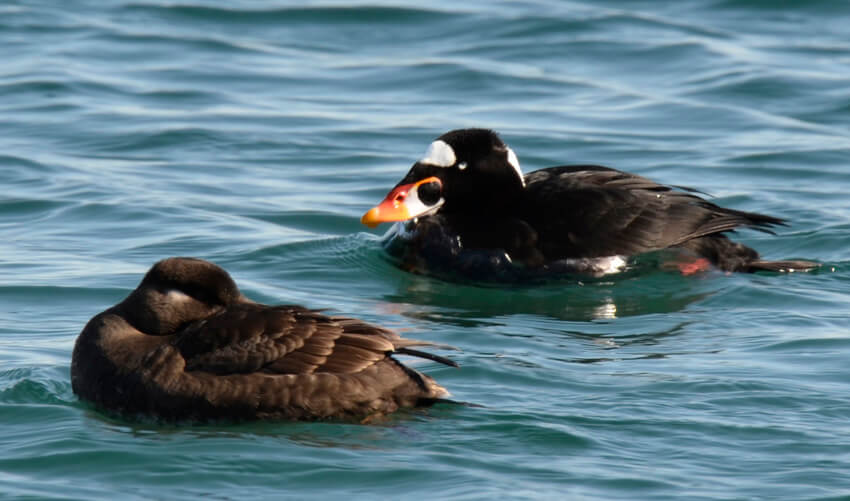
Another Florida duck that we can say has a reddish toned bill is the Surf Scoter, a large sea duck native to North America that is typically associated with cold coastal waters rather than inland habitats.
This species is most often found in Florida as an uncommon winter visitor along coastal waters, with reliable sightings usually coming from places such as Cape Canaveral National Seashore. It is primarily a marine species, spending most of its time on open sea rather than freshwater systems.
One of its most distinctive features is the bill, which appears swollen and bulky compared to most ducks. At a distance it often looks orange, but up close it is actually patterned with white, red, and yellow tones, and includes a noticeable dark spot near the base.
Adult males are almost entirely black with bold white patches on the forehead and nape, giving them a high contrast appearance on the water. Females are slightly smaller and generally browner, with a more uniform plumage that is darker above and paler below, making them less conspicuous but still identifiable by structure and bill shape.
Like other sea ducks, Surf Scoters undergo a simultaneous molt during which they temporarily lose their flight feathers and become flightless. Their vocalizations also differ by context, with males producing gurgling calls and explosive puk puk sounds during courtship, while females use harsher crowlike calls when defending young.
Duck Identification Posters/Charts
Celebrate the beauty of ducks with detailed, high-resolution identification posters designed for both learning and decor. Each chart features vibrant colors, sharp details, and a smooth premium finish that’s perfect for classrooms, study spaces, living rooms, or offices.

6. King Eider
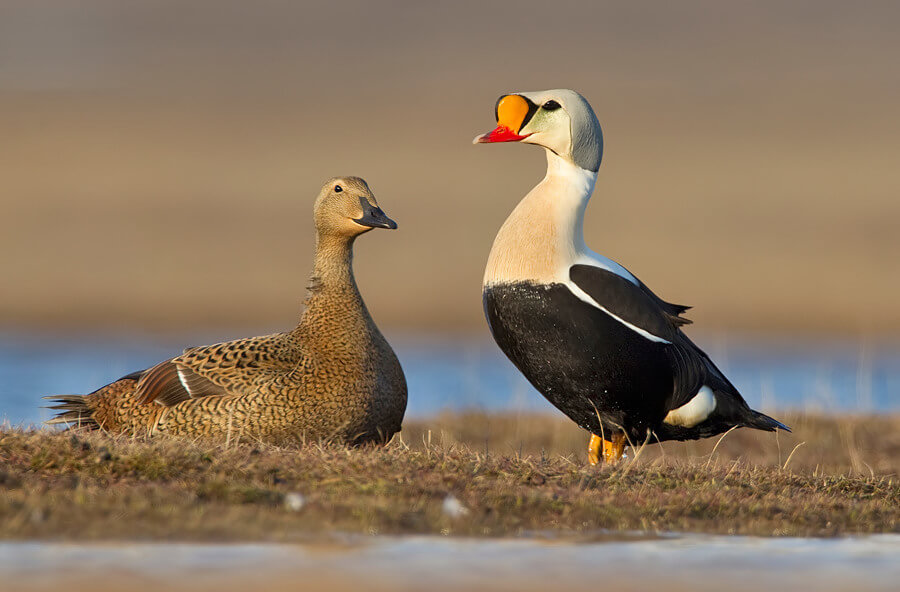
Besides Surf Scoter, another strange-looking sea duck that has reddish beaks is the King Eider, a large Arctic species that breeds along the northern coasts of northeast Europe, North America, and Asia.
This species is a very rare vagrant in Florida, typically appearing only in coastal waters during winter, and records are highly unusual. One notable sighting was an individual observed in 2011 in downtown Pensacola, highlighting just how exceptional its appearance in the state can be.
The bill is one of its most distinctive features, appearing orange to reddish in tone, often contrasting strongly with the surrounding facial plumage. Males are unmistakable, showing a mostly black body, a buff tinted white breast, and a highly ornate multicolored head pattern that makes them stand out among sea ducks. Females, sometimes informally referred to as “queen eiders,” are more subdued, with a warm overall brown plumage that is slightly paler on the head and neck.
As with other eiders, this species is adapted to cold marine environments and is strongly associated with Arctic coastal regions, making any appearance far south of its normal range a notable event for birdwatchers.
Discover Other Strange-looking Ducks: The 15 Strangest Ducks on the Planet
7. White-winged Scoter
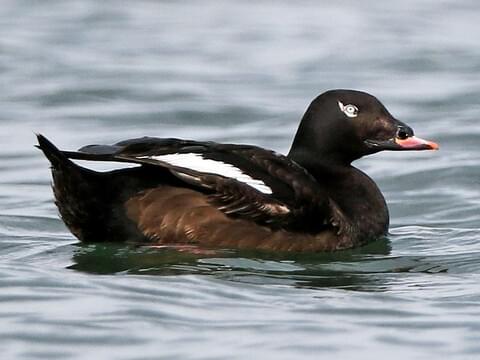
The largest of the scoter species, the White-winged Scoter is a heavy-bodied sea duck that occasionally appears in Florida as an uncommon winter visitor, mainly along coastal waters and large inland lakes. Good viewing opportunities can sometimes be found at locations such as Fort De Soto Park, where wintering sea ducks may gather.
Females typically range from about 48 to 56 cm in length and are slightly lighter and smaller than males, which can reach up to 60 cm and are noticeably heavier overall.
The bill shows a distinct orange red coloration, which is often accompanied by a prominent black knob at the base. This combination gives the face a bold and somewhat angular appearance, especially when viewed at close range.
In males, the overall plumage is mostly black, but broken by a striking white patch around the eye and a white speculum on the wing, both of which stand out strongly on the water. Females are more subdued, showing dark brown plumage that is slightly paler on the head and contrasting less sharply with the surrounding water.
White winged Scoters are strong diving birds and are adapted for benthic feeding, often foraging at depths between 5 and 20 meters in wintering areas. Their larger size allows them to access deeper prey compared to Surf and Black Scoters, giving them a slightly different ecological niche.
8. White-cheeked Pintail
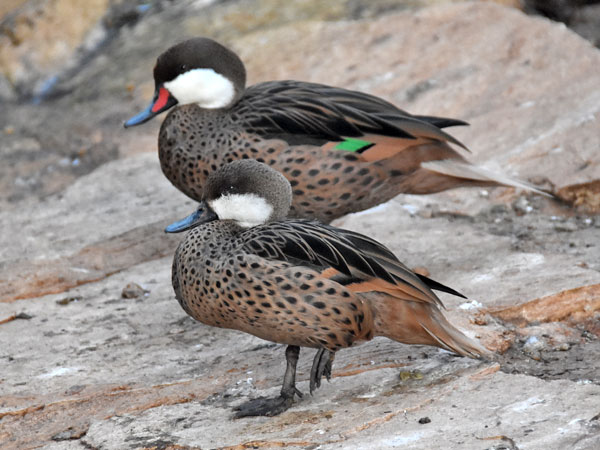
As its name suggests, the White cheeked Pintail is a dabbling duck best recognized by its clean white face markings and long, elegant body shape. It is a species that is patchily distributed across South America and the Caribbean, and in Florida it is considered an uncommon vagrant to wetlands, with recent records such as the 2020 sighting at Lely Resort.
This duck shows a relatively consistent appearance between the sexes, although females are slightly smaller and have duller plumage overall. The body is mainly warm brown, but the most striking feature is the white cheeks, which contrast clearly against the rest of the face. The bill is another useful field mark, typically grey with a reddish base among males.
Like other pintails, this species has a slender body and an elongated shape, including a pointed tail that is characteristic of the group, though it is less pronounced than in the Northern Pintail. Its feeding behavior is typical of dabbling ducks, with a diet consisting of aquatic plants, grass seeds, algae, and small invertebrates, which it obtains by foraging at the water surface or in shallow wetlands.
9. Long-tailed Duck

The Long-tailed Duck is a distinctive sea duck that often stands out even at a distance, thanks to its signature long tail.
It is a medium sized diving duck that breeds in the tundra and taiga regions of the Arctic and winters along the northern coastlines of both the Atlantic and Pacific Oceans. In Florida, it is an uncommon winter visitor, typically appearing in coastal waters and occasionally on large inland lakes, with reliable sightings reported from places such as Merritt Island National Wildlife Refuge.
The male’s bill is dark grey, crossed by a pink band, giving it a subtle but unique two-toned appearance.
The species is known to shows strong seasonal variation in plumage. For instance, in winter, males display a striking pattern with a mainly white head and neck, a dark cheek patch, a dark breast, and a mostly white body, all set off by their long pointed tail. In summer, they become much darker overall, with a dark head, neck, and back, and a contrasting white cheek patch.
Females are more subdued, with brown upperparts and a shorter pointed tail. In winter, they show a white head and neck with a dark crown, while in summer the head becomes darker overall.
Unfortunately, populations wintering in some regions such as the Baltic Sea have declined significantly, partly due to accidental capture in fishing nets. Despite this, the species remains a remarkable Arctic breeder and a sought-after sighting in Florida’s coastal waters during the colder months.
10. Muscovy Duck
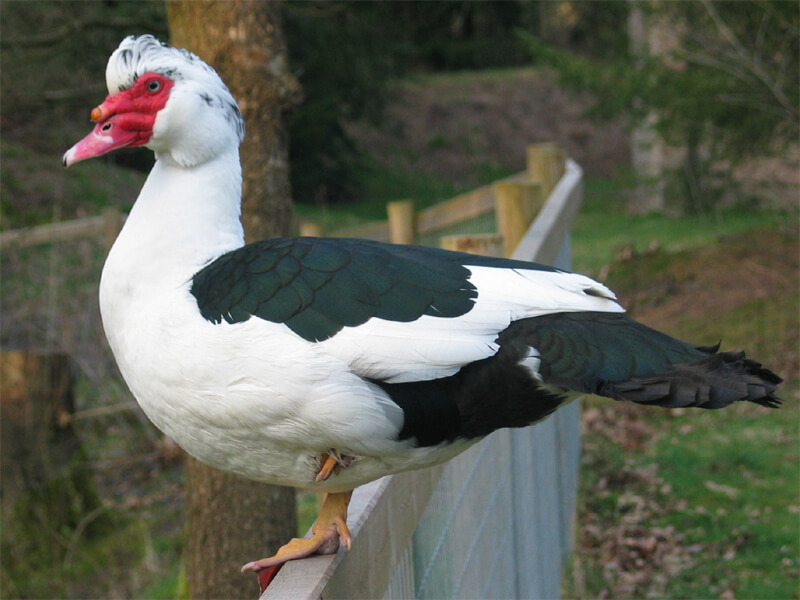
The final duck in our list is the common Muscovy Duck, a familiar sight across many parts of Florida despite not being native to the region.
Muscovy Ducks are easily recognized by their unique structure and facial features. They have long claws on their feet and a broad, flat tail that gives them a heavier, more grounded appearance compared to most other ducks. On the head, the male shows a short crest along the nape, adding subtle texture to its profile. The bill shows some variation in color: in some individuals it appears dark with small speckles of pale pink, while in others it can look more reddish overall, especially when combined with the surrounding bare facial skin. A distinctive dark red to blackish knob is present at the base of the bill, blending into the often fleshy facial caruncles that can also show reddish tones.
In Florida, this species is very common but is considered non native, invasive, and feral. It is frequently found around urban and suburban environments, including lakes, canals, parks, and residential areas. Originally native to South America, the Muscovy Duck populations seen in Florida are largely descended from escaped or released domestic birds rather than true wild populations.
Discover other ducks with red bills: 15 Ducks With Red Beaks