Black Ducks with Orange Beaks: Easy Identification Guide
On a birding forum I occasionally visit, somebody asked: “What kinds of ducks are black with orange beaks?” As you’d expect, the replies quickly spiraled with everyone chiming in with their own guesses, some accurate, others… less so.
So I decided to put together a proper guide featuring ducks that genuinely fit this description. If you’ve ever spotted an unfamiliar black duck with a bright orange bill and wondered what it might be, this should help you narrow down its identity with confidence.
So, which ducks actually match the bill? A quick answer would be: Rosy-billed Pochard, a few scoters, and some mergansers. But that’s just the surface—let’s take a closer look.
Rosy-billed Pochard
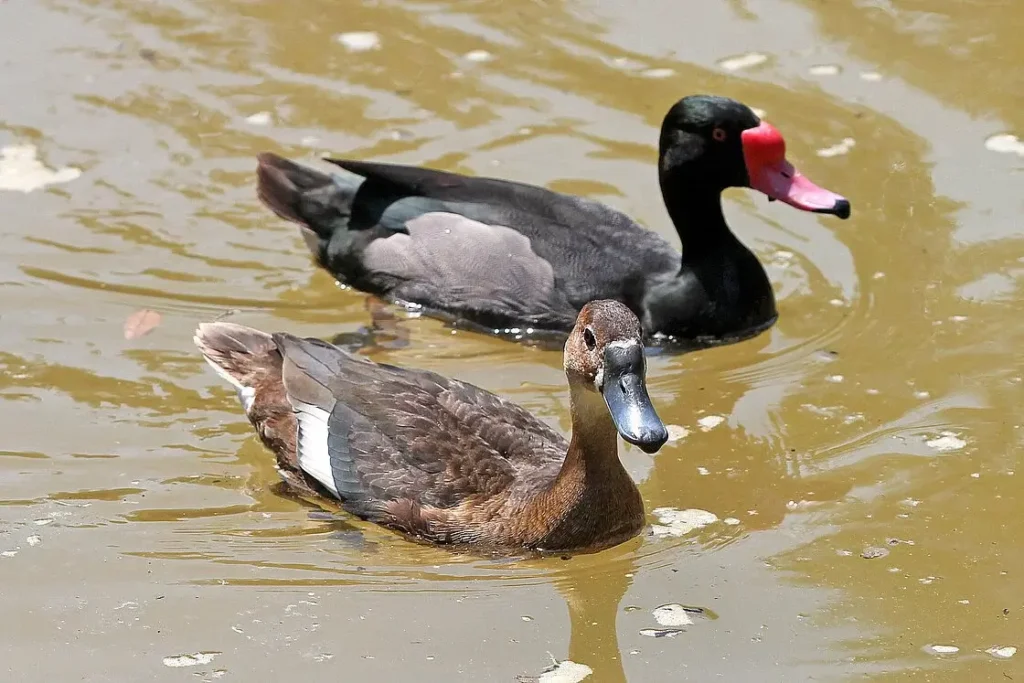
Male rosy-billed pochards have dark, purplish-black heads, necks, and chests, with paler grey sides. They also show broad white wing stripes, but these are only visible when the wings are fully stretched. The species also has a signature bright red bill with a rounded knob at the base. So, when you spot one on the water, it can easily be mistaken for a duck with black plumage and an orange beak. If anything, many people perceive red as orange, or have difficulty distinguishing between the two (a condition known as protanomalous vision).
Quick Facts: Although rosy-billed pochards are classified as diving ducks, they often feed more like dabbling ducks, foraging for seeds, roots, sedges, aquatic plants, and other grasses in shallow water. In fact, they are not as adept at walking on land as other dabbling ducks, because their legs are set further back on the body—an adaptation that helps them move more efficiently when swimming underwater.
Stejneger’s Scoter
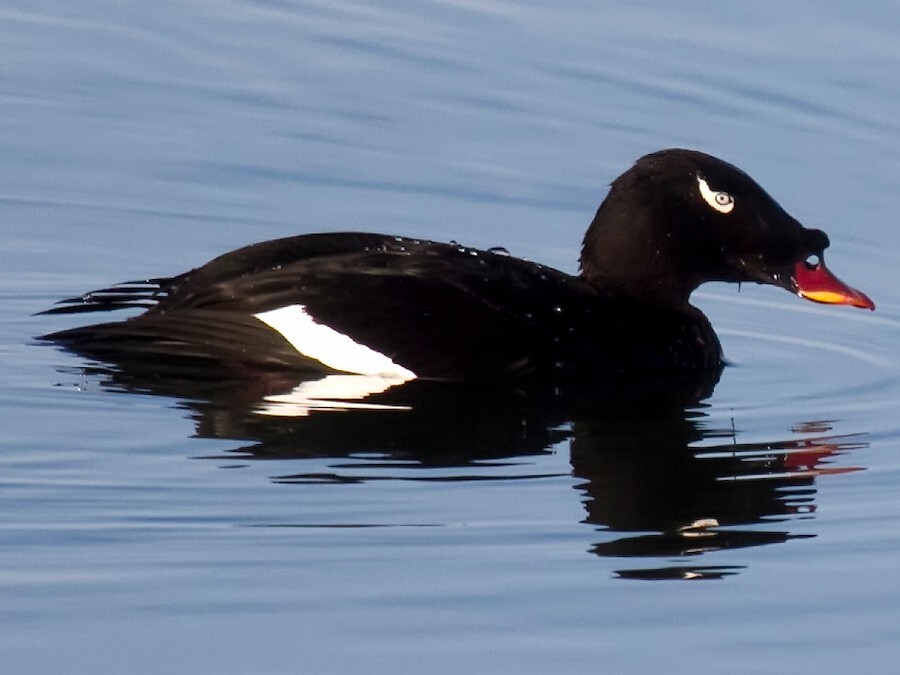
This is the first scoter that also fits the description. Male Stejneger’s scoters are almost entirely black, but they have a small white patch under the eye, which you may miss unless you take a close look. They also have a dark knob at the base of the bill and a bill that is mostly orange-yellow toward the tip.
Females are dark chocolate-brown rather than black, and shows two rounded white patches on the face, which help separate them from other scoters.
Quick Facts: Stejneger’s scoters breed in the far north of Asia, east of the Yenisey Basin, and migrate south in winter to temperate regions, reaching as far as China. In freshwater habitats, they mainly feed on insects and crustaceans, while in marine environments, they switch to feeding largely on molluscs and crustaceans.
Surf Scoter
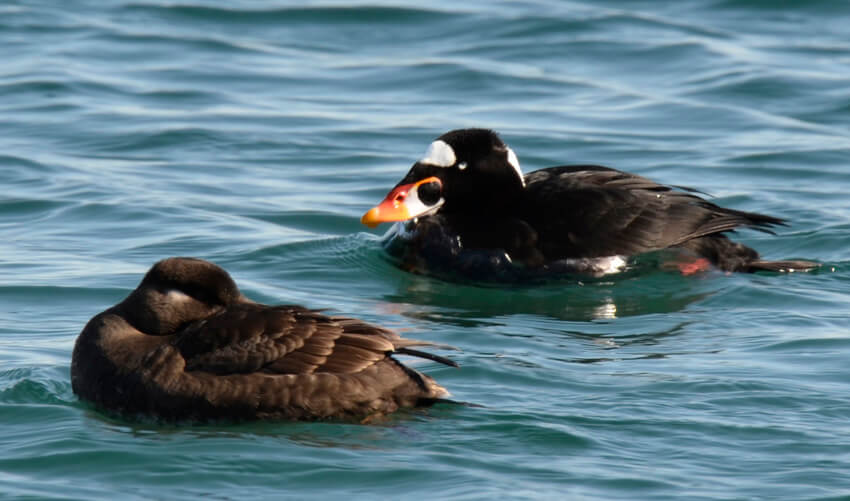
Adult male Surf Scoters are mostly black, with noticeable white patches on the forehead and the back of the neck. Females are a bit smaller in size and tend to be browner overall. The males also have a large, swollen bill that can appear orange from a distance, although up close it shows a mix of white, red, and yellow, along with a dark spot near the base. So, it is also a strong match when you’re trying to identify a black duck with an orange beak.
Quick Fact: Surf scoters breed in northern parts of Canada and Alaska and spend the winter along the Pacific and Atlantic coasts of North America. During late July through early August, they undergo a simultaneous molt of their flight feathers, becoming temporarily flightless for about four weeks. This a particularly vulnerable period for these ducks.
Velvet Scoter
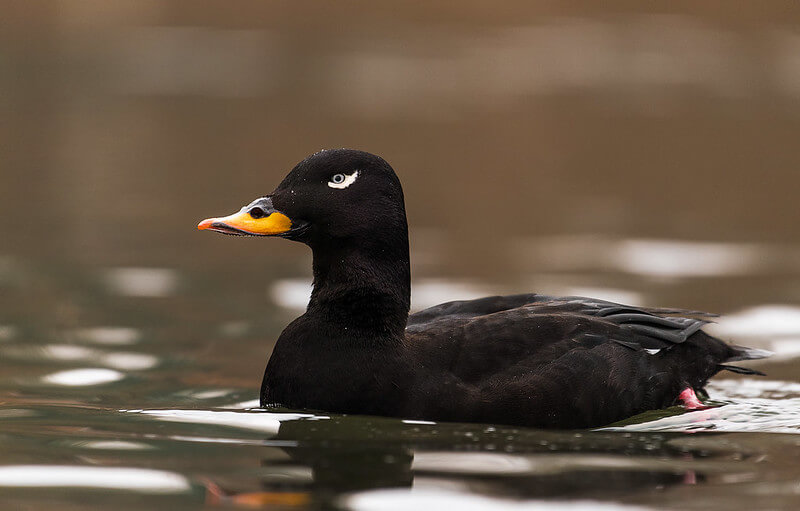
Male velvet scoters have glossy black plumage, with bold white patches on the wings and a small white mark just behind the eye. Their bill is partly orange. Females look similar in shape but lack the glossy sheen, appearing duller and more brown overall. So, it is also a good candidate when you are trying to narrow down on black ducks with orange bills.
Quick Facts: Velvet scoters breed across the far north of Europe and the Palearctic, west of the Yenisey Basin. They build lined nests on the ground, usually close to the sea, lakes, or rivers, in habitats such as woodland or tundra.
White-winged Scoter
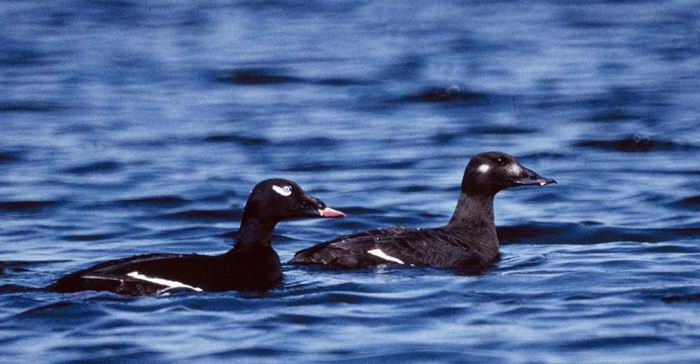
This is the largest species of scoter, and it also fits our description well. The male is almost entirely black, with just a white patch around the eye and a white wing panel (speculum). When the bird is on the water, that white on the wings is often hidden, so the overall look is a solid black duck. The bill shows a mix of orange and red, along with a large black knob at the base.
Quick Facts: White-winged scoters mainly breed in the boreal forests from Alaska to western Canada, becoming less common farther east and south. In winter, they move to more temperate areas, including the Great Lakes and the northern coasts of the United States and southern Canada.
Black Scoter
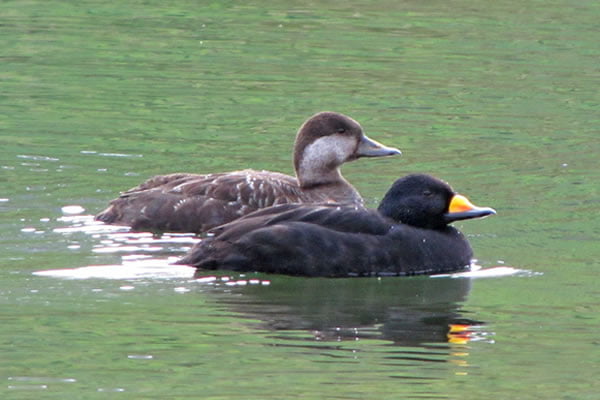
The final scoter that fits our description is the black scoter, and it’s one of the easiest scoters to identify. The adult male is entirely black, with no white markings at all, giving it a clean, solid black appearance on the water.
The bill is large and swollen, and it shows a strong orange-yellow color. From a distance, that bright bill stands out clearly against the dark plumage, making it a very good match for a black duck with an orange beak. Females are brown rather than black and have paler cheeks.
Quick Facts: Black scoters breed in the far north of North America, including areas like Labrador, Newfoundland, and regions around Hudson Bay, and they are also found on the Siberian side of the Bering Strait. In winter, they move south to coastal areas of the northern United States and Canada, reaching as far as San Francisco Bay on the Pacific side and the Gulf of Mexico on the Atlantic side, as well as parts of Asia down to China.
Can you tell apart common scoters and black scoters? Discover key differences here: Common Scoter vs Black Scoter: Identification Guide
Red-breasted Merganser
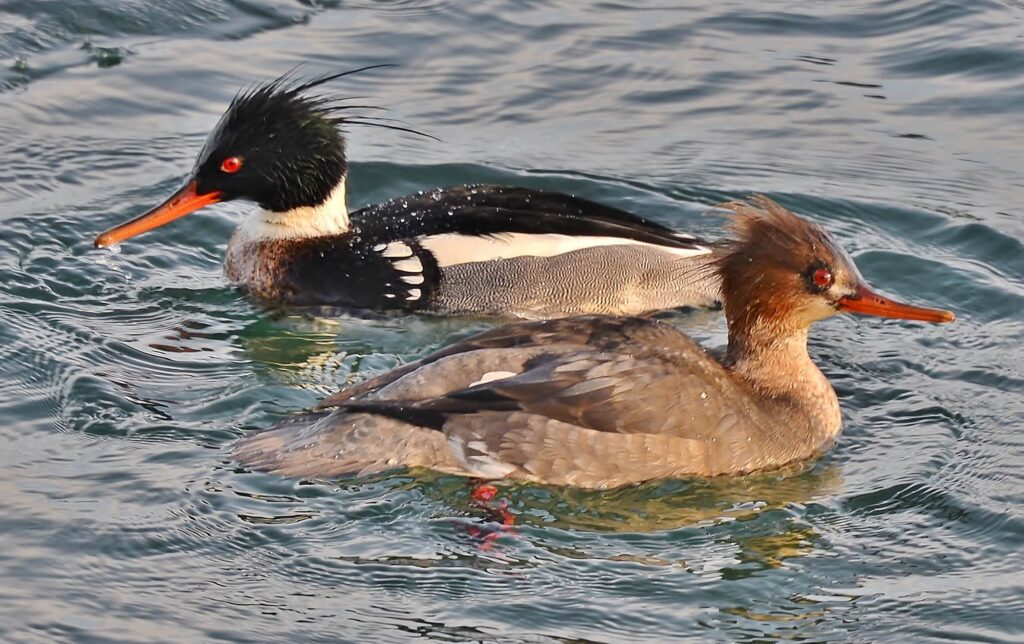
On water and from a distance, male red-breasted mergansers may appear black and paired with their long, thin reddish bill, someone could easily describe them as a black duck with an orange beak. But here’s the actual plumage of the duck:
The male has a dark head with a greenish sheen, a clean white neck, a rusty-colored breast, a black back, and pale underparts. It also shows a shaggy, spiky crest, along with a long, narrow red bill that has fine serrations along the edges. From afar, those contrasting colors can blend together, giving a much darker overall impression than the bird actually has. Females have rusty-brown heads and more greyish-brown bodies.
Quick Facts: The red-breasted merganser is found across much of the temperate to subarctic Northern Hemisphere. Its global population is considered stable, although in some areas it faces pressure from habitat loss and other environmental changes.
Scaly-sided Merganser
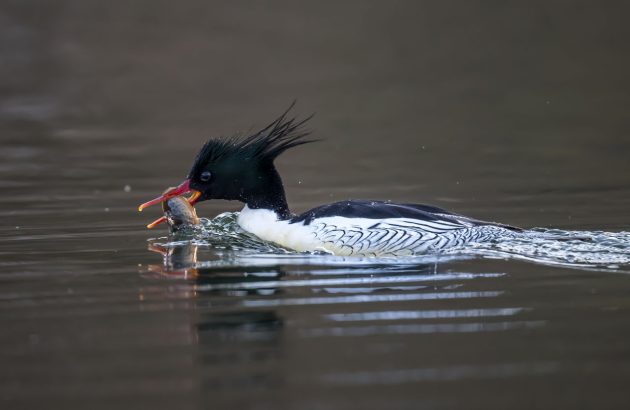
Another merganser that somebody may describe as a black duck with an orange bill, especially when it is sitting on the water, is the scaly-sided merganser. At a distance, the male can look quite dark overall, and its long, thin red bill may easily be perceived as orange.
Up close, though, the details tell a different story. The adult male has a black head and neck, with a white breast and underparts, and darker upperparts. The sides and rump show a distinctive scaled pattern, which gives the species its name. Like other mergansers, it also has a slim red bill and a slightly shaggy crest, which can be quite long in males. Females have warmer buffy heads and more grey in place of the male’s black.
Quick Facts: Scaly-sided mergansers breed along rivers in forested regions of the southeastern Russian Far East and parts of northeastern China. They prefer quiet, mid-sized rivers winding through mountain forests and are known for being shy and easily disturbed.
Discover other ducks with orange bills: 20 Ducks with Orange Bills (With Pictures & Detailed ID Guides)