
20 Ducks with Orange Bills (With Pictures & Detailed ID Guides)
A brightly colored bill can be a great clue when identifying ducks, and orange-beaked duck species are some of the most striking. But which ducks have orange beaks? Check out the list below for 20 most popular ducks with orange beaks from around the globe.
1. White-headed Steamer-Duck
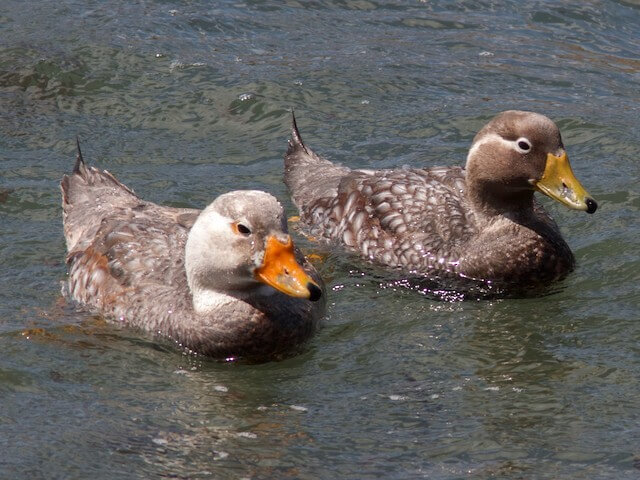
The White-headed Steamer-Duck is a flightless duck species found only in Argentina. Adult males have pale heads and bright yellow-orange bills with a black nail, while their feet and webs share the same yellow-orange color with black claws. Their bodies are mostly grey with white bellies, and during molting, the male’s bill becomes duller in shade.
This duck is remarkable not just for its bold appearance but also for its limited coastal habitat, which ranges from the southern San Matías Gulf to Islote Chato. Being flightless, it relies on strong swimming and diving skills to escape predators and search for food along rocky shores.
Discover other Flightless ducks: Flightless Ducks: 7 Iconic Ducks That Can’t Fly
2. Fuegian Steamer Duck
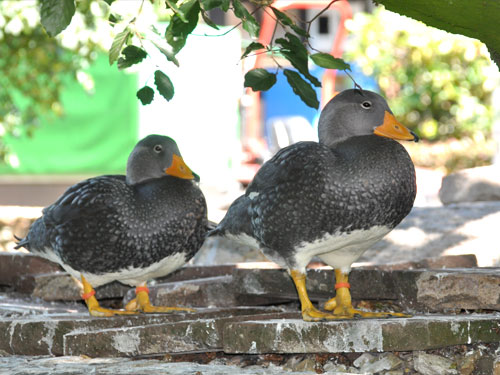
The Fuegian Steamer Duck is the largest of all the steamer ducks, with males weighing over 5 kg and measuring up to 84 cm in length.
Males have blue-gray heads and necks with pale crowns, narrow white eye-rings that continues as stripes, and reddish-brown throats, while females are darker with brown-gray heads and similarly reddish throats. Both sexes have white underbellies and grey tails, with females sometimes showing brown or wine-colored feathers.
This powerful, flightless duck is built for life in cold, coastal waters. It uses its size and strength to defend territory and forage along rocky shorelines, making it an impressive and dominant presence among South America’s waterfowl.
3. Falkland Steamer Duck
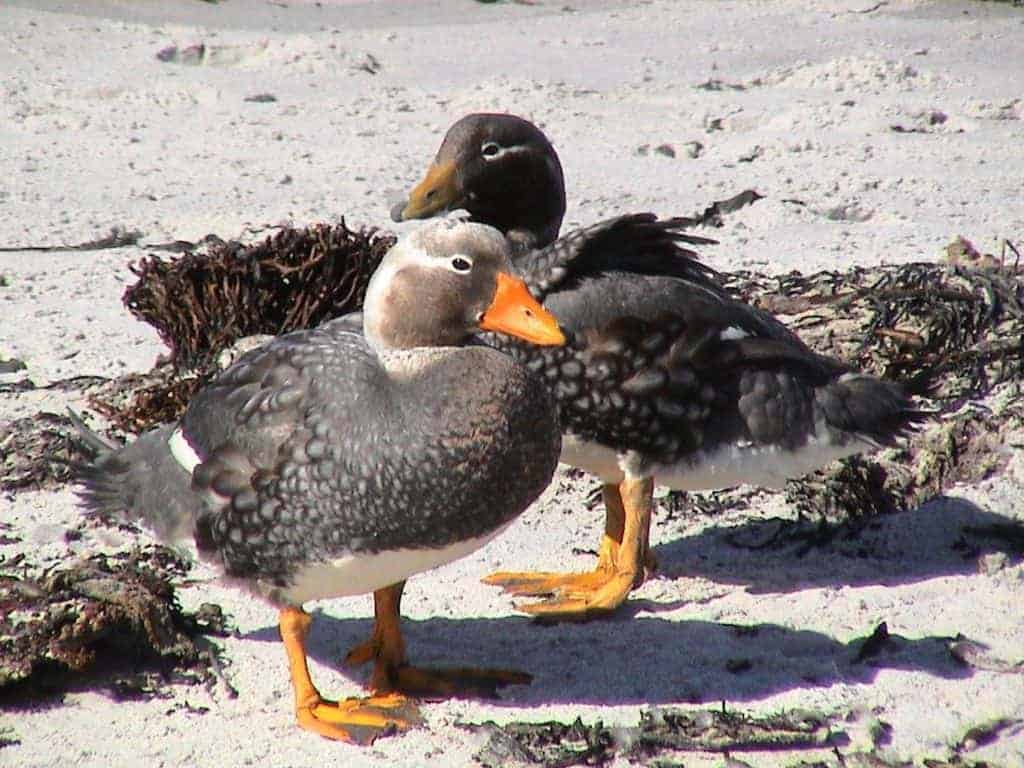
This is one of the only two bird species that are considered to be endemic to Falkland Islands. It is flightless like White-headed Steamer-Duck.
Males have a striking orange bill that stands out against their brown to grey plumage and light grey-white head, while females are darker with an olive-green bill. Both sexes share yellow-orange feet, a distinctive feature of this species.
Falkland Steamer Duck makes up for its inability to fly with powerful swimming skills and bold, territorial behavior. It shares its habitat with the flying steamer duck, but can be distinguished by its shorter wings, thicker neck, and robust bill.
4. Flying Steamer Duck
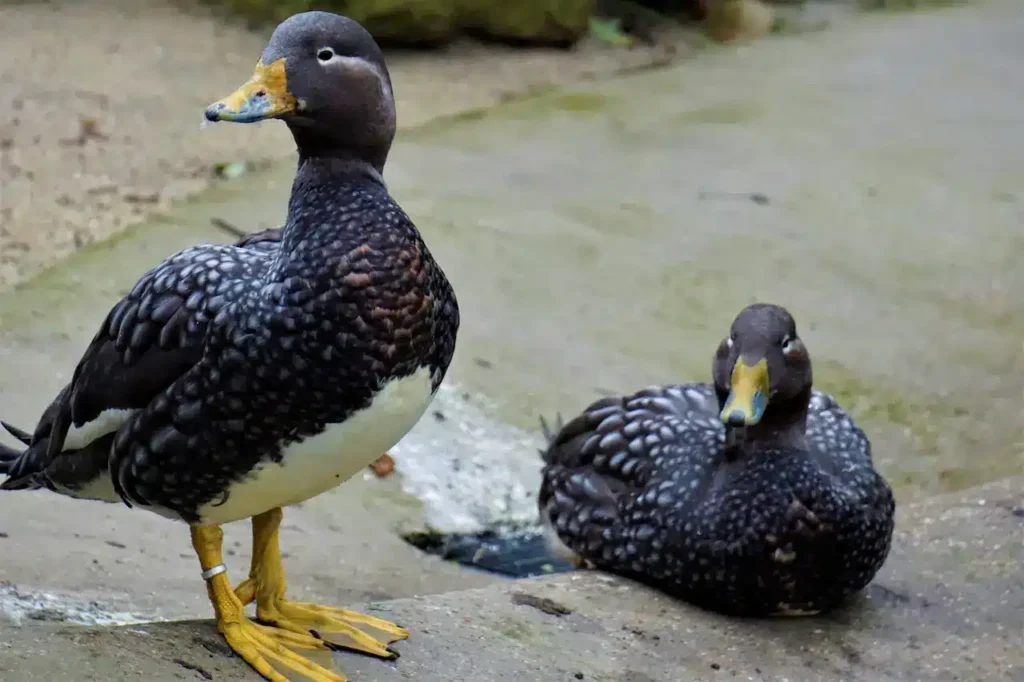
The Flying Steamer Duck is the only steamer duck capable of flight, although some large males are too heavy to take off.
They are the smallest of the four Tachyeres species but share the classic steamer duck look, with brown heads and necks marked by white stripes running from their eyes to the nape, and brown-gray gradient bodies. Their underbellies are mostly white, and both sexes have bright orange feet. Male bills are dark gray with subtle yellow accents, while females have smaller orange bills tipped with black.
These ducks are unique for living on inland freshwater areas as well as coastal waters in southern Chile, Argentina, Tierra del Fuego, and the Falkland Islands, showing remarkable adaptability in their habitat.
5. Buff Orpington Duck
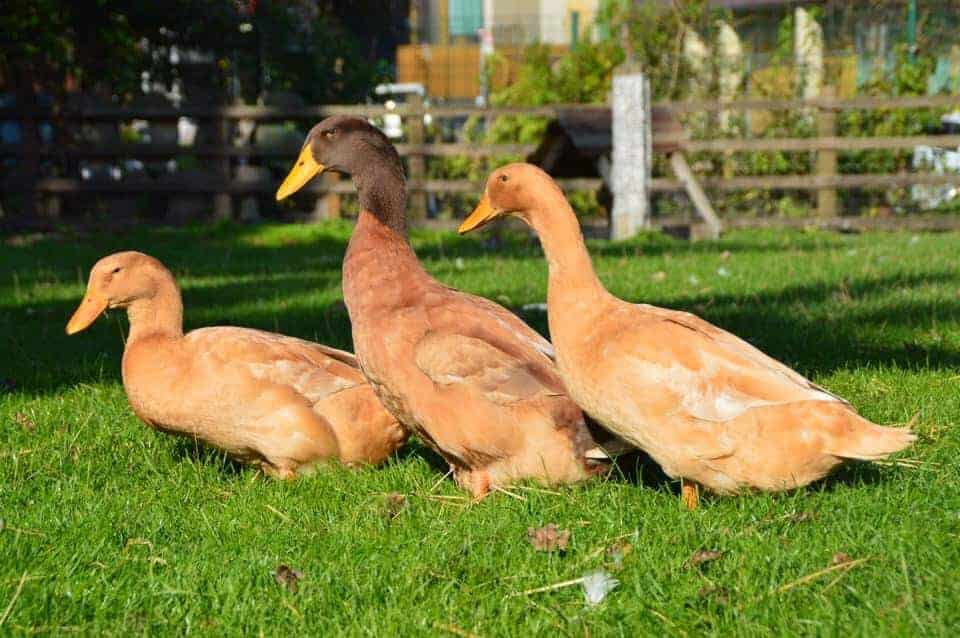
The Buff Orpington Duck is a domestic breed from England, developed in the early 20th century by William Cook. He created this warm buff-colored duck by crossing Cayuga, Runner, Aylesbury, and Rouen ducks.
Females have a distinctive brown-orange bill, which is why this breed is included in our list, while drakes have yellow bills.
This is a dual-purpose breed, valued for both meat and eggs, with females capable of laying up to 220 eggs a year. Buff Orpington Ducks are calm and friendly, and they adapt well to ponds, gardens, and small farm environments, making them a popular choice for backyard flocks.
6. Mottled Duck
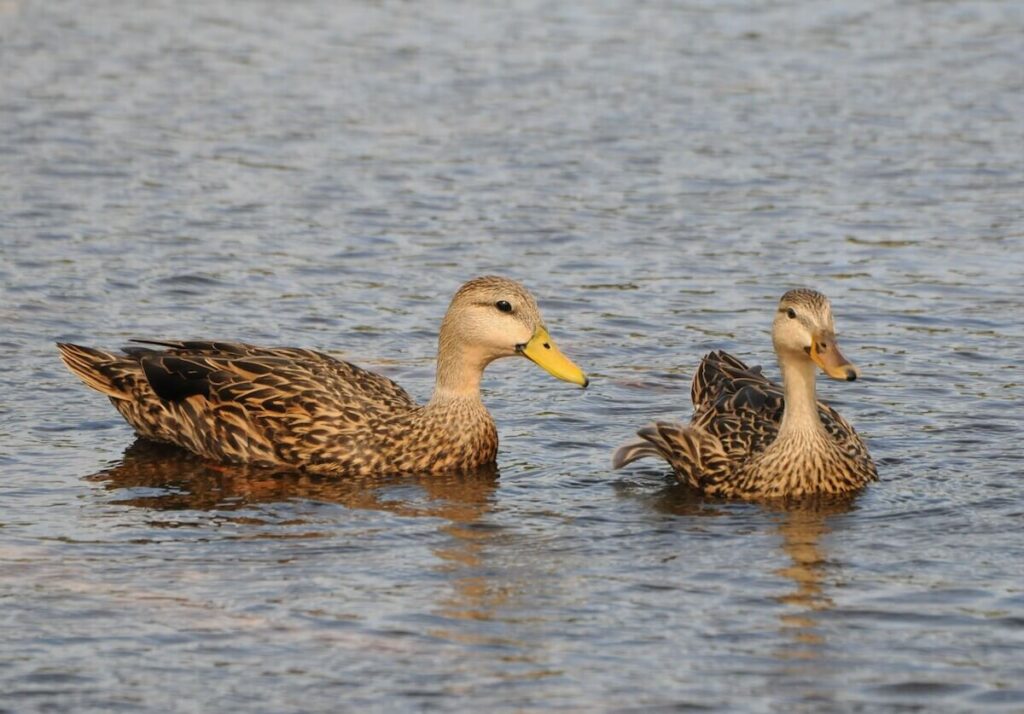
Approximately one out of every 20 Mottled Ducks is banded, which makes them highly valued by hunters.
Males have bright yellow bills, while females’ bills are orange and sometimes marked with dark spots. Their bodies are mostly dark, with lighter heads and necks, orange legs, and dark eyes.
Both males and females show a shiny green-blue patch on their wings and they can easily be confused with female mallards, but unlike mallards, their wing patches lack a white edge.
These ducks mostly stay along the Gulf of Mexico and don’t migrate far. Their darker feathers and colorful bills make them easy to spot and tell apart from similar ducks in flight.
Can you tell male and female mottled ducks apart? Discover key features to look out for here: Identifying Mottled Duck Male Vs Female
7. Cherry Valley Duck

The Cherry Valley Duck is a large, pure white Pekin hybrid with bright orange bills and legs, making it instantly recognizable. Both males and females look similar, though drakes are slightly bigger.
This breed is valued for its calm and docile temperament, which makes it easy to handle in both backyard flocks and large farms. A dual-purpose duck, it matures quickly for meat production while also laying 150–200 eggs a year, combining hardiness, adaptability, and productivity in one versatile package.
Discover other ducks with predominantly white plumages: Types of White Ducks: 16 Beautiful Breeds, With Pictures
8. Red-breasted Merganser
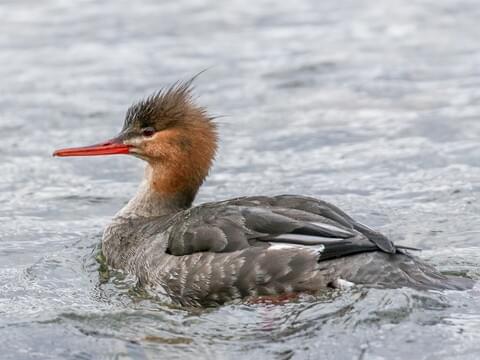
Native to much of the temperate and subarctic regions of the Northern Hemisphere, the Red-breasted Merganser is a striking diving duck.
Males show a dark head with a green sheen, a white neck, and a rusty red breast, while females and juveniles are mostly gray-brown with rusty heads. They have a long, thin red-orange bills with serrated edges, that are perfect for catching slippery fish underwater.
Known for their spiky crests and fast flight, these ducks dive skillfully to hunt small fish, aquatic insects, worms, crustaceans, and even amphibians.
9. Scaly-sided Merganser
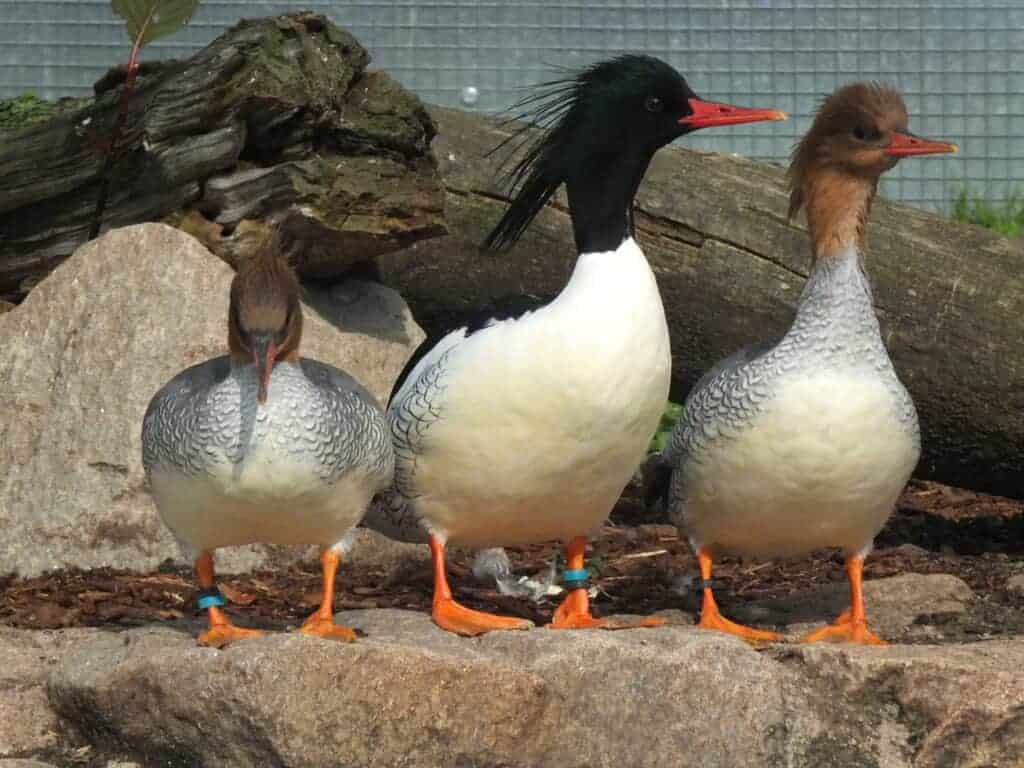
Also known as the Chinese Merganser, the Scaly-sided Merganser is an endangered diving duck found in Manchuria and southern Siberia, breeding in the north and wintering farther south. It has a bright orange-red bill and a long, shaggy crest, with males showing a nearly shoulder-length crest while females and young have shorter, wispy feathers.
Adult males display a black head and neck, white breast and underparts, and dark patterned wings, while both sexes feature the characteristic scaled markings along their body. These secretive ducks nest in trees near rivers, and their populations have declined due to loss of primary forests, making conservation efforts crucial for this rare species.
10. Stejneger’s Scoter
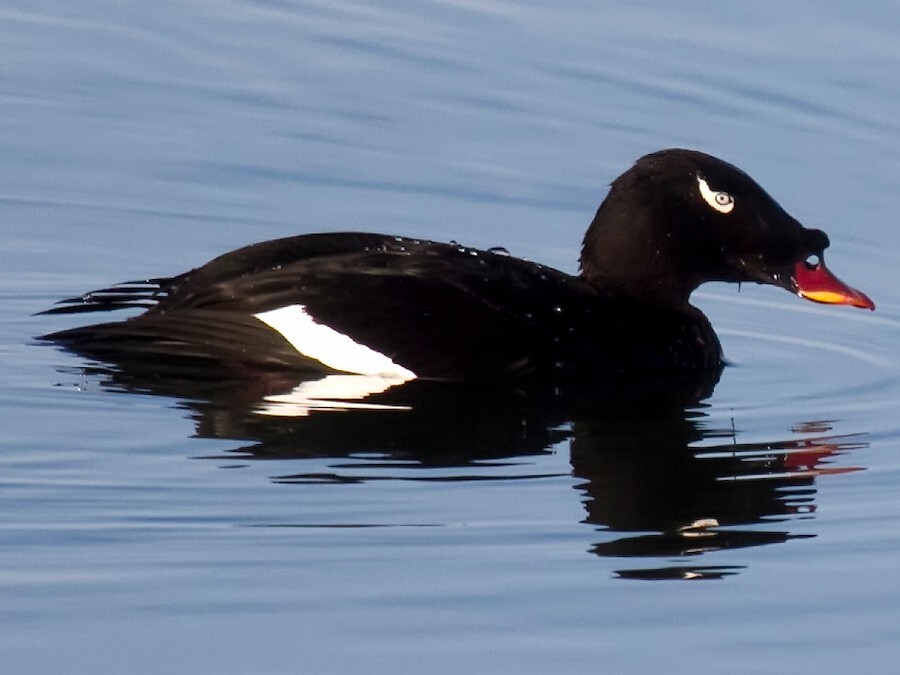
This is a large sea duck that breeds in the far northern regions of Asia, east of the Yenisey Basin, and winters in more temperate waters as far south as China.
Male Stejneger’s Scoters are striking, with a tall knob at the base of their mostly orange-yellow bills and a long “Roman nose” profile that distinguishes them from similar species. They form large coastal flocks during winter and prefer open waters for feeding.
These ducks are strong divers, hunting fish and other aquatic prey, and their unique bill shape and head profile make them a fascinating species for birdwatchers in their range.
11. Surf Scoter
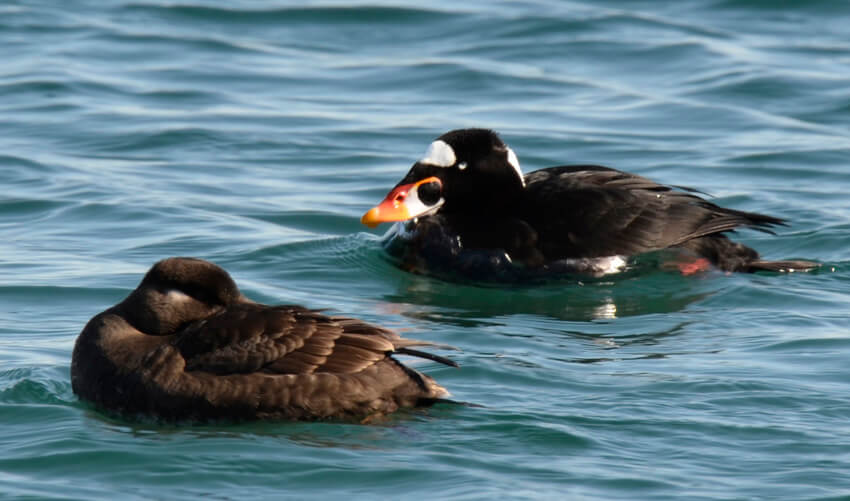
The Surf Scoter is native to North America and breeds in northern Canada and Alaska, wintering along the Pacific and Atlantic coasts.
Adult males are mostly black with distinctive white patches on the forehead and nape, while females are smaller and brown, with subtle pale patches on the cheeks and sometimes the nape. The bill of the male is swollen and patterned with orange, white, red, and yellow, with a black spot near the base while females have darker, simpler bills.
Surf Scoters are diving ducks that feed on mollusks and crustaceans, and their bold head markings and unique bill patterns make them easy to identify among other scoter species.
12. Velvet Scoter
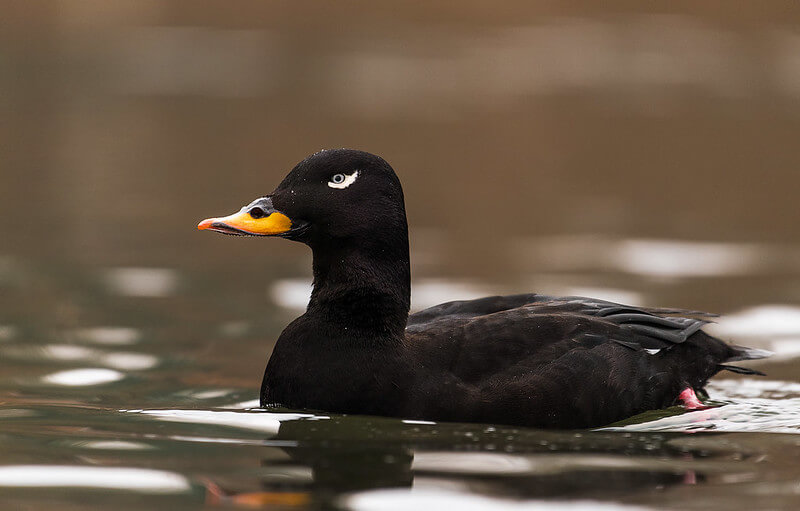
Another large sea duck, the Velvet Scoter has a thick neck, a long broad bill, and a pointed tail. Males are glossy black with large white wing patches and small white markings behind the eyes, while their partly orange bills stand out. Females look similar but are duller and browner, without the glossy feathers.
This species breeds across northern Europe, from Norway to central Siberia and northeast Kazakhstan, and winters farther south in temperate waters, including Great Britain and the Black and Caspian Seas.
Velvet Scoters are considered Vulnerable, facing threats from habitat loss and hunting, which makes their conservation an important priority.
13. White-winged Scoter
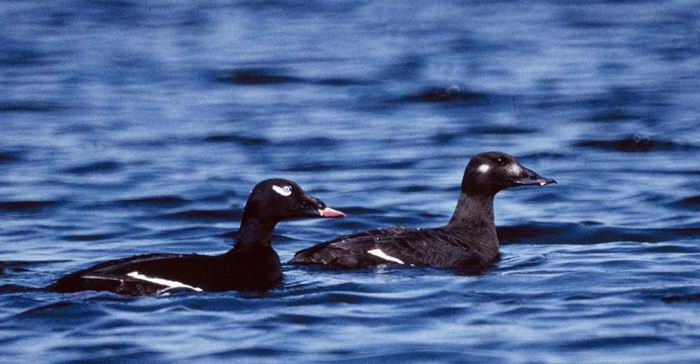
This is the largest of the North American scoters, with males weighing up to 2.1 kg and females up to nearly 2 kg. Adult males are mostly black with white around the eyes and a white wing patch, and they have a striking orange-red bill with a large black knob at the base. Females are brownish and can be recognized by their body shape and feathered gape. White-winged Scoters take three years to reach full adult plumage, with younger males showing browner flanks and reduced eye markings.
They breed across boreal forests from Alaska to Western Canada and winter farther south along the Great Lakes, northern U.S. coasts, and southern Canadian coasts, making them the scoter species with the largest breeding range in North America.
14. Northern (Borealis) Eider
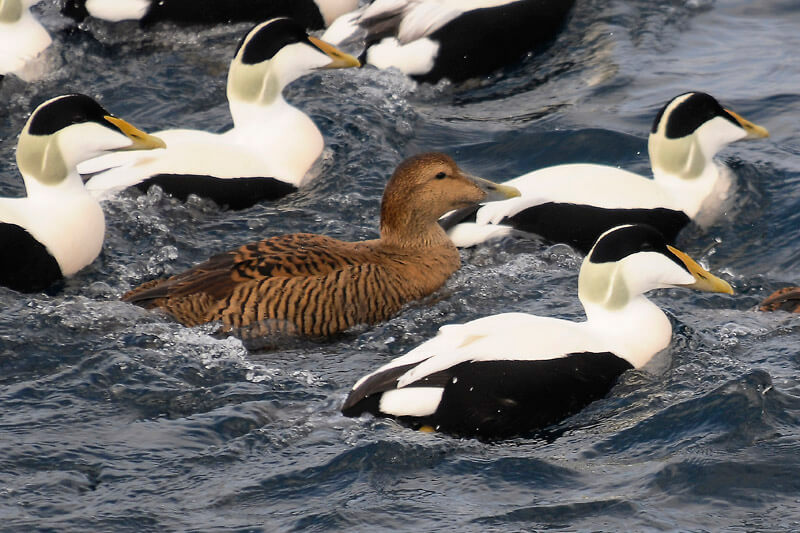
This is a large sea duck and a rare Arctic subspecies of the Common Eider. Males have bright orangey-yellow bills and legs, black-and-white plumage, and small upright “scapular sails” on the back. Females are duller but still show subtle differences from regular Common Eiders.
Native to the Arctic North Atlantic, Northern (Borealis) Eiders sometimes appear in Britain and Europe as winter visitors. They feed along coasts and their unique bill and plumage make them a special sight for keen birdwatchers.
15. Spectacled Eider
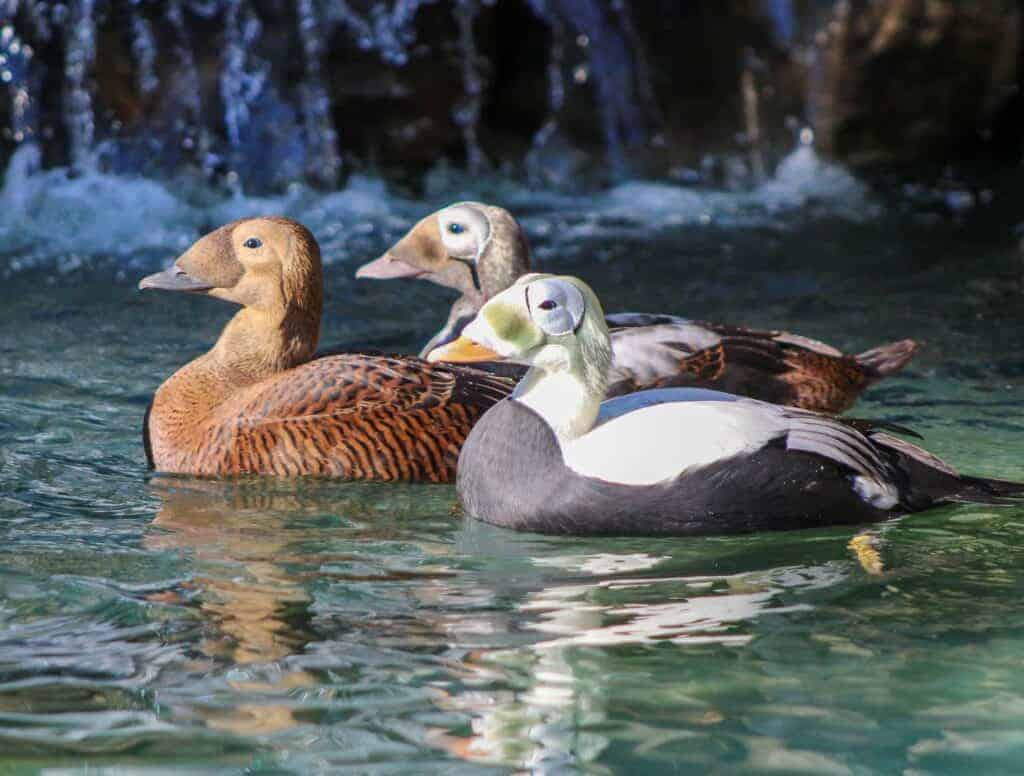
The Spectacled Eider is a medium-sized sea duck, slightly smaller than the Common Eider. Males have a black body, white back, yellow-green head, and striking circular white eye patches that give the species its name, along with a glowing yellow-orange bill. Females are rich brown, with paler “goggles” around the eyes that help identify them, while immature birds resemble the females.
Native to Arctic coastal areas, Spectacled Eiders are strong divers that feed on mollusks and other sea life. They are considered Threatened in the U.S., though globally they are listed as Least Concern, thanks to their stable population and wide range.
16. King Eider
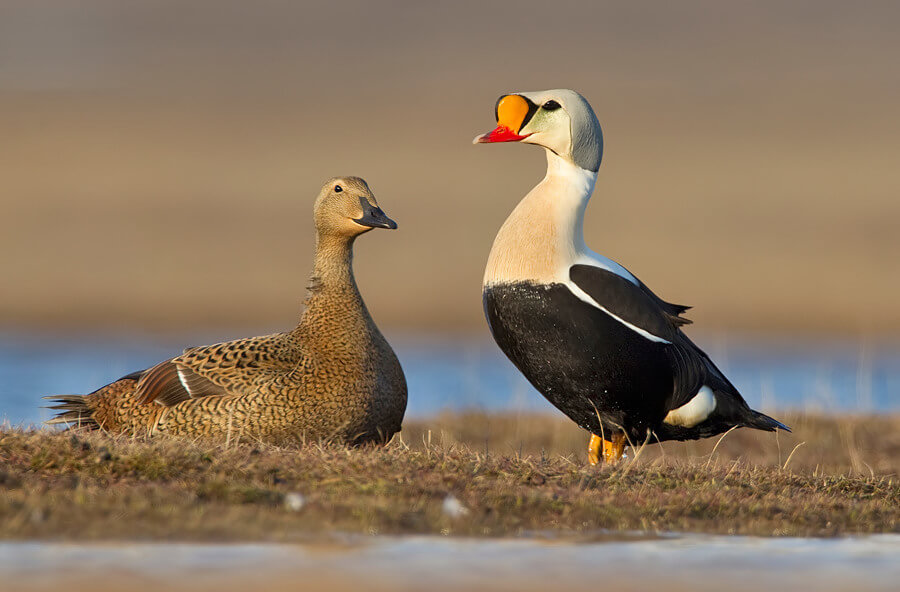
The King Eider is a large, striking sea duck known for its colorful breeding plumage. Males have a mostly black body, a buff-tinged white breast, and a multicolored head with pale blue-grey neck and nape, a pale green cheek, and a bright red-orange bill with a white tip and a large yellow knob. Females are warm brown with blackish chevrons on their body and fine streaks on the head and neck.
These ducks spend most of the year in coastal Arctic waters and migrate to tundra areas in Alaska, Canada, Greenland, Svalbard, and Russia to breed. They winter in subarctic seas, including the Bering Sea, Greenland’s west coast, eastern Canada, and northern Norway.
17. Black-bellied Whistling Duck
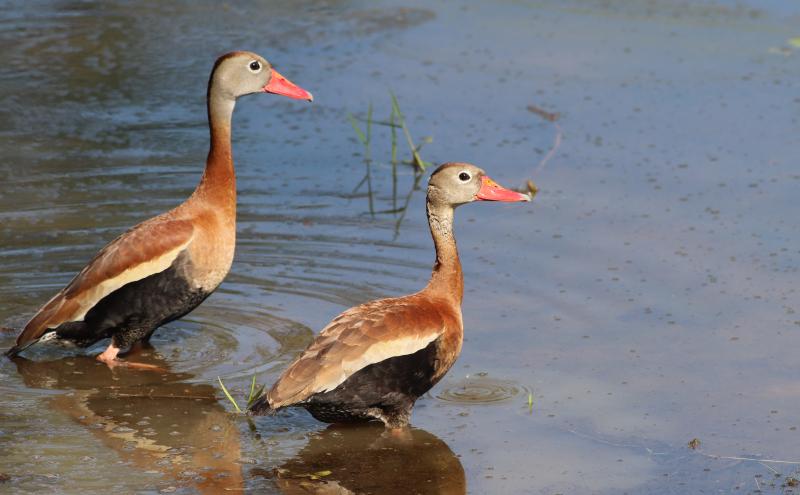
This is one of only two whistling duck species native to North America. It has a long pink to pinkish-orange bill and matching feet, along with a pale gray face, chestnut-brown body, and a bold black belly and tail.
Both males and females look alike, and the large white wing patches are easy to spot in flight. Known for its clear whistling calls, this duck is very social and often gathers in large flocks. It usually nests in tree cavities near water and is considered quite tame, even in the wild.
Can you tell male and female black-bellied whistling ducks apart? Discover key features to look out for here: Identifying Male vs Female Black-bellied Whistling Ducks
18. Laysan Teal
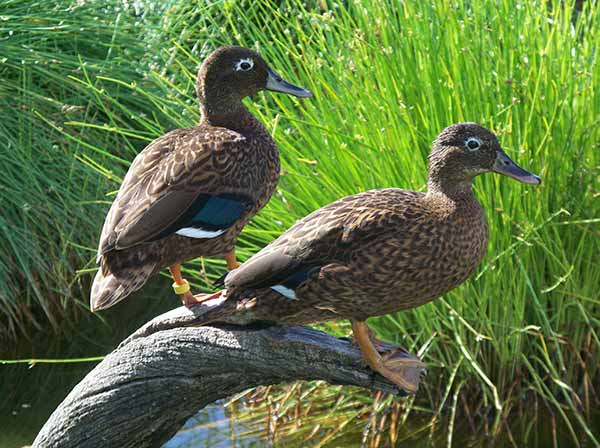
Also known as the Laysan duck or koloa pōhaka, this small duck is found only in the Hawaiian Islands. It has a dark brown body with a clear white eye-ring, while males have a dark green bill with black blotches and females have a dull orange bill with similar markings.
This species is a poor flyer and often chooses to freeze in place when threatened instead of flying away. It spends much of its time walking and foraging on land, showing a unique adaptation compared to most other ducks.
19. Saxony Duck
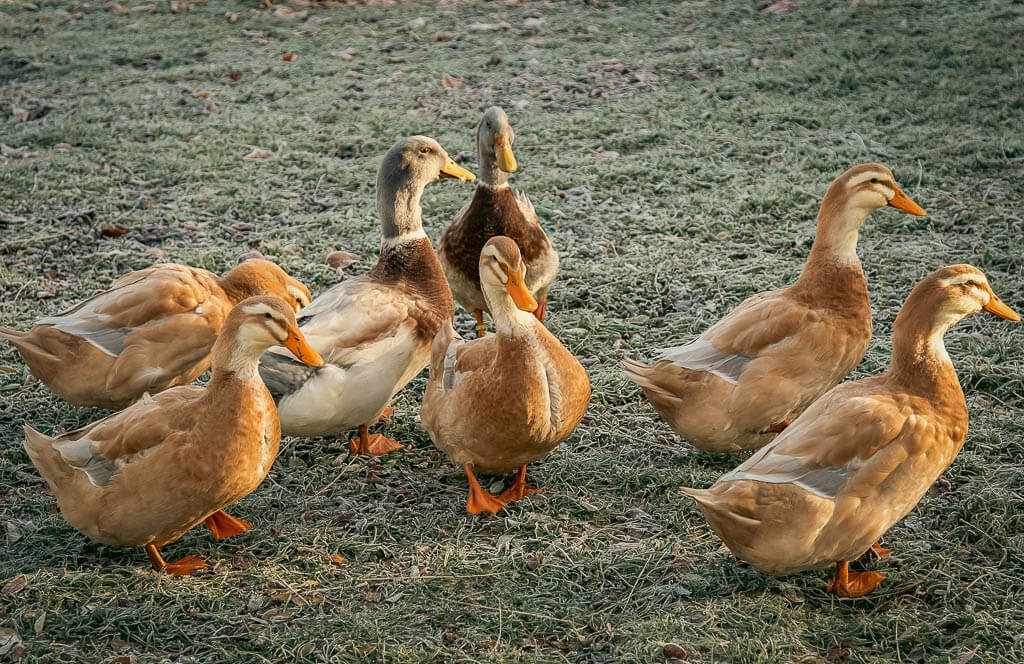
The Saxony Duck is a German domestic breed developed in the 1930s, with both males and females showing a yellow-orange bill and bright orange legs and feet. It is a heavy, well-built duck with a broad body, deep breast, and a smooth, close-feathered appearance.
This is a dual-purpose breed, raised for both meat and eggs. Females typically lay around 80 to 100 eggs a year, making them useful for small farms. Despite being developed earlier, the breed was only officially recognized in 1957 due to disruptions caused by World War II.
20. Golden Cascade
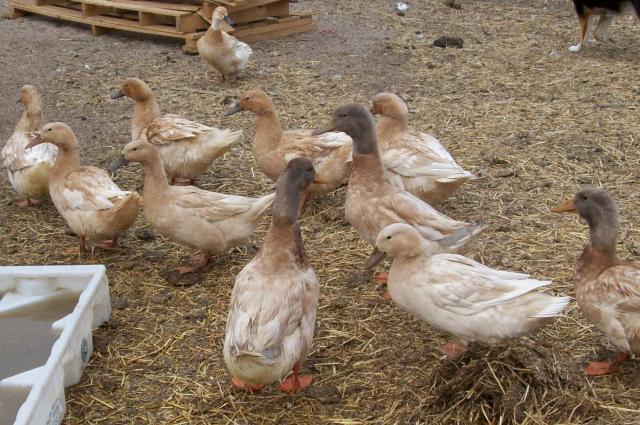
Our final duck species with an orange beak is the Golden Cascade, a domestic breed developed in the United States by David Holderread in the late 1970s.
Females have fawn or buff plumage and orange bills with brown markings, while males display a satin green or bronze head, a white neck ring, reddish breast, and a yellow bill.
This breed was created to grow quickly, lay well, and be active, and it is also auto-sexing, meaning males and females can be distinguished at hatching. Weighing 6–8 pounds (2.7–3.6 kg), Golden Cascades are hardy and versatile, making them popular for both small farms and backyard flocks.