16 Black and White Diving Ducks (With Pictures)
One thing I really enjoy about watching diving ducks is their classic “now-you-see-them, now-you-don’t” behavior. One moment they’re floating calmly on the water, and the next they vanish beneath the surface, often reappearing several meters away. This constant disappearing act makes them fascinating to observe, especially when you’re trying to keep track of them.
Black and white diving ducks are particularly breathtaking to watch during this display. Their bold coloration creates a striking contrast against the water, making them stand out even as they pop in and out of sight. Beyond appearance, this coloration also serves important purposes such as helping with camouflage from predators and playing a role in courtship, where strong visual patterns can attract mates.
Check out these 16 black and white diving ducks and discover how to identify them, along with other key details about their behavior, habitat, and more.
1. Bufflehead
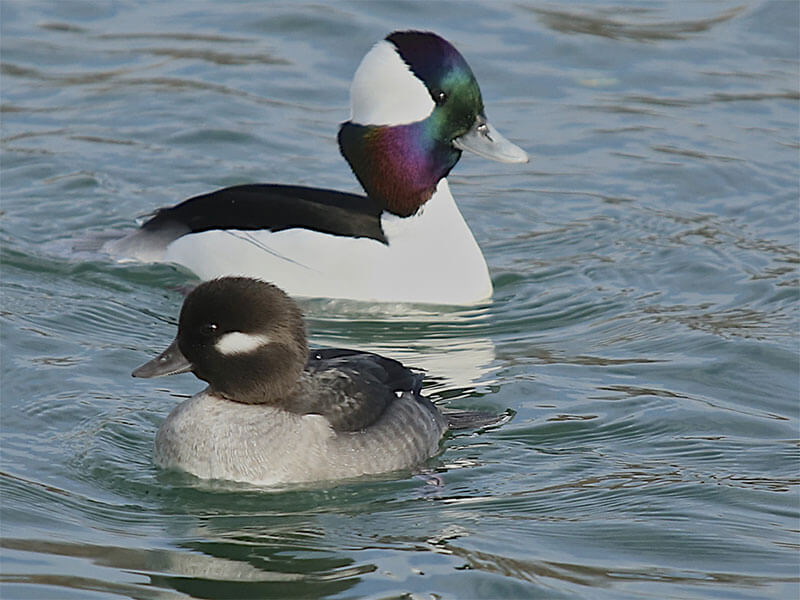
A tiny diver with a big personality, the Bufflehead stands out with its bold black-and-white plumage. The male is especially eye-catching, with a shiny dark head that flashes green and purple in the light and a large white patch behind the eye. Females are more subtle, with grey tones, a pale underside, and a smaller white patch on the head.
These ducks are highly active divers, so you are likely to see them constantly dipping below the water in search of food to keep up with their fast metabolism. Unlike many ducks, they usually stay in small groups rather than large flocks.
Buffleheads nest in old woodpecker holes, particularly those made by northern flickers, and their small size helps them fit neatly into these tight tree spaces. During winter, they move to coastal waters and inland lakes across North America, where they continue their busy, diving lifestyle.
2. Common Goldeneye
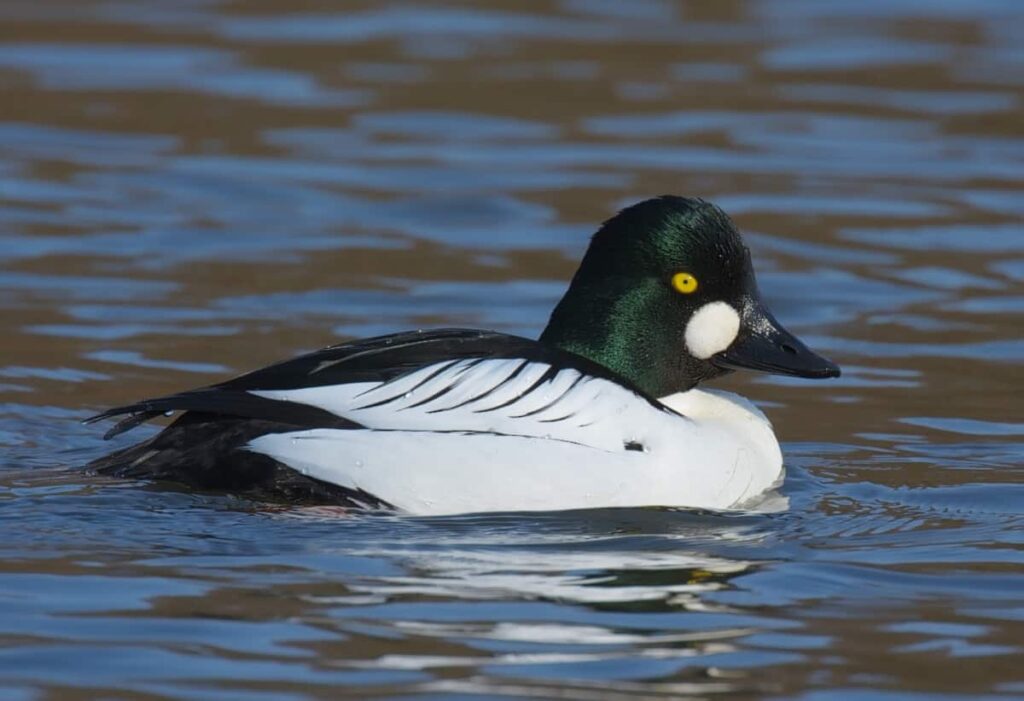
Common Goldeneye is named after its striking golden-yellow eyes, which shine brightly against the male’s dark, glossy green head and round white cheek patch. His back is dark, and his neck and belly are crisp white. The female wears a brown head and mostly grey body. Both sexes sport orange-yellow legs and feet.
These ducks breed in the boreal forests of the taiga, and tend to nest in tree cavities that they often return to year after year. They will readily use nest boxes too. Aggressive and territorial, males perform elaborate courtship displays, and the species is highly migratory, wintering in protected coastal waters or inland lakes at more temperate latitudes.
3. Barrow’s Goldeneye
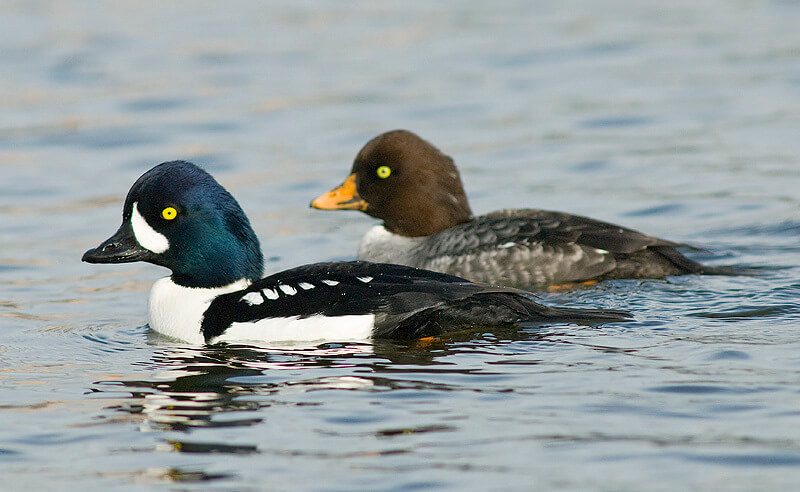
Barrow’s Goldeneye was named in honor of Sir John Barrow and is a close cousin of the Common Goldeneye. They share the striking black-and-white plumage that makes goldeneyes so distinctive. Adult males have a dark head with a purplish sheen and a white crescent at the front of the face, while females display a mostly yellow bill and a rounded head. Compared with the Common Goldeneye, males have more black on the back, a purpler gloss, and a slightly smaller bill, while females have subtle differences in head shape and bill coloration.
These ducks breed on wooded lakes and ponds, primarily in northwestern North America, with scattered populations in eastern Canada and Iceland. Female Barrow’s Goldeneyes show strong site fidelity, returning to the same breeding grounds and even the same nest sites year after year, ensuring continuity across generations.
4. Long-Tailed Duck
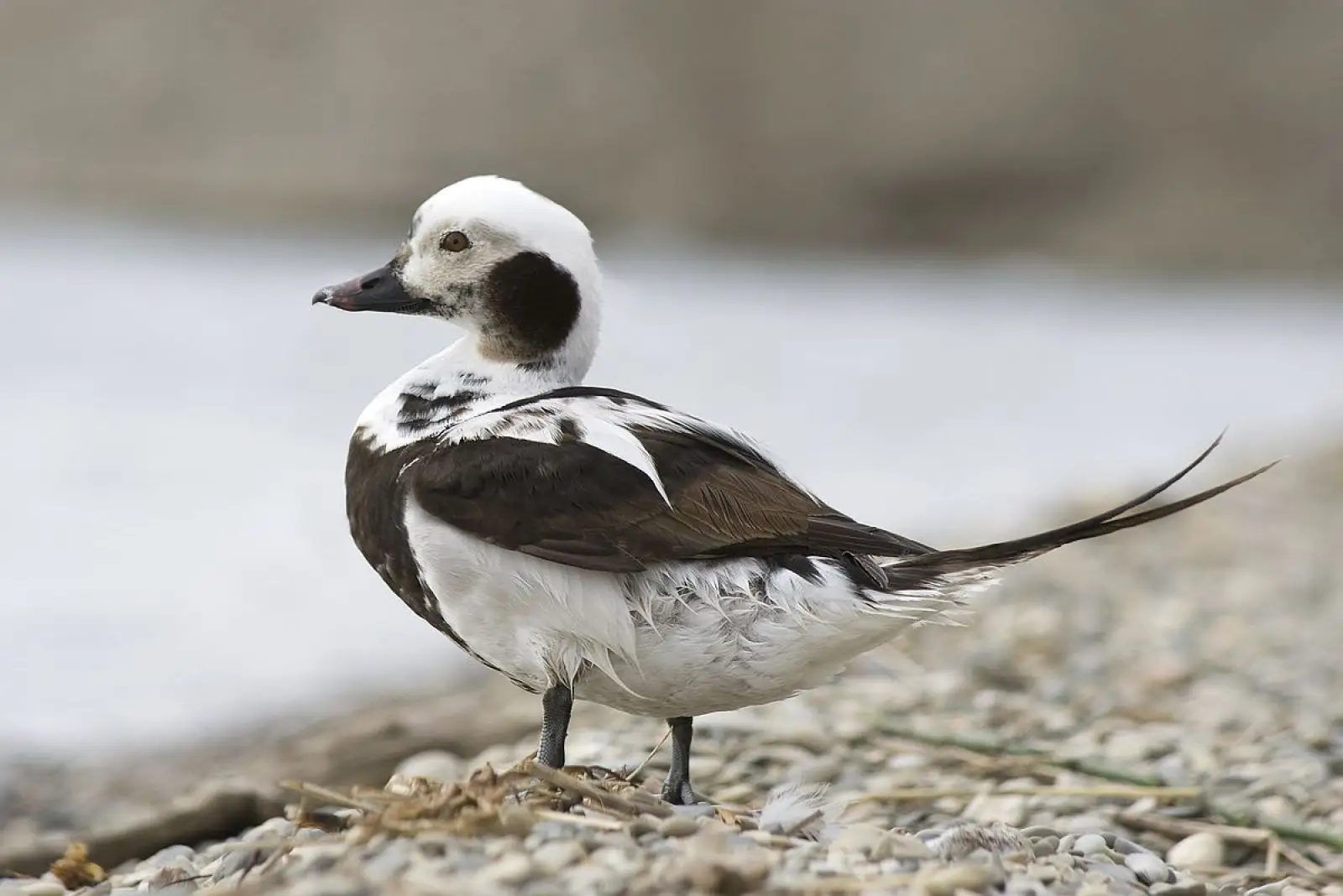
The Long-Tailed Duck is a striking medium-sized sea duck, instantly recognizable by the male’s long pointed tail and the dramatic seasonal changes in plumage. In winter, males display a mostly white body with a dark cheek patch, while in summer they show a dark head, neck, and back with a contrasting white cheek patch. Females are more subtle, with a brown back and shorter pointed tail, and like the males, their head coloration shifts between seasons.
They breed in tundra pools, marshes, and northern mountain lakes, and winter along the northern coastlines of the Atlantic and Pacific Oceans. Highly social, they gather in large flocks during migration and winter, diving frequently for mollusks, crustaceans, and small fish to fuel their energy-demanding lifestyle.
5. Smew
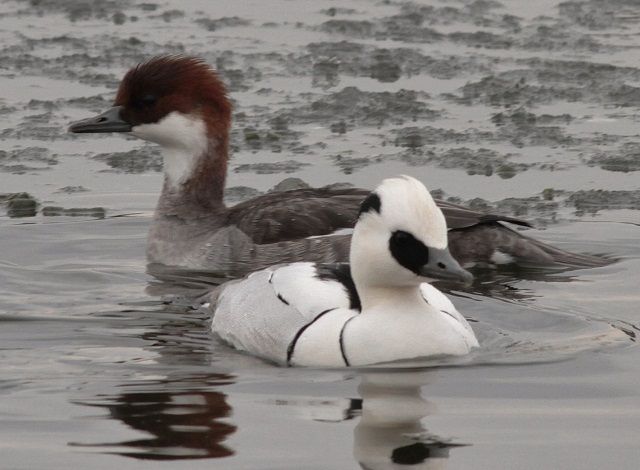
The Smew is another striking black-and-white diving duck, with the adult male often nicknamed the “panda duck” or “cracked ice” for its bold pattern. Females and immature males, called “redheads”, are mostly grey with a chestnut forehead, white chin and cheeks, and dark lores. Young males gain the adult black-and-white plumage at around 8–10 months, while adult males adopt a lighter eclipse plumage in late summer and autumn.
Equipped with a hooked, serrated bill, Smews are expert fish catchers, and often dive efficiently in fish-rich lakes and slow rivers. They breed across the northern taiga of the Palearctic, from Scandinavia to Chukotka, and rely on tree cavities for nesting. In flight, their oval white wing patches make them unmistakable among other diving ducks.
6. Tufted Duck

The Tufted Duck is instantly recognizable by the male’s prominent head tuft, glossy black body, and contrasting white flanks, paired with golden-yellow eyes and a blue-grey bill. Females are more subdued, brown with lighter flanks, and sometimes show white at the base of the bill, which can make them look a little like scaups.
Partially migratory, Tufted Ducks breed across temperate and northern Eurasia. The males are mostly silent but give a soft whistle during courtship, while females are more vocal, producing a harsh, growling “karr”, usually in flight. These ducks are expert divers, feeding primarily on aquatic invertebrates and plant matter in lakes and slow rivers.
7. Common Eider
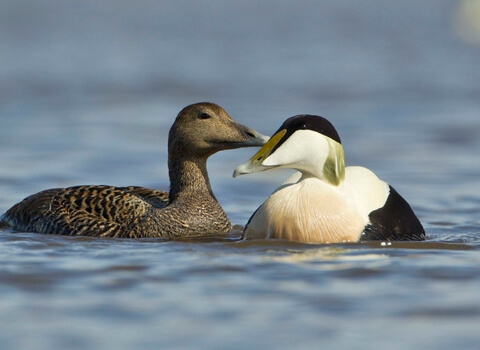
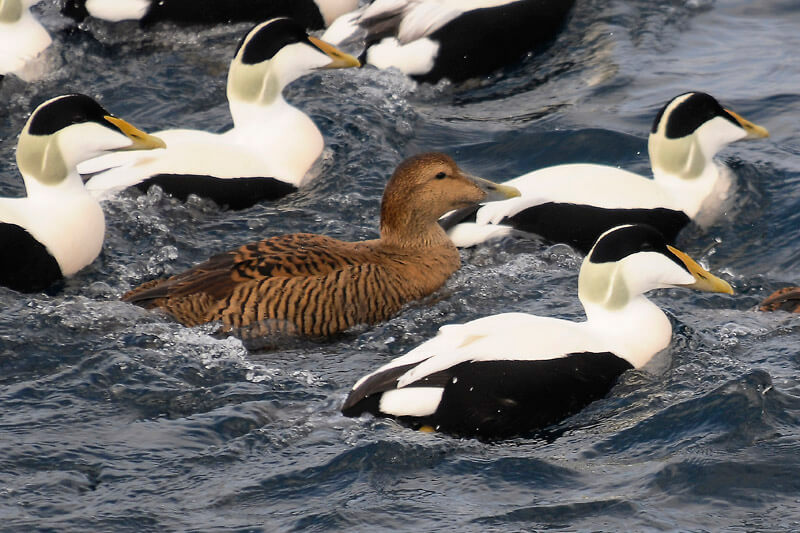
Also known as St. Cuthbert’s duck or Cuddy’s duck, the Common Eider is a large sea duck measuring 50–71 cm (20–28 in). The male is striking, with black-and-white plumage and a green nape, while the female is a warm brown, distinguishable by her large size and unique head shape.
Breeding in the Arctic and northern temperate regions, Common Eiders migrate slightly south in winter, forming large coastal flocks. Remarkably strong fliers, they can reach speeds of up to 113 km/h (70 mph). Males perform odd, almost human-like display calls during courtship, which adds an unusual touch to their coastal breeding rituals.
8. Common Merganser
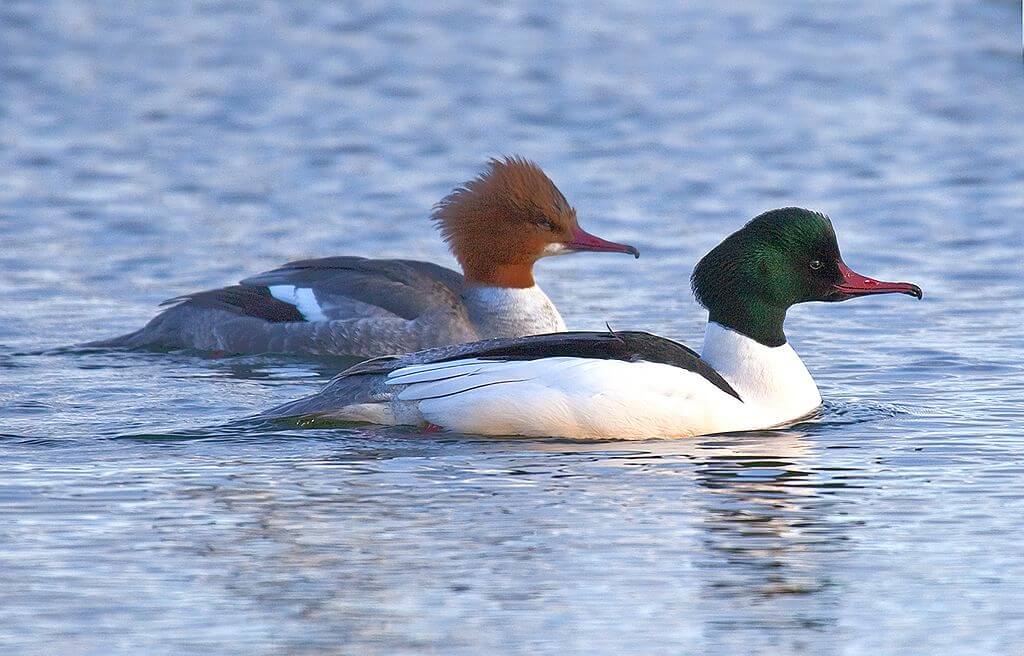
Common Mergansers, or goosanders in Eurasia, are large diving ducks with a striking black-and-white pattern in breeding males. Breeding males are particularly easy to recognize with their white body, dark back, and shiny green head. Females and immature males are mostly gray with cinnamon-red heads and white throats, showing a softer, less contrasting palette.
These ducks are fish-eating specialists, with serrated “sawbills” that grip slippery prey underwater. They nest in tree cavities near water and are known for returning to the same sites each year. Their diet isn’t limited to fish though as they also eat molluscs, crustaceans, insect larvae, and occasionally small birds or mammals, making them versatile aquatic hunters.
9. Ring-necked Ducks
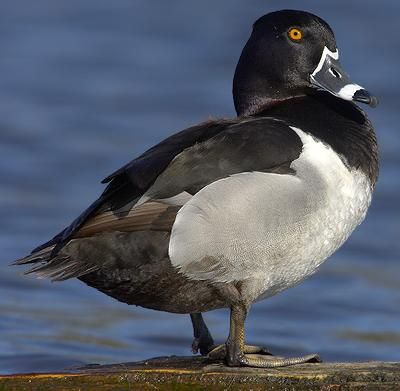
Ring-necked Ducks are medium-sized diving ducks with a sleek, angular shape. Adult males show a striking black-and-white pattern similar to their relative, the Eurasian tufted duck: shiny black head and back, white breast, a white wing line, and two white rings around a gray bill, with bright yellow eyes. Females are more subdued, with gray-brown bodies, a dark back, subtle bill markings, grayish-blue feet, and brown eyes encircled by white; they also give a soft “trrr” call. These ducks feed by diving or dabbling, and the ducklings rely on small animals like insects, snails, and worms for food.
10. King Eider
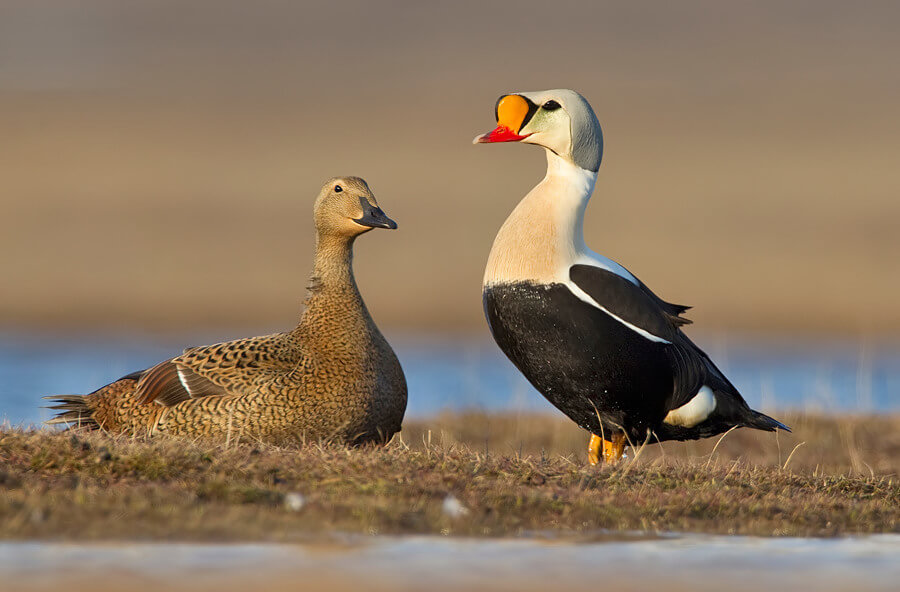
Another striking black-and-white diving duck is the male King Eider. It stands out with a mostly black body, buff-tinged white breast, and a multicolored head, which is pale bluish-grey on the head, nape, and neck, with a pale green cheek and a bright red bill topped by a yellow knob. Some back feathers curve upward like tiny spurs, adding to his dramatic appearance. Females are more understated, warm brown with fine black streaks and chevron markings, a buffy eye ring, and a subtle spot at the base of their bill.
King Eiders breed along Arctic coasts across Alaska, Canada, Greenland, Svalbard, and Russia, and migrate to winter in arctic and subarctic marine waters, including the Bering Sea and northern Norway.
11. Northern ‘Borealis’ Eider
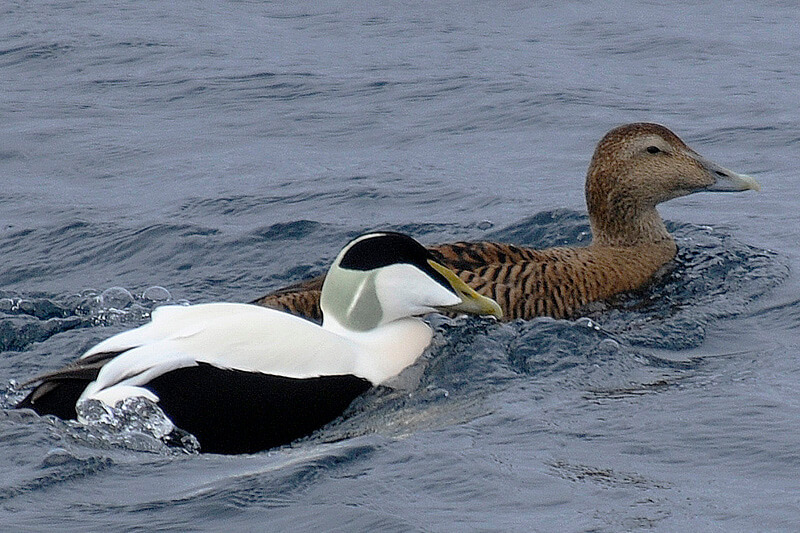
The next black-and-white diving duck is the Northern Eider (Somateria mollissima borealis), a rare Arctic form of the Common Eider. Males resemble typical Common Eiders but show small scapular “sails” on their backs and a bright yellow-orange bill and legs. The bill is slightly longer, droops at the tip, and has distinctive lobes and black edging.
In Britain, Northern Eiders are very rare, usually appearing in small numbers alongside Common Eiders. Subtle differences in plumage, bill, and leg color make them a prized sight for keen birders. Other vagrant Eider forms, like Dreser’s Eider, have also been recorded, highlighting the hidden diversity within this familiar sea duck.
12. Scaly-sided Merganser
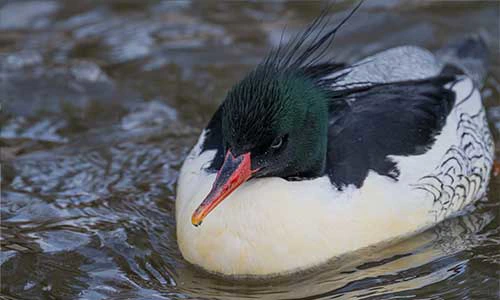
Another merganser that we can say is black and white is the Scaly-sided Merganser (Mergus squamatus), an endangered species found in Manchuria and southeastern Siberia. Adult males are striking, with a black head and neck, white breast and underparts, blackish mantle and wings, and a thin red bill. Both sexes sport a wispy crest, longer in males, and the flanks show a distinctive scaled pattern. Females replace much of the black with grey and have a buffish head. Their legs are orange-red, and their dark eyes give them a sharp, alert look. This merganser breeds in the north and winters farther south, often in forested rivers.
13. Spectacled Eider
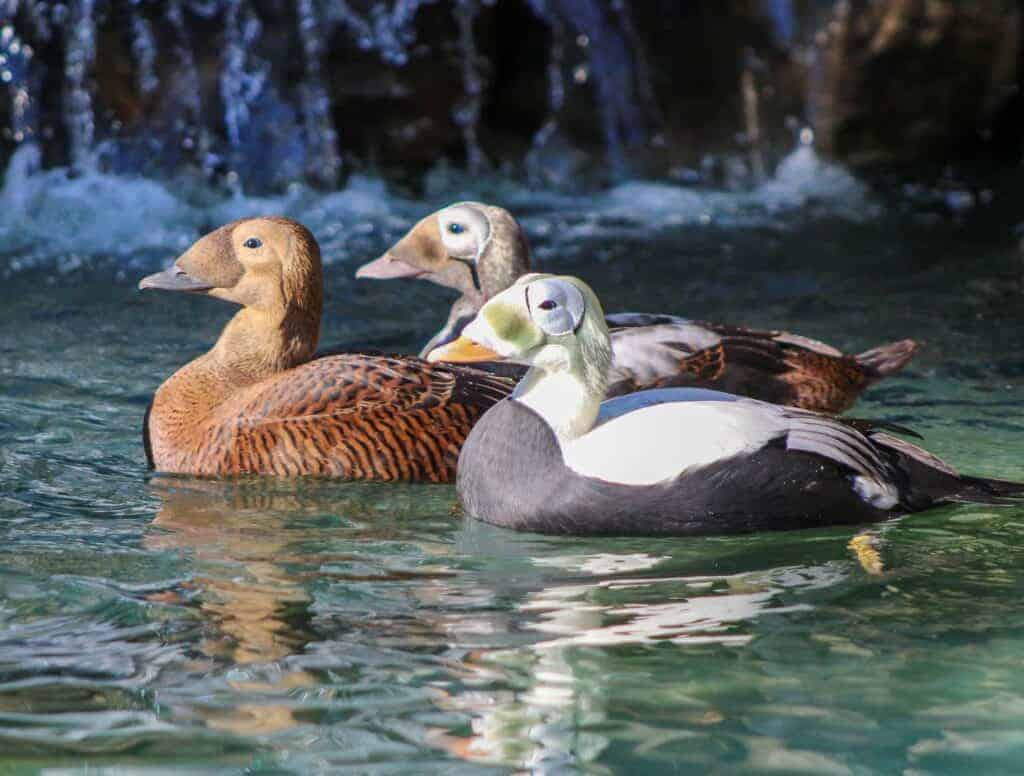
Slightly smaller than the Common Eider, the Spectacled Eider is instantly recognizable by the male’s black body, white back, and yellow-green head adorned with large white “spectacle” patches around the eyes. Females are rich brown but can still be identified by their pale eye markings and robust size. These sea ducks breed along the coasts of Alaska, eastern Russia, and the Bering Sea, with males giving a soft crooning call and females a harsh croak.
14. Steller’s Eider
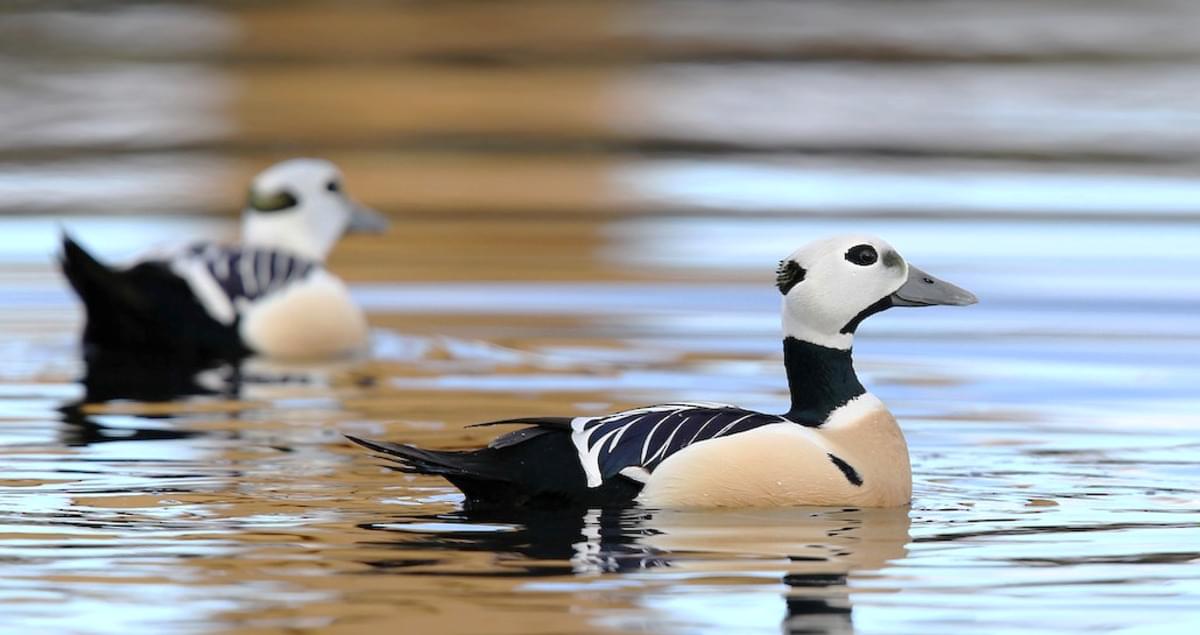
Another eider that we can also include in our list of black-and-white diving ducks is the Steller’s Eider. This small, fast-flying Arctic sea duck breeds along the coasts of Russia, Alaska, and the Baltic Sea. The male is unmistakable in breeding plumage, with a black cap, chin, collar, eye-ring, and rump, contrasted by a white head and shoulders, light green patches near the eyes, and a cinnamon breast marked with a black spot. Females and juveniles are shades of brown with pale eye-rings and subtle white-edged wing feathers. Both sexes display an iridescent bluish-purple speculum on their wings, and their compact bodies, relatively long tails, and thick bills make them highly distinctive among eiders.
15. Greater Scaup
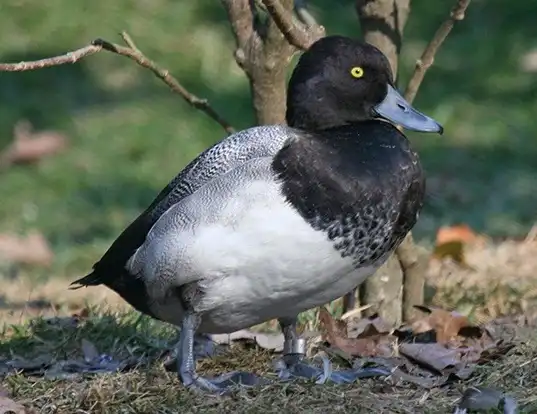
Another duck that also meets our black-and-white diving duck description, especially when you observe it from afar, is the male Greater Scaup. From a distance, the contrast of its dark head and breast against the white belly and wing stripe makes it instantly recognizable. Males sport a green to purple iridescent head, pale grey upperparts, and a bold white wing stripe, while females are mostly brown with white wing and facial patches. Both sexes have blue-grey bills and yellow eyes. Greater scaup nest near water—on islands or floating mats of vegetation—and dive for mollusks, plants, and insects, sometimes reaching depths of 6 meters, rarely 10. They are social and form massive wintering flocks, known as “rafts,” that can number in the thousands.
16. Lesser Scaup
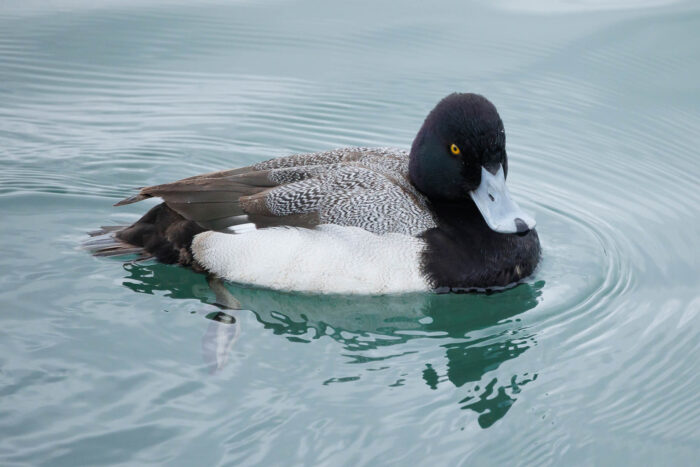
Finally, if Greater Scaup is on our list, the next obvious duck species to include is the Lesser Scaup, due to their high resemblance. Adult males display a glossy black head with a small tuft, black breast, whitish-grey back, and striking white underparts. Their wings show dark vermiculations with a prominent white patch on the secondaries, while the tail and rectrices are black. Females are mostly dark brown with a subtle white band at the base of the bill and a lighter ear region. Compared to Greater Scaup, Lesser Scaup are smaller, less bulky, and have a narrower, straighter bill. In flight, the white secondary wing patch is the key feature that sets them apart.