
15 Brown Ducks in Florida: ID and Viewing Locations Guide
Among the Indigenous peoples of the Southeastern Woodlands, including the Seminole, Miccosukee, Timucua, and Apalachee, birds were often seen as messengers between the spirit world and the physical realm. In that sense, brown ducks can be viewed as symbols of a grounded connection to the earth, reflecting qualities like home, reliability, simplicity, and consistency.
But which duck species in Florida are actually brown? Around 15 species show predominantly brown plumage, and below we highlight how to identify them and tell them apart in the field.
1. Mottled Duck
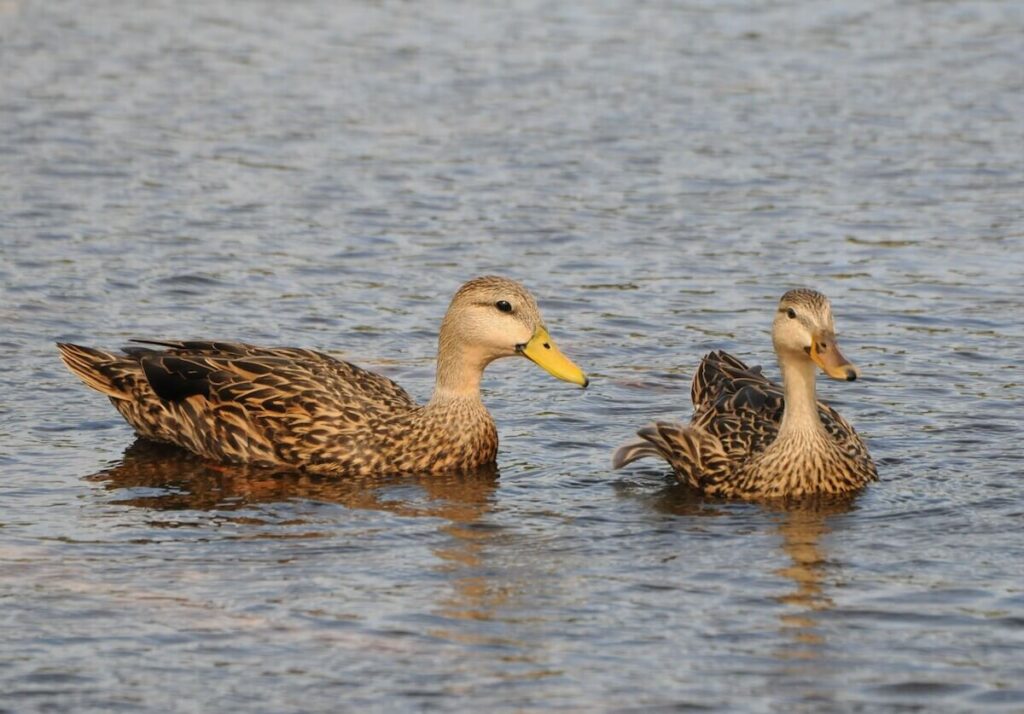
The Mottled Duck is a medium-sized dabbling duck and one of the most familiar brown ducks in Florida. Its plumage is dominated by rich, earthy brown tones, giving it a dark, mottled appearance across the body, while the head and neck are slightly lighter, creating a subtle contrast. This overall brown coloration helps it blend seamlessly into marshy and coastal environments.
A key feature is the glossy green-blue speculum on the wing, which lacks the bold white borders seen in Mallards, making it a useful identification clue. Males and females look very similar, though the male shows a bright yellow bill, while the female’s bill is orange with darker markings. Check out more tips on how to differentiate males from females here: Identifying Mottled Duck Male Vs Female
This species is a year-round resident in Florida and is especially common in wetlands, marshes, and coastal habitats. One of the most popular locations you can find these ducks is the J.N. “Ding” Darling National Wildlife Refuge, where it thrives in shallow, vegetated waters.
2. Black-bellied Whistling-Duck
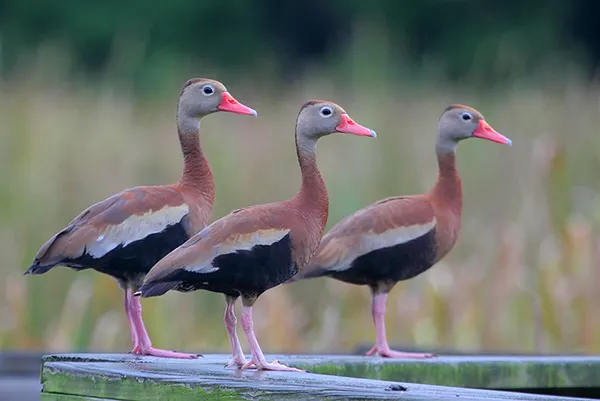
Whistling ducks are named after their distinctive high-pitched calls, and one of the most common you are likely to find in Florida is the Black-bellied Whistling-Duck.
Although not entirely brown, this species shows a strong brown presence in its plumage. The body is a rich chestnut tone, especially across the back, neck, and upperparts, giving it a warm, earthy appearance. This is contrasted by a pale gray face and a black belly and tail.
Its long pink bill, long legs, and upright posture make it stand out from more typical ducks. Males and females look alike, while juveniles appear slightly duller with a gray bill and less contrast overall. Here is how to tell males and females apart: The Key to Identifying Male vs Female Black-bellied Whistling Ducks
This species commonly nests in tree cavities, including hollow trunks and even palm trees. It favors shallow freshwater habitats such as ponds, lakes, marshes, and cultivated areas with abundant vegetation, where it feeds mainly at night on seeds and other plant material.
In Florida, the Black-bellied Whistling-Duck is very common and occurs year-round, with numbers often peaking in summer. It can be found in marshes, lakes, rice fields, and swamps, with reliable sightings at locations such as Corkscrew Swamp Sanctuary.
3. Fulvous Whistling-Duck
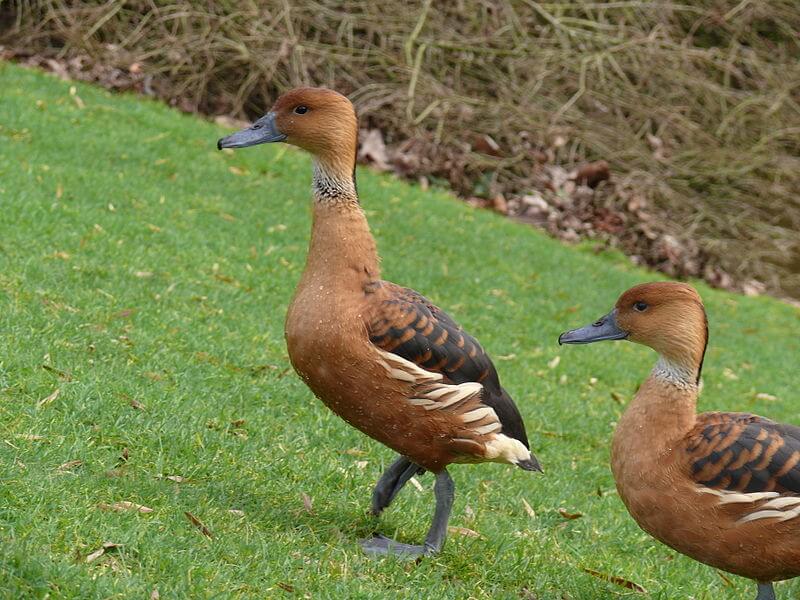
The other species of whistling ducks that you can also find in Florida is the Fulvous Whistling-Duck.
This species is one of the more distinctly brown ducks, with a warm reddish-brown plumage that covers most of the body, giving it a smooth and fairly uniform appearance. The long grey bill and long legs add to its upright, elegant look.
In flight, a white band across the otherwise dark tail becomes visible and serves as a useful field mark. Like other whistling ducks, it produces clear whistling calls that can be heard both on the ground and in flight.
The Fulvous Whistling-Duck has a wide global range, occurring across much of South America, parts of Central America, the southern United States, the West Indies, and beyond. Despite this broad distribution, it favors lowland wetlands with dense vegetation.
In Florida, it is relatively common and present throughout the year. It is typically found in ponds, marshes, and rice fields, with reliable sightings at locations such as Lake Apopka.
4. Cinnamon Teal

The Cinnamon Teal is a small dabbling duck that shows a strong contrast between the sexes. Males are rich reddish in color, giving them a warm, cinnamon-toned appearance that stands out among brown ducks. Females, on the other hand, are more subdued, with soft brown plumage that blends well into marsh vegetation, making them harder to spot.
This species favors shallow wetlands such as marshes and ponds, where it feeds mainly on plant material gathered from the surface. Cinnamon Teals are migratory, with many individuals moving south to winter in northern South America and the Caribbean.
They are uncommon ducks in Florida, typically appearing as winter visitors. They may be observed at places like Merritt Island National Wildlife Refuge, where suitable wetland habitats are available.
5. Masked Duck

Another brown duck you are likely to spot in Florida is the Masked Duck, a tiny stiff-tailed duck found across the tropical Americas.
Despite its small size, this species shows a strong brown presence in its plumage. Breeding males display a rich rust-colored body that gives them a warm brown appearance, contrasted by a bold black face.
Females, non-breeding males, and juveniles are more muted, with a finely barred brownish-grey body and a buff-toned face marked by two dark horizontal stripes. This softer brown pattern provides excellent camouflage in dense wetland vegetation.
The Masked Duck is highly secretive and tends to remain hidden in thick cover around ponds and marshy areas. It is rarely seen out in the open and is more often detected by brief glimpses as it moves through vegetation.
In Florida, this species is a rare vagrant that occasionally wanders north from its usual range. It is typically found in quiet, vegetated ponds, with one of the most recent records coming from Key West Tropical Forest & Botanical Garden in 2011.
6. Ruddy Duck

This is another Florida’s stiff-tailed duck with noticeable brown plumage, belonging to a small group of specialized diving ducks.
The Ruddy Duck is compact and stocky, with a broad, scoop-shaped bill and a stiff tail that is often held upright. While breeding males show brighter colors, females and non-breeding males display a more subdued brown appearance, with a soft brown body and a pale cheek marked by a faint, blurry stripe. This overall brown tone gives them a low-key look on the water. In flight, they appear darker above, with uniformly dark wings.
One of the more interesting features of this species is its specialized anatomy used during courtship displays: an expandable trachea and air sacs that help produce distinctive sounds.
Ruddy Ducks are diving feeders and are commonly found in bays, ponds, and other calm waters. In Florida, they are widespread during winter, although some individuals remain throughout the year. They can be reliably seen at locations such as Everglades National Park.
7. Blue-winged Teal
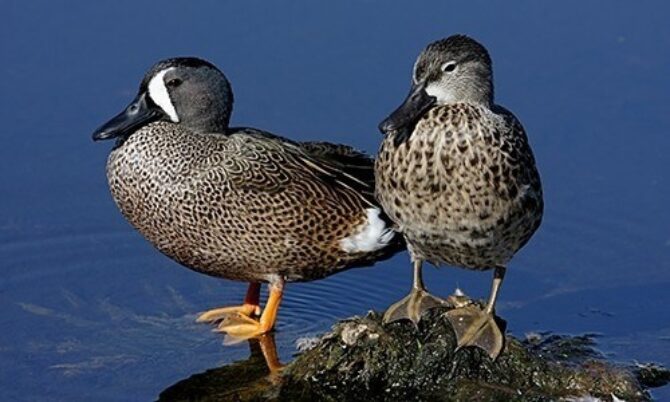
The Blue-winged Teal is one of the most widespread ducks in Florida and is especially abundant during the winter months.
While males in breeding plumage show more color, the species still fits well among brown ducks due to the female and overall body tones. Adult females display a mottled brown plumage that provides excellent camouflage in marshy habitats, with a subtle pale area at the base of the bill. Males have a light brown body that blends into wetlands, contrasted by a greyish-blue head and a distinctive white facial crescent, along with a darker tail.
This is a small dabbling duck that frequents shallow wetlands, where it feeds and rests. It often uses exposed surfaces such as mudflats, shoreline edges, and even muskrat houses or fallen logs as resting spots.
In Florida, the Blue-winged Teal is extremely common and can be found across the state in wetlands and marshes. It is present year-round but is most numerous in winter, with reliable sightings at locations such as Saint Marks National Wildlife Refuge.
8. Green-winged Teal
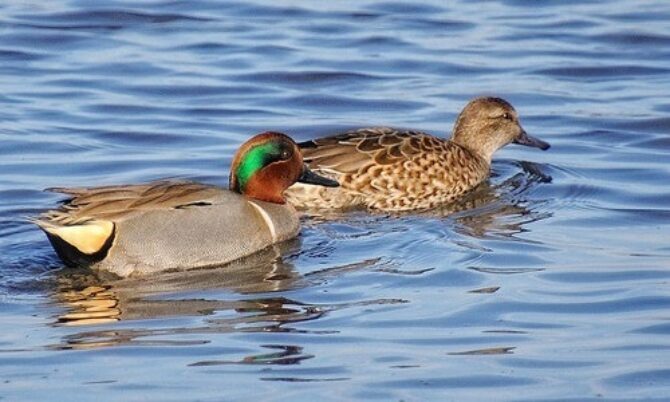
Slightly smaller than its blue-winged counterpart, the Green-winged Teal is another widespread brown duck in Florida.
This small dabbling duck shows a strong brown presence, especially in females, which have a soft, light brown mottled plumage similar to a female Mallard. This subdued coloration allows them to blend easily into wetland habitats.
Breeding males are more detailed, with finely patterned gray flanks and back, a chestnut head marked by a deep green eye patch, and a green speculum edged in white that is visible both in flight and at rest.
The species is highly migratory, traveling far south of its breeding grounds during winter. It favors sheltered wetlands such as marshes, bays, and slow-moving rivers, where it feeds mainly by dabbling or grazing on plant material.
In Florida, the Green-winged Teal is a common winter visitor and is found almost exclusively during this season. It occurs widely in suitable wetland habitats, with reliable sightings at locations such as Myakka River State Park.
9. Gadwall
The Gadwall is another subtle but elegant brown duck that is commonly seen in Florida during the winter months.
Females show the strongest brown coloration, with a soft, light brown plumage that closely resembles a female Mallard but appears slightly more finely patterned and uniform.
Males in breeding plumage are more intricate, showing a muted grey body with chestnut-toned wings and a clean white speculum that becomes visible in flight or when resting on the water. Outside the breeding season, males take on a more female-like appearance, though they retain their distinctive wing pattern. Learn how to differentiate males and females in either seasons: Gadwall Male Vs Female: Key Differences in Breeding and Non-Breeding Plumage
This species is strongly associated with open wetlands, including marshes, shallow lakes, and wet grasslands with dense vegetation along the edges. It feeds mainly by dabbling, often with the head submerged while searching for plant material.
In Florida, the Gadwall is a common winter visitor found in wetlands, bays, and ponds. It is regularly recorded at sites such as Saint Marks National Wildlife Refuge.
10. White-cheeked Pintail
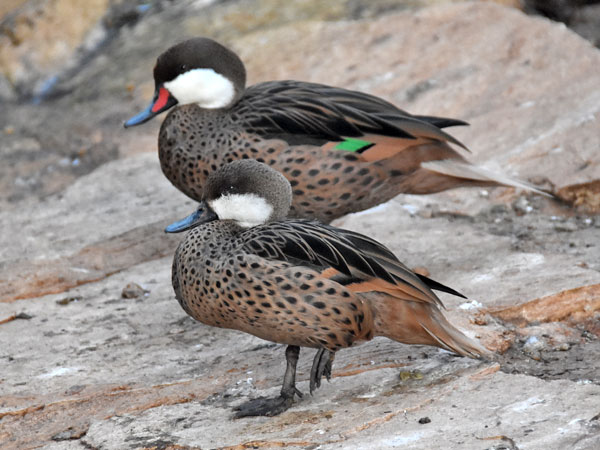
Named after its distinctive facial markings, the White-cheeked Pintail is a slim brown duck that occasionally reaches Florida as a rare visitor from further south.
This species shows a mainly brown plumage, giving it a soft, earthy appearance overall. The most striking feature is the clean white cheeks, which stand out against the warmer brown tones of the head and body. It also has a red-based grey bill and a fine, slender tail typical of pintails, though less elongated than in its northern relatives.
The wing shows a subtle iridescent green speculum, adding a hint of color. Males and females look very similar, with females appearing slightly smaller and more muted, while juveniles show a duller bill and overall softer tones.
The White-cheeked Pintail is native to the Caribbean, South America, and the Galápagos Islands, where it occupies a range of wetland habitats. It is commonly associated with brackish environments such as estuaries, mangrove swamps, and coastal lagoons, though it can also be found in freshwater ponds and lakes.
In Florida, it is considered an uncommon vagrant from farther south, with very few recorded sightings. One of the more recent observations was at Lely Resort in 2020.
11. American Wigeon
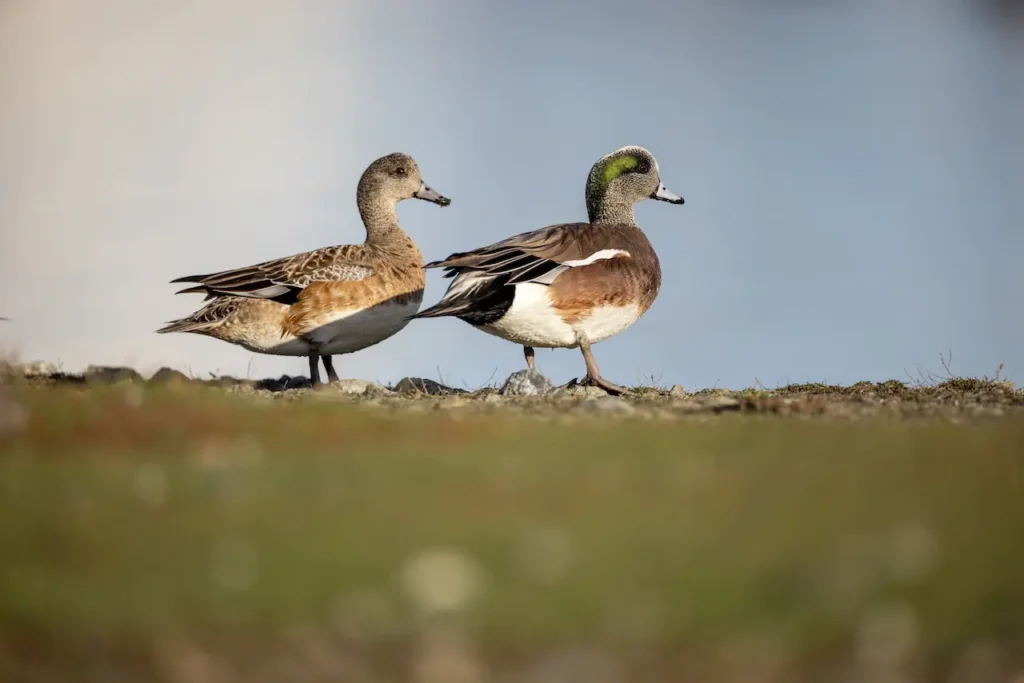
Also known as the Baldpate, the American Wigeon is a widespread dabbling duck found across North America and a familiar winter visitor in Florida.
Females show soft grey and brown plumage that blends well into wetland and grassy habitats. Males in breeding plumage are more distinctive, with a warm brown body contrasted by a pale cream-colored crown that extends down the forehead. This light head pattern gives the species its “baldpate” nickname. A green patch around the eyes adds subtle color to an otherwise earthy palette.
Both sexes share a pale blue bill with a black tip, along with a white belly that becomes visible when the bird is active on the water.
American Wigeons are strongly associated with open wetlands, lakes, and flooded fields, where they are often seen grazing on vegetation rather than diving. They are also known for feeding in flocks and mixing with other dabbling ducks.
In Florida, this species is a common winter resident, appearing regularly in suitable habitats across the state. It can be found in wetlands, lakes, and agricultural fields, with reliable sightings at locations such as Myakka River State Park.
12. Eurasian Wigeon
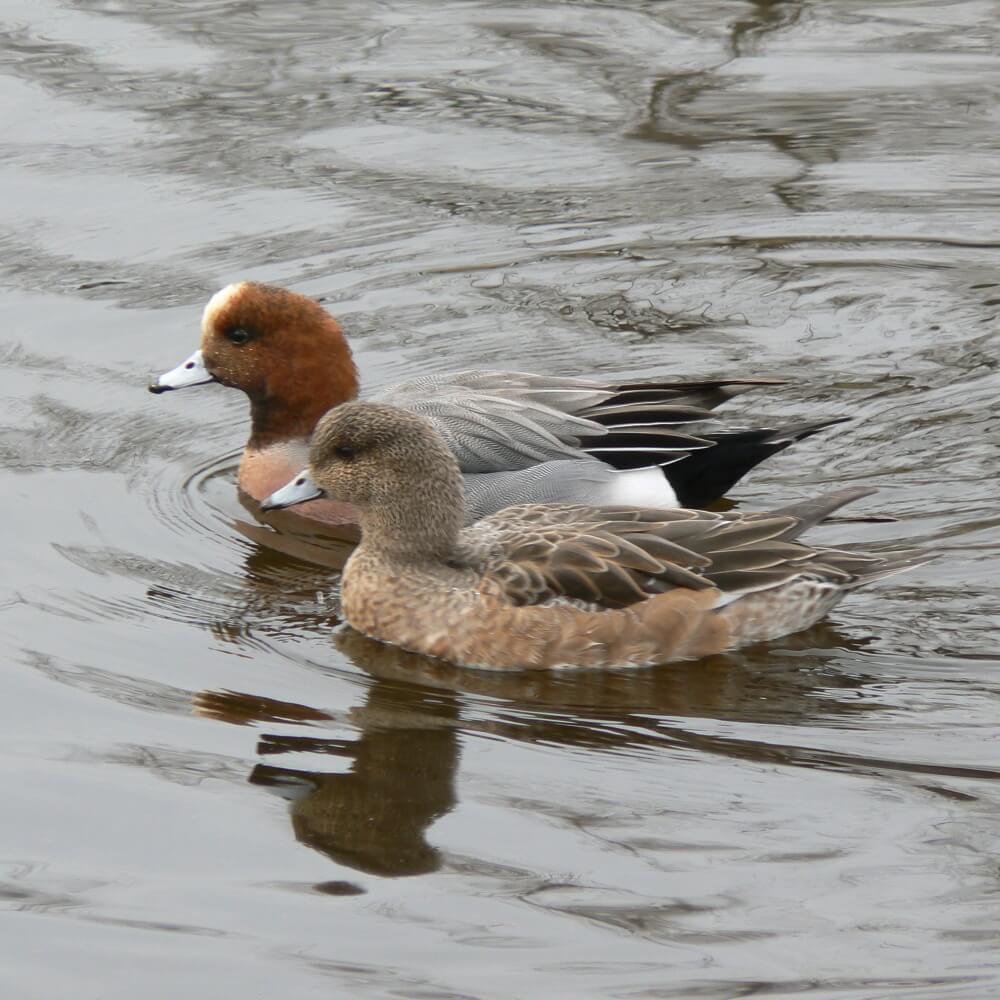
One of three extant species of wigeon, the Eurasian Wigeon is another brown duck you can spot in Florida, though only as a rare visitor from across the Atlantic.
This species shows a strong brown presence, especially in females, which have soft light brown plumage similar to a female American Wigeon, making them difficult to separate without closer inspection. Here’s how to tell the two species apart: Eurasian Wigeon Vs American Wigeon: Key ID Differences
Males in breeding plumage are more distinctive, with grey flanks and back, a dark rear end, and a clean white wing patch that stands out clearly in flight or when resting. A dark green speculum adds a subtle contrast within the wing, helping with identification in mixed flocks.
The Eurasian Wigeon breeds in the far northern regions of Europe and the Palearctic and is the Old World counterpart of the American Wigeon. It is strongly migratory, wintering well south of its breeding grounds in regions such as southern Asia and Africa.
In Florida, it is considered a scarce vagrant, with records from various times of the year. It may be encountered in mixed waterfowl flocks in wetlands, lakes, bays, estuaries, and fields, with Merritt Island National Wildlife Refuge being one of the better locations to look for this uncommon visitor.
13. Mallard

The Mallard is the most familiar duck in Florida and one of the most widespread waterfowl species in the world, present in the state throughout the year.
Females are the brown form of the species, showing mottled brown plumage that provides effective camouflage in wetlands, ponds, and urban waterways.
Males are far more distinctive in breeding plumage, with a glossy green head, a bright white neck ring, and a chest that transitions into purplish-brown tones, contrasted by grey-brown wings and a pale grey body.
Both sexes display a wing speculum, a patch of iridescent blue to purple feathers bordered with white, which becomes visible in flight.
Mallards are highly adaptable ducks that thrive in a wide range of freshwater habitats, from city parks and retention ponds to marshes and larger wetlands. Their flexibility in diet and habitat use is a major reason for their success across diverse environments.
In Florida, they are common year-round and can be seen almost anywhere there is open water. One reliable site for observation is Fort De Soto Park, where they occur alongside many other waterfowl species.
See also: 13 Ducks That Look Like Mallards
14. American Black Duck
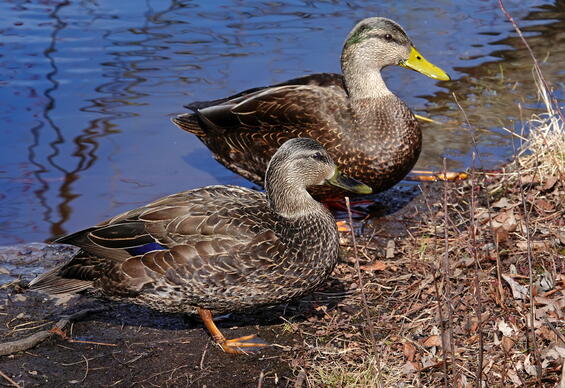
The American Black Duck closely resembles a Mallard but shows a noticeably darker overall plumage, giving it a more uniform and subdued appearance in the field.
Both sexes are similar in structure and general coloration, with dark brown to sooty tones across the body and a lack of strong patterning compared to Mallards.
The male is best separated by its yellow bill, while the female has a duller greenish bill with darker markings along the upper edge. Here are more tips on how to differentiate males and females of this species: How to Identify Drake Vs Hen Black Duck: Key Differences
In mixed flocks, it can be easy to overlook this species because of its close resemblance to darker Mallards, especially in poor lighting. They also regularly interbreed with mallards, which can make identification more challenging in areas where both occur.
In Florida, the American Black Duck is uncommon and mainly appears during winter. It inhabits estuaries, salt marshes, ponds, and coastal lakes, with reliable sightings at sites such as Saint Marks National Wildlife Refuge.
15. Northern Pintail
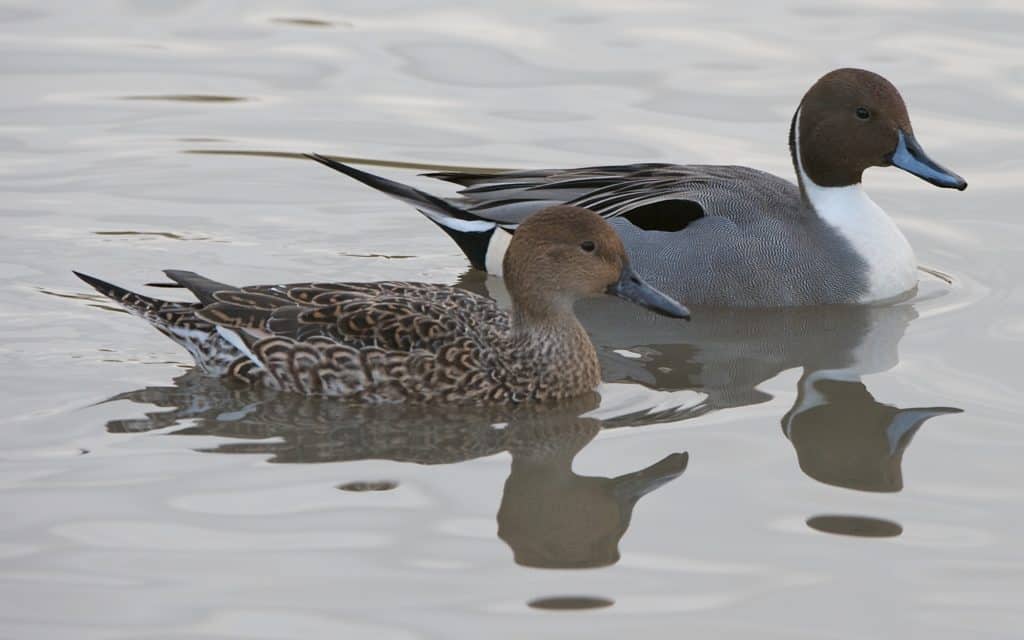
The final Florida’s duck that shows some brownish coloration is the Northern Pintail, a sleek and elegant dabbling duck known for its long, pointed tail feathers.
We have also added it to our brown-toned ducks list due to the female’s overall plumage and the male’s patterned grey, brown, and black toned back. Females display a soft, drab brown coloration that blends into wetland environments, similar to other female dabbling ducks.
On the other hand, males are more refined in appearance, with a chocolate-brown head, a clean white stripe running down the neck into the pale underparts, and finely patterned grey, brown, and black tones across the back and flanks. Both sexes share blue-grey bills and grey legs and feet.
Northern Pintails are highly social outside the breeding season and often form large mixed flocks with other waterfowl in open wetlands. Their calls are also distinctive, with males producing a soft whistle and females giving a typical duck-like quack when disturbed.
In Florida, this species is a common winter visitor, typically found in wetlands, lakes, estuaries, salt marshes, and bays. One reliable location to observe them is Saint Marks National Wildlife Refuge.