
30 Ducks with Black Heads: Complete List

Spotted a duck with a black head and wondering what species it might be? You’re in the right place. We’ll help you figure it out in no time. Generally, ducks with black head plumage is fairly common in the duck world, with more than 30 species showing this striking feature.
In this guide, we’ve included a wide range of ducks with black heads to help you identify the one you saw with confidence. To keep things focused, we’ve only covered species with completely black heads, leaving out ducks with black-and-white head patterns (you can explore those in our separate post: 20 Ducks with Black And White Heads ).
That said, we have included ducks with iridescent dark green heads in our list. While they may appear green in bright light, these heads often look black or very dark in typical conditions. This is because the color isn’t due to pigment but microscopic feather structures, which reflect light to produce green, blue, or even purple hues at certain angles while the underlying feather color remains dark.
1. Black-headed Duck
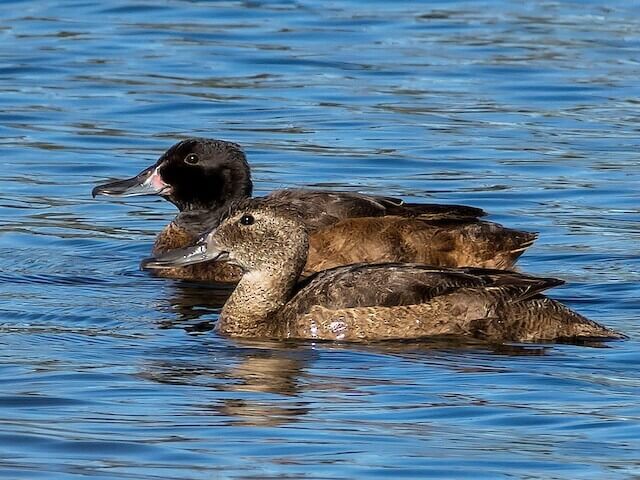
One of the most obvious species to consider when identifying a black-headed duck is the aptly named Black-headed Duck. As its name suggests, the adult male displays a rich, glossy black head and upper neck, a feature that stands out clearly against the rest of its body.
The upperparts are predominantly deep brownish-black, intricately patterned with cinnamon or pale rufous speckles and fine vermiculation, giving the bird a subtly textured appearance when viewed up close. In contrast, the female shows a dark brown head and neck rather than true black, along with a noticeable whitish throat. Otherwise, she closely resembles the male in overall pattern and structure.
Beyond plumage, this species is also notable for its somewhat unusual distribution, occurring in two distinct ranges. One population is found along the western side of central Chile, while the other extends from southern Bolivia through central Paraguay and Argentina, reaching into southern Uruguay and the southernmost parts of Brazil.
2. African Black Duck
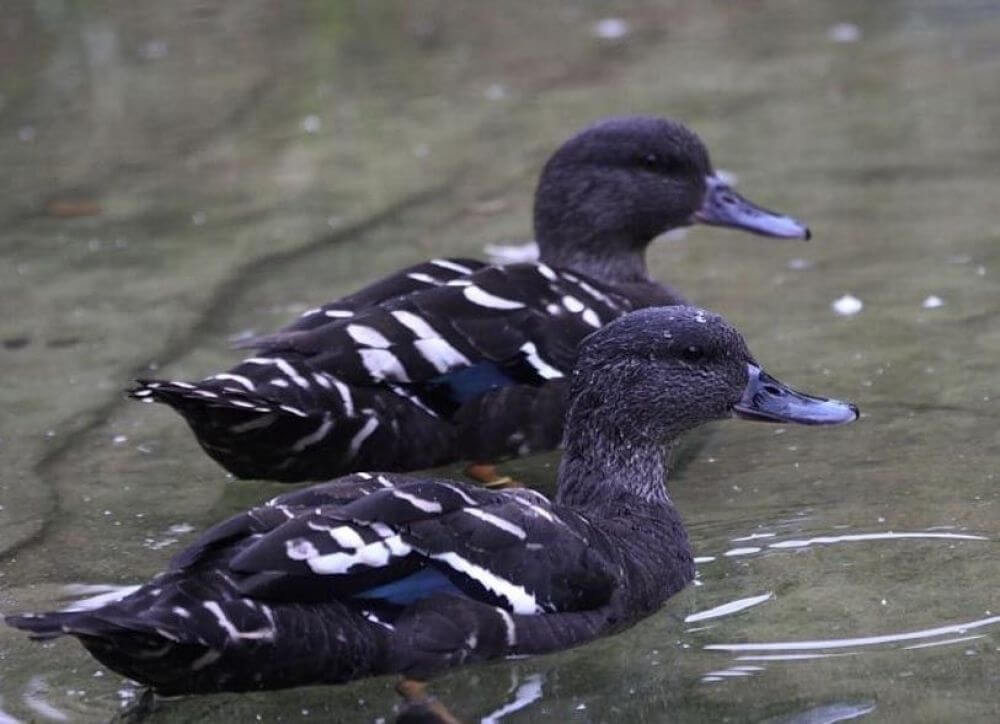
Also known as the black river duck, Ethiopian black duck, or West African black duck, this is another species you would naturally expect to have a black head based on its name—and it does not disappoint. The African Black Duck presents an overall dark appearance, with a deep blackish head that blends seamlessly into its equally dark body, giving it a sleek, uniform look on the water.
Up close, the back is marked with distinct white streaks and spots that contrast against the otherwise dark feathers, while the bill remains dark and the legs and feet show a noticeable orange coloration. This subtle patterning helps break up its silhouette, especially in dappled light along forested waterways.
Although it is genetically closest to the Mallard group, the African Black Duck stands apart in both behavior and, to some extent, its plumage. It loves flowing freshwater habitats, and spend much of the day along rivers and streams, particularly in wooded and hilly regions. Interestingly, it often shifts to larger, more open bodies of water at night. True to its cautious nature, it typically nests in concealed spots close to running water, making it a species that is more often heard or glimpsed than easily observed.
3. Lake Duck
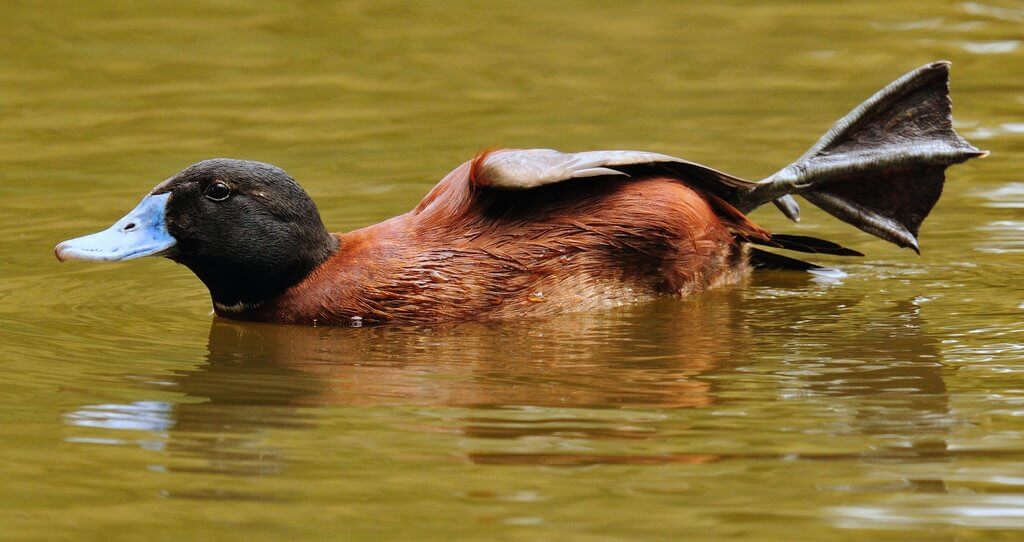
The Lake Duck is a small South American stiff-tailed duck that immediately draws attention for its distinctive appearance. The head often appears very dark, especially in shaded or low-light conditions. This darker head contrasts with the rest of its brown compact body, giving the bird a neat, streamlined profile.
The Lake duck is famous for a remarkable biological record: it holds the Guinness World Record for the largest avian reproductive organ, documented from a specimen in Córdoba, Argentina, which measured an extraordinary 42.5 centimetres (16.7 inches). While unusual, this detail has made the Lake Duck one of the more frequently cited examples of extreme anatomical specialization in birds.
4. Andean Duck
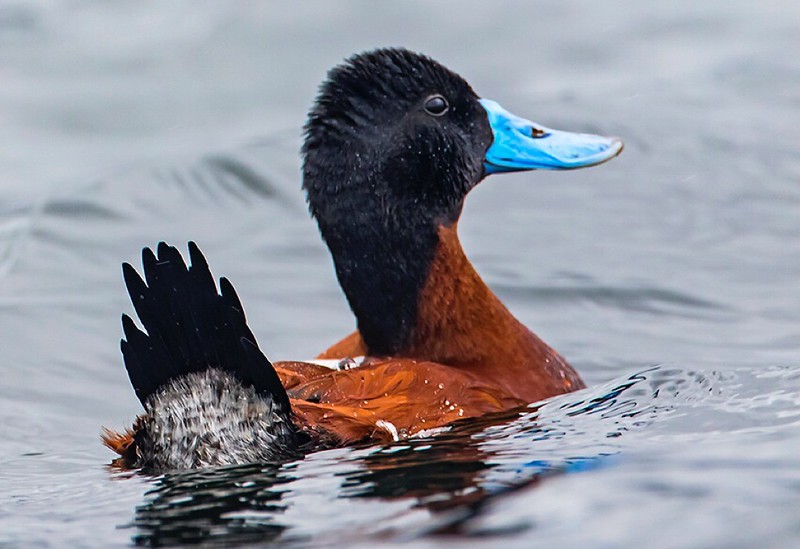
These closely resemble the Lake Duck in both shape and overall plumage. Another member of the stiff-tailed duck group, they are native to the high-altitude regions of the Andes in South America. Like the Lake Duck, the head is dark and often appears black, especially at a distance or under subdued light, while the rest of the body is largely brown.
Overall, the Andean duck is a small, sturdy duck with a compact, strongly built body and a short, stout, scoop-shaped bill adapted for foraging in freshwater habitats. As with other stiff-tailed ducks, it also has a distinctive long, rigid tail, which is frequently held cocked upward above the waterline, a characteristic posture that helps make the group instantly recognizable in the field.
5. Blue-billed Duck
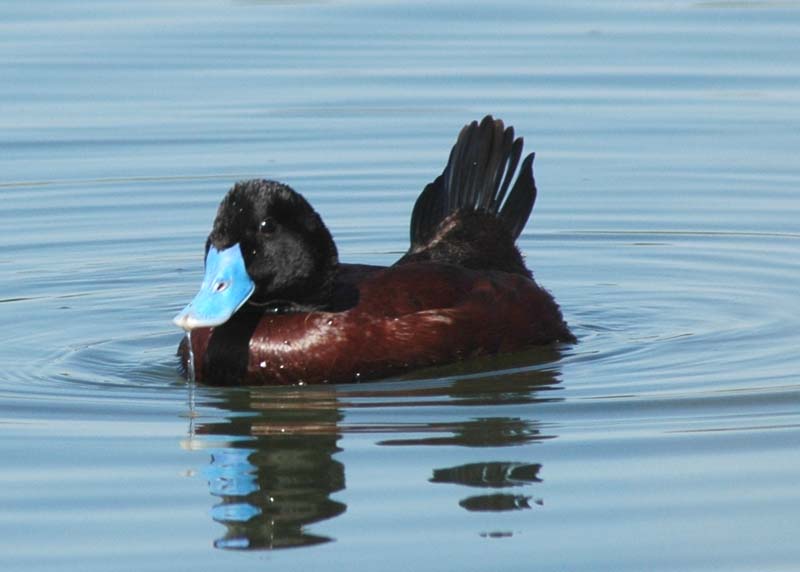
Named after the male’s distinctive blue bill, this small Australian stiff-tailed duck is especially striking during the breeding season, when the bill shifts from a muted slate-blue to a vivid bright blue. At the same time, the male develops a glossy black head and neck with rich chestnut tones across the back and wings, later fading to a darker grey outside the breeding period. The female, by contrast, remains more subdued year-round, with mostly black plumage edged in brown.
Growing to about 40 cm in length, the Blue-billed Duck is highly aquatic and rarely ventures onto land, where it has difficulty walking and moves with a noticeable, penguin-like gait. It is endemic to Australia’s temperate regions, favoring inland wetlands and often gathering in large numbers on both natural waters and artificial habitats such as sewage ponds.
6. Maccoa Duck
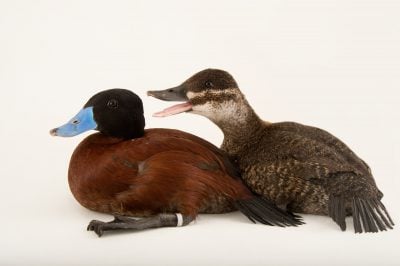
The Maccoa Duck is another stiff-tailed duck that closely resembles the stiff-tailed ducks we have featured so far in this list. This stiff-tailed diving duck is found across Eastern and Southern Africa, where it inhabits deep freshwater lakes and reservoirs.
The breeding male is particularly striking, with a completely black head and throat that contrasts sharply with a vivid cobalt-blue bill. The female is more subdued, showing a greyish-black bill with a pale tip, a light brown face, and a darker crown and cheek stripe, along with an off-white throat. Like the Blue-billed Duck, Maccoa Ducks are highly adapted to an aquatic lifestyle, making them strong underwater swimmers but relatively awkward on land, where their movement is limited and ungainly.
7. Ring-necked Duck
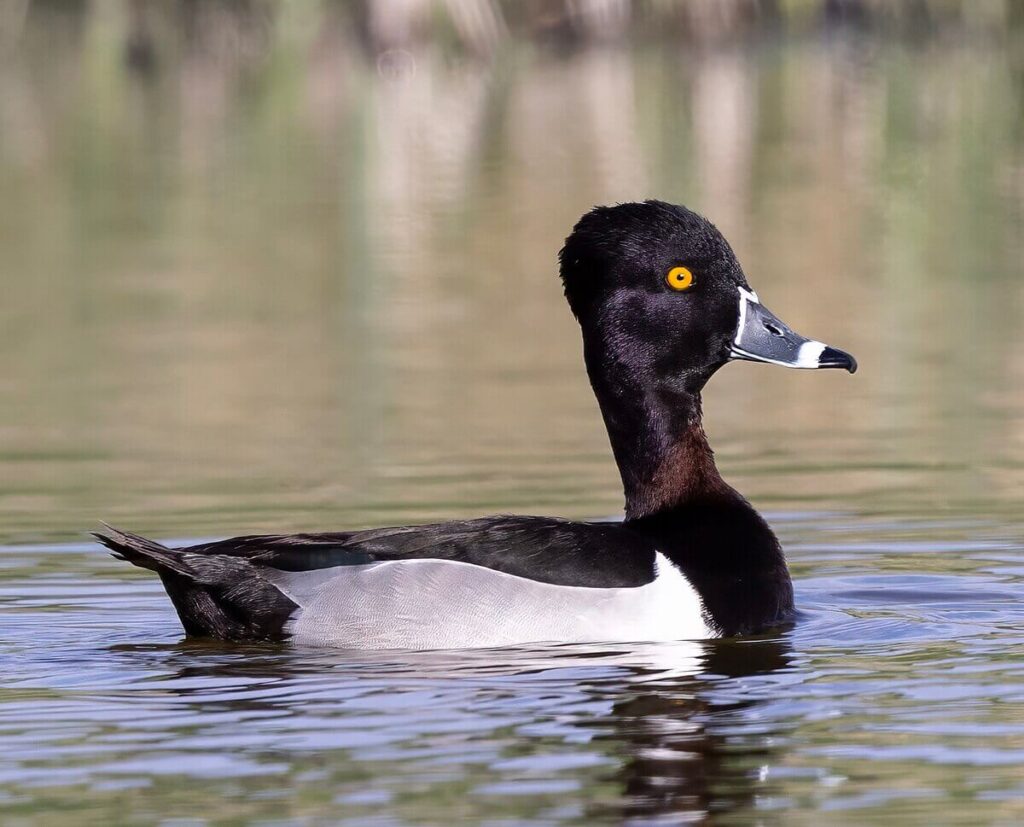
The Ring-necked Duck is a striking diving duck, with the male showing a glossy black, angular head that can appear jet black in most lighting conditions. This dark head contrasts sharply with its pale gray bill, which is marked by two distinct white rings—a key identification feature. The rest of the male’s plumage includes a black back, a crisp white breast, and a subtle white line along the wings, complemented by bright yellow eyes.
The female presents a softer appearance, with a grayish-brown head and body, a darker brown back, and a dark bill with a more subtle pale band. She also shows faint white eye-rings and brown eyes.
This species breeds in wooded lakes and ponds across the northern United States and Canada, particularly within the boreal forest regions, where it favors quiet, well-vegetated waters.
8. Northern Shoveler
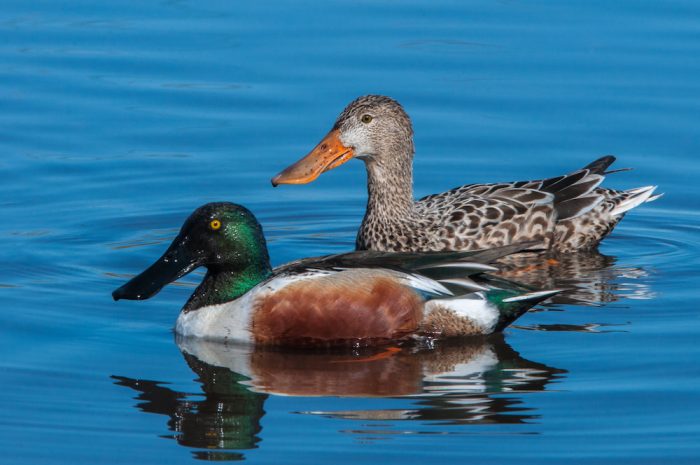
This is one of the easiest ducks to recognise in the field, thanks to its unmistakable large, spatulate (spoon-shaped) bill, which sets it apart from almost all other species. The breeding male is particularly eye-catching, with an iridescent dark green head that often appears black at a distance or in poor light. This dark head contrasts with a clean white breast and rich chestnut flanks, while the bill is black or very dark grey.
The female is more subdued, showing a mottled brown plumage similar to that of other dabbling ducks, but she can still be readily identified by her long, broad bill.
The Northern Shoveler breeds across a wide range, including large parts of Eurasia, western North America, and the Great Lakes region of the United States, typically favouring shallow wetlands where its specialized bill is used to filter food from the water.
9. Tufted Duck

Another easily recognizable species, the Tufted Duck stands out thanks to the prominent tuft at the back of its head, which gives the species its name.
The adult male is particularly striking, with a glossy black head that can appear jet black in most lighting, complemented by a thin trailing crest. This dark head contrasts with clean white flanks, a blue-grey bill, and bright golden-yellow eyes, creating a bold and distinctive appearance.The female is more understated, with overall brown plumage and paler flanks, though she often retains a subtle hint of the tuft.
Tufted Ducks are migratory across much of their range, moving to milder regions in southern and western Europe and southern Asia during winter, while populations in places like the British Isles may remain year-round.
10. Greater Scaup
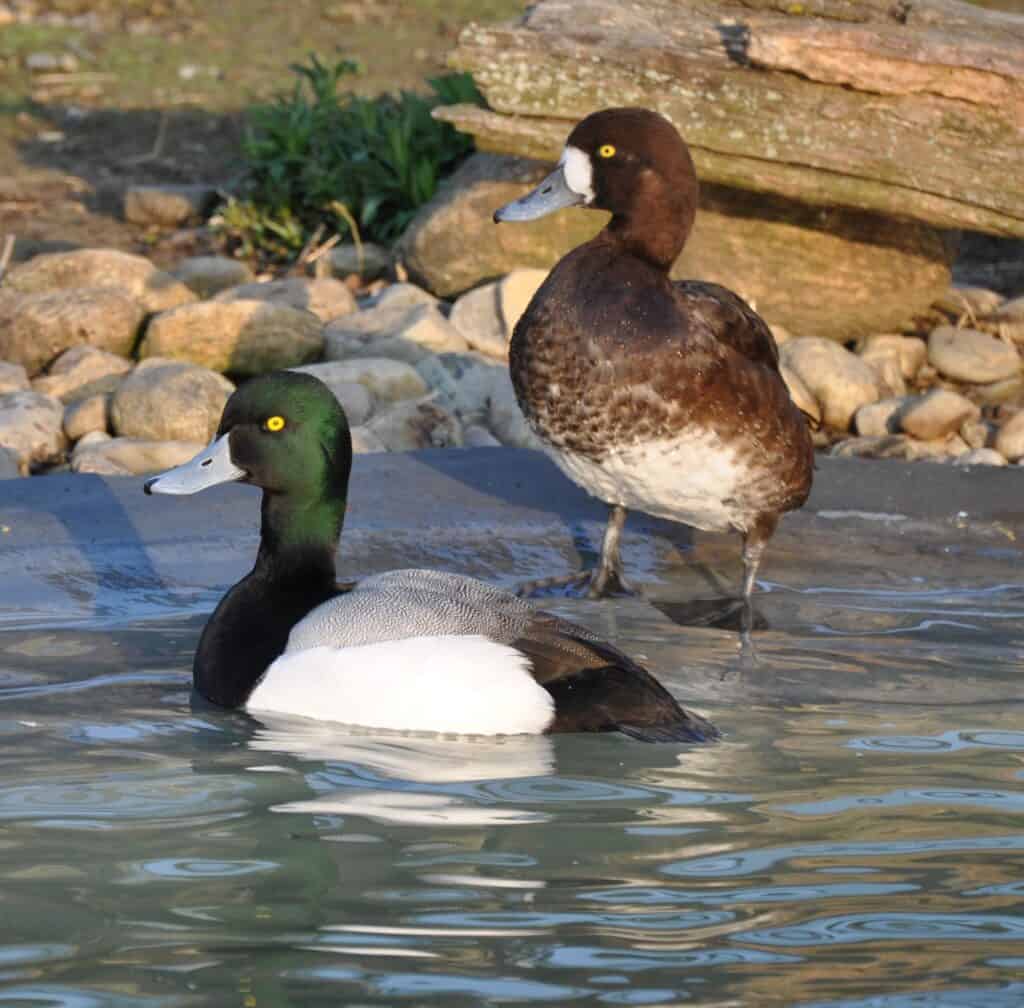
Closely resembling the Tufted Duck (but lacking the signature tuft and differing in call), the Greater Scaup is another species with a distinctly dark head. The male’s head appears black in most conditions, though it can show a subtle green or purple gloss depending on the angle of the light. This dark head contrasts with a black breast, white belly, and pale grey upperparts, while the light blue-grey bill and yellow eyes add to its crisp, clean look. A bold white wing stripe is also visible in flight.
The female is more subdued, with mostly brown plumage, a dull blue bill, and a characteristic white patch on the face. This species has a wide circumpolar distribution, breeding within the Arctic Circle across both the Palearctic and Nearctic regions, from Iceland and Scandinavia through northern Russia and Siberia to Alaska and northern Canada.
11. Lesser Scaup
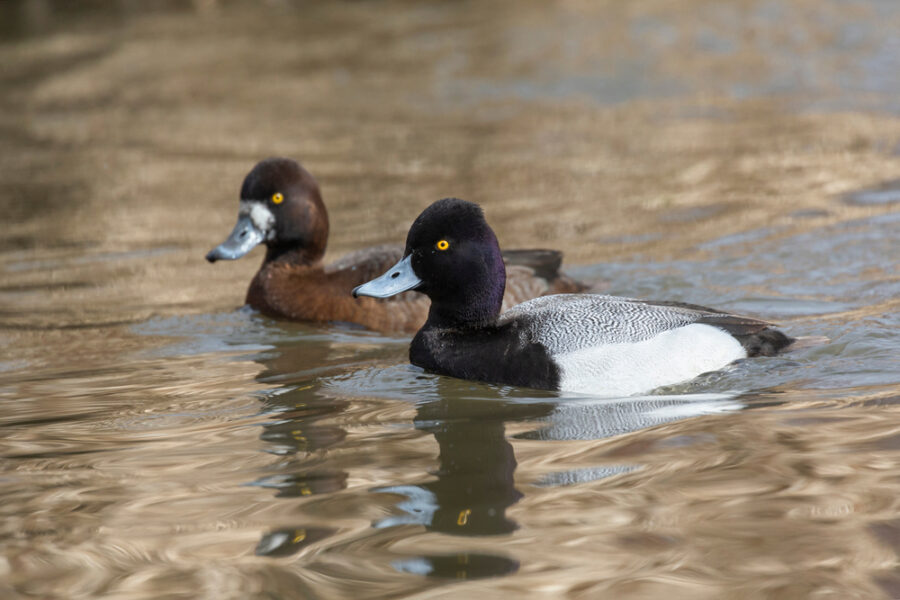
This is another duck that also resembles the Tufted Duck, though it lacks the obvious tuft and differs in both structure and call. It is often confused with the Greater Scaup as well, but generally shows a smaller, narrower bill with a straighter profile rather than the broader, spatulate shape of its larger relative.
The adult male has a glossy black, iridescent head that often appears jet black in most lighting, sometimes with a faint purplish sheen, along with a black breast and a pale grey back finely patterned with darker vermiculations. A slight peak at the hindcrown may be visible but is far less pronounced than the Tufted Duck’s crest. The female is mostly dark brown, marked by a distinctive white band at the base of the bill and often a slightly paler ear region. This small diving duck breeds in North America and migrates south to Central America during winter.
12. Black Scoter
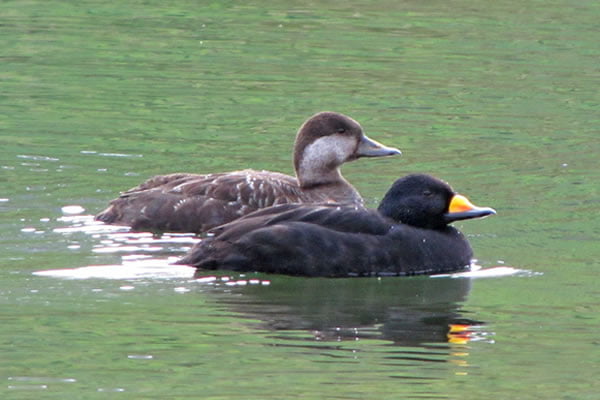
This large sea duck is easily recognised by its bulky shape and prominent, swollen bill. The adult male is entirely black, including the head, which appears uniformly dark in all lighting conditions. Its most striking feature is the large, bulbous bill, which is mostly yellow and stands out vividly against the otherwise all-black plumage. Notably, the male lacks any white markings, helping distinguish it from most other scoters.
The female is a more subdued brown, with paler cheeks that can make the head appear slightly patterned. She closely resembles the female Common Scoter but tends to show more extensive pale areas on the face. Here are more features you can use to differentiate these two species: Identifying Common Scoter vs Black Scoter
Black Scoters are primarily coastal outside the breeding season, where they dive for crustaceans and molluscs in marine waters. During the breeding period on freshwater, their diet shifts to include insects and their larvae, fish eggs, and occasionally plant material such as duckweed.
13. New Zealand Scaup
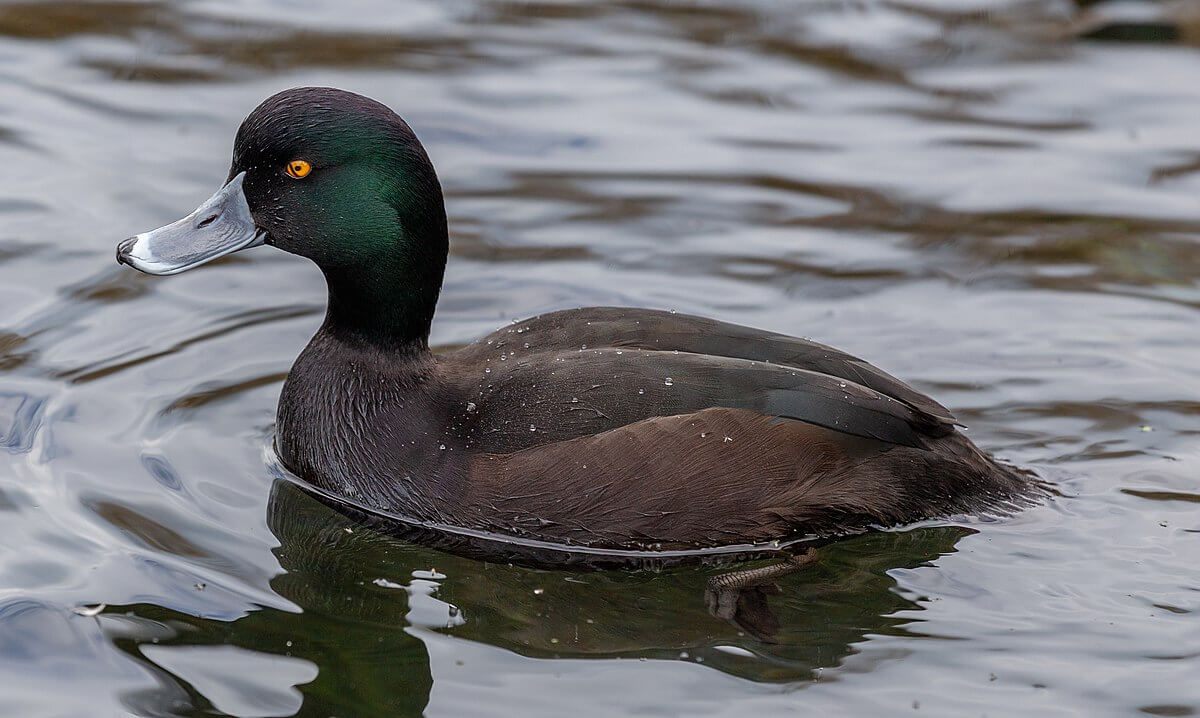
Another scaup with a dark, often black-looking head, the New Zealand Scaup (also known as the black teal or pāpango in Māori) is a compact diving duck native to New Zealand. The male shows deep black-brown plumage overall, with a dark head that can appear fully black in most lighting, sometimes with a subtle greenish sheen.
The female is more subdued, with chocolate-brown plumage and brown eyes, along with a noticeable white patch on the face during the breeding season.
This species is widespread across both the North and South Islands, where it inhabits deep freshwater lakes and ponds, and has adapted well to artificial habitats such as hydroelectric reservoirs and oxidation ponds.
14. Common Merganser
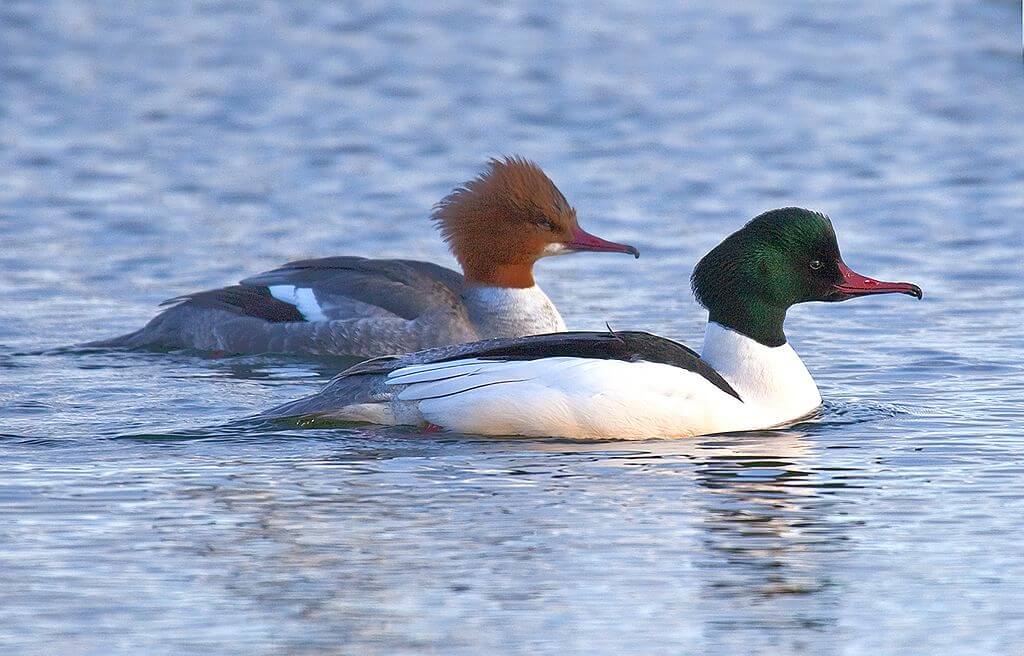
A large duck of rivers and lakes in forested regions across Europe, Asia, and North America, the Common Merganser stands out for both its size and specialized feeding habits. The breeding male is particularly striking, with a clean white body often tinged with a soft salmon-pink hue, contrasted by a dark head that appears black in most light conditions but reveals an iridescent green sheen in good light. The rump and tail are grey, while the wings show a bold pattern of white on the inner half and black on the outer.
Females and non-breeding males show a very different look, with largely grey bodies and a reddish-brown head, along with a white chin and pale wing patches.
Mergansers are highly adapted fish hunters, with long, narrow bills lined with fine serrations that help them grip slippery prey, earning them the nickname “sawbills.” While fish form the bulk of their diet, they also feed on a variety of aquatic animals, including molluscs, crustaceans, insect larvae, and occasionally even small vertebrates.
15. Red-breasted Merganser
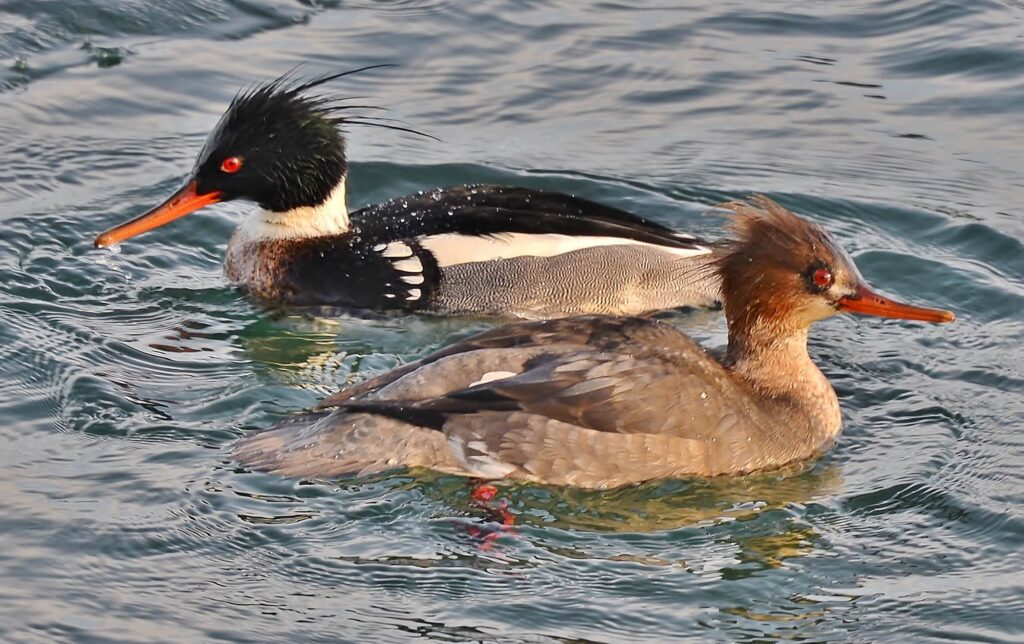
Native to much of the temperate to subarctic Northern Hemisphere, the Red-breasted Merganser is a sleek, fish-eating duck often found on coastal waters as well as inland lakes. The breeding male is particularly distinctive, with a dark head that can appear black at a distance but shows a subtle green sheen in good light. This is paired with a crisp white neck, a rusty-red breast that gives the species its name, a black back, and clean white underparts.
The female presents a softer contrast, with a warm rusty head and a greyish-brown body. Like other mergansers, this species is highly adapted for a life of diving, using its streamlined body and narrow, serrated bill to chase and small fish underwater. Its diet also includes aquatic insects, worms, crustaceans, and amphibians, making it a versatile predator in a range of aquatic habitats.
16. Scaly-sided Merganser
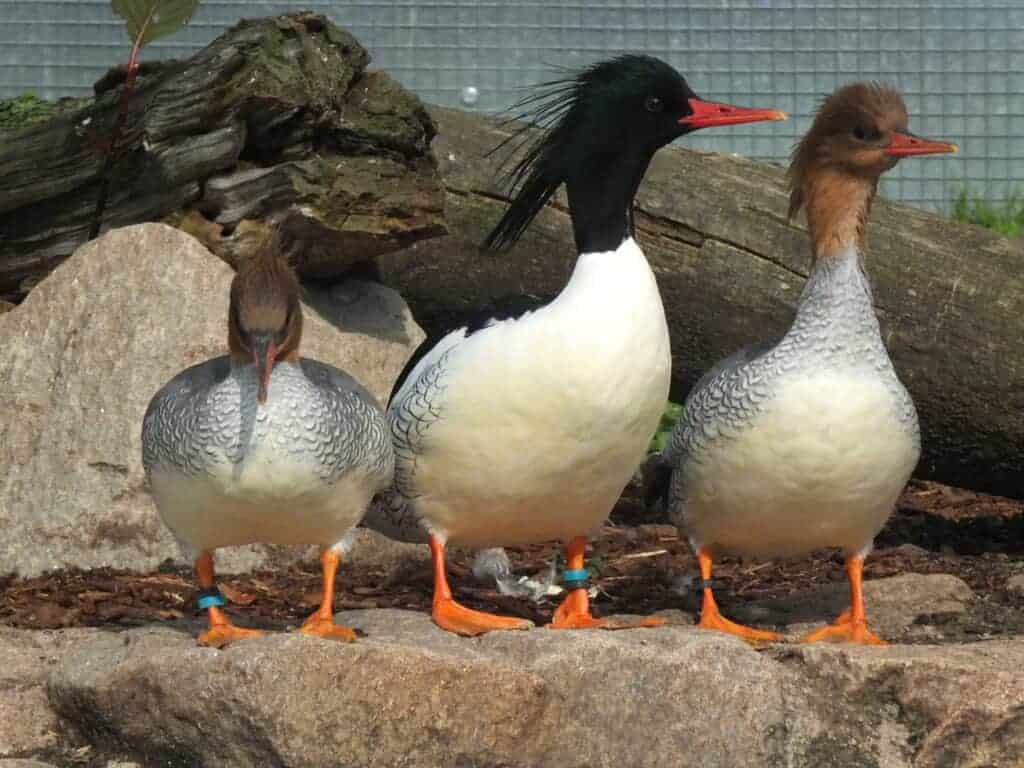
This is another merganser that shows a dark head, though its appearance is made even more distinctive by its unique patterned plumage. Both sexes have a crest of wispy, elongated feathers, most developed in adult males where it can extend nearly to the shoulders, while remaining shorter and more subtle in females and juveniles.
The adult male has a black head and neck that can appear uniformly dark in most lighting, contrasting with a clean white breast and underparts. The mantle and wings are blackish, broken by paler inner wing patches, while the flanks show the species’ characteristic fine, scaly patterning that gives it its name. Females are more muted, with a buffish head and overall greyer tones replacing the male’s black and white contrast.
Unlike many ducks, Scaly-sided Mergansers are tree nesters, continuing the unusual nesting behavior seen in the merganser and goldeneye lineage. They rely on forested river systems for breeding. The young are raised in tree cavities and then drop down to the water shortly after hatching.
Discover: 7 Types of Mergansers You Should Know
17. Australian Shelduck

The Australian Shelduck is a large, striking waterfowl native to southern Australia and Tasmania. The male has a dark, greenish head that can appear black in most lighting, set off by a bold white neck collar and a rich chestnut breast. The rest of the body is mostly dark, giving it a strong, contrasting appearance.
Females are similar in overall pattern but are smaller and show white markings around the eyes, which help with identification in the field. Both sexes have chestnut and black wings with a green speculum, and reveal prominent white wing patches in flight.
This species breeds mainly in southern Australia and Tasmania, with many birds moving north in winter. Like other shelducks, they gather at traditional moulting sites such as Lake George in New South Wales, where large flocks can occur.
18. Paradise Shelduck
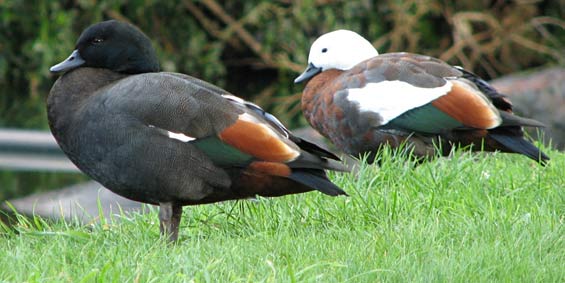
This is another shelduck that spots black head, though this feature is mainly seen in males. It is a distinctive goose-like duck that is endemic to New Zealand. (Discover other ducks that look like geese here: 12 Ducks That Look Like Geese). The male is particularly striking, with a dark black head that contrasts sharply with its barred black and grey body, giving it a bold and patterned appearance in the field.
The female, by contrast, is one of the most distinctive among shelducks, with a clean white head and a rich chestnut body. Despite their contrasting appearances, both sexes share a similar overall structure and strong presence.
Paradise Shelducks are primarily herbivorous, grazing on pasture grasses and clover, though they will also opportunistically feed on a range of invertebrates when available.
19. Common Shelduck
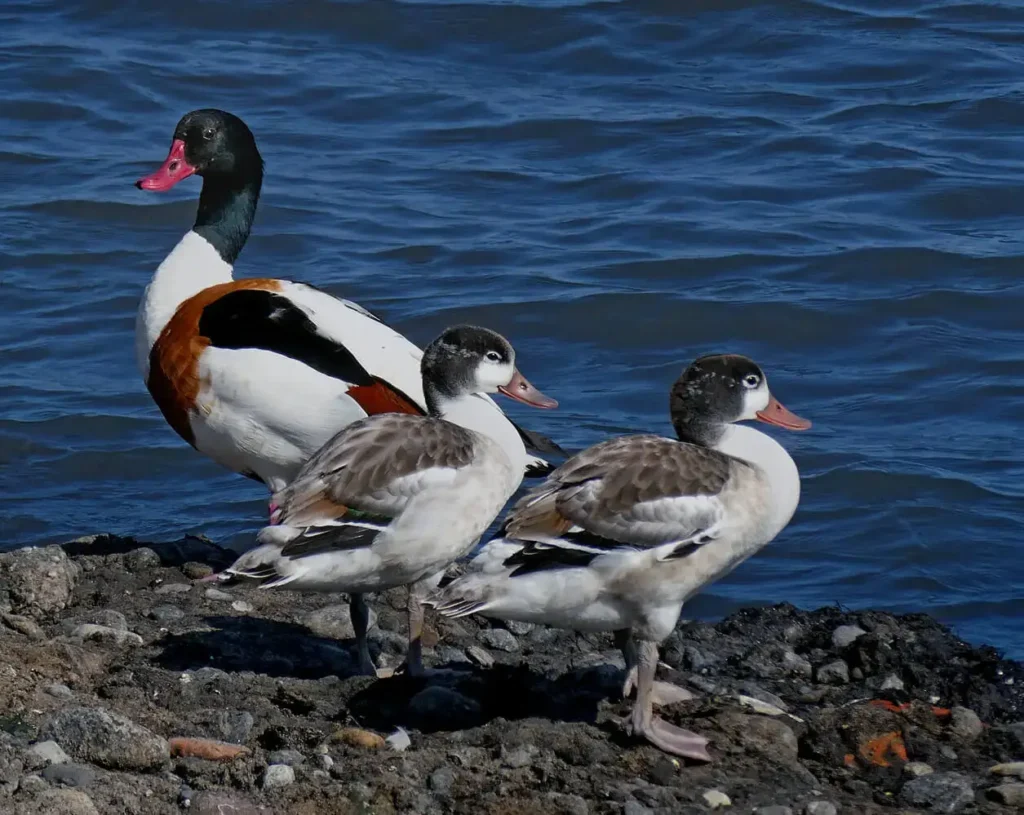
Even the colorful Common Shelduck shows a black-looking head, particularly in typical field conditions where its deep tones can appear almost uniform. It is a striking species, with a dark green head and neck, a white body marked by rich chestnut patches, a black belly, and bright pink legs and feet. The reddish-pink bill adds further contrast to its bold appearance.
Males and females are similar, though the female is slightly smaller and often shows subtle white facial markings. In the breeding season, the male appears especially vivid, with a brighter red bill and a noticeable knob at the base of the forehead.
This species is widespread across the Euro-Siberian region of the Palearctic, breeding in temperate areas and wintering further south, including parts of the Maghreb.
20. Yellow-billed Duck
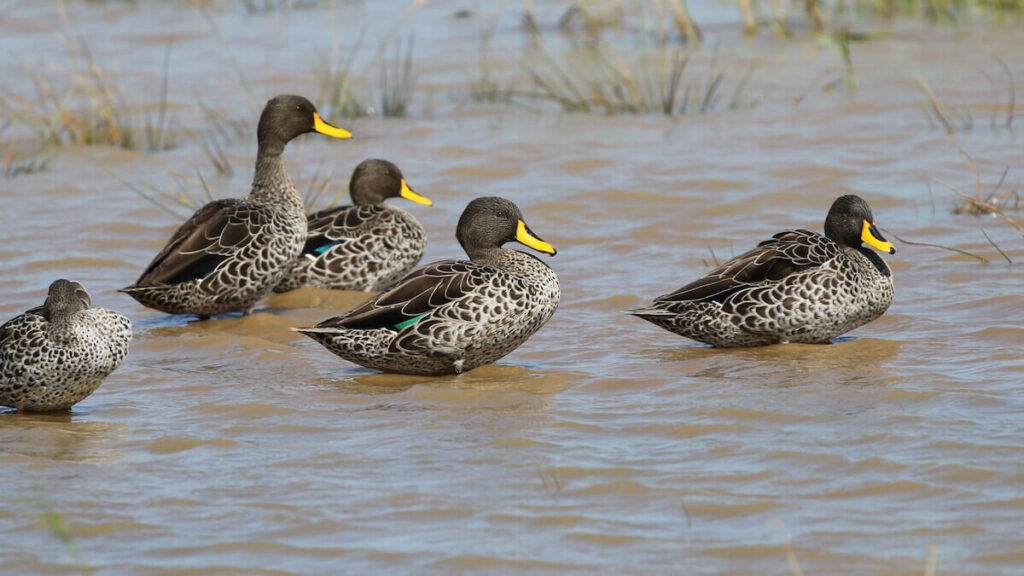
As its name suggests, the most striking feature of this species is its bright yellow bill, which stands out clearly against its otherwise muted plumage. These are mallard-sized ducks, mainly grey overall, with a darker head that can appear almost black in typical field conditions, especially at a distance.
Sexes are similar, with juveniles appearing slightly duller than adults. The male produces a soft, teal-like whistle, while the female has a familiar mallard-like quack. This species is generally associated with freshwater habitats, where it feeds and rests in pairs or small groups.
21. Hartlaub’s Duck
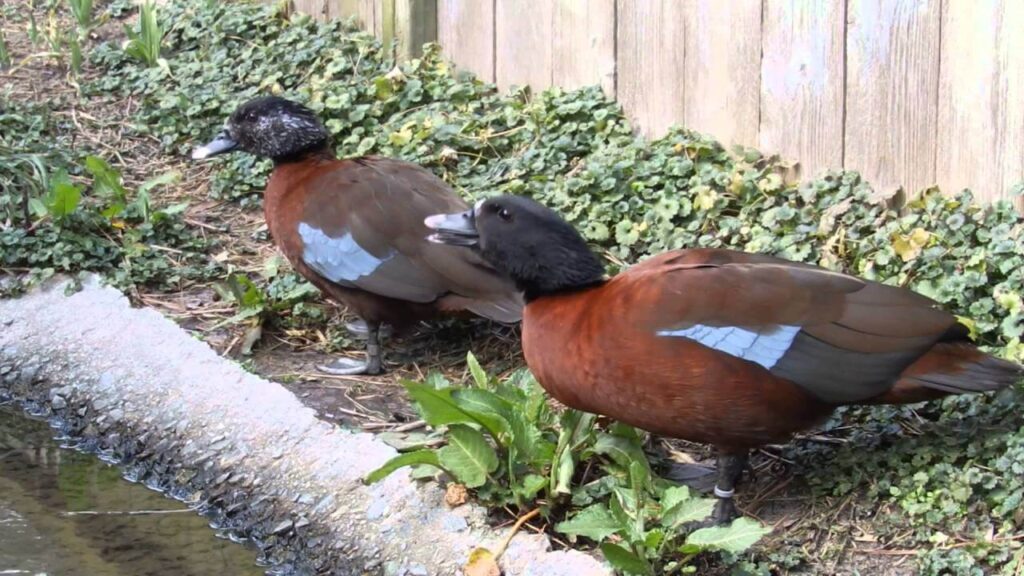
Hartlaub’s Duck is a dark chestnut-colored species of African forest wetlands, and is the only member of its genus (monotypic). It is a compact, richly toned duck that often appears uniformly dark at a distance, with a black head that can sometimes show subtle white markings on the crown. The overall plumage is deep red-brown, giving the bird a warm, uniform appearance once fully matured.
Adult plumage is not immediate, taking up to six months to fully develop. This species is resident across equatorial West and Central Africa, ranging from Guinea and Sierra Leone eastward through Nigeria to South Sudan, and south into Gabon, Congo, and the Democratic Republic of the Congo.
22. Baer’s Pochard
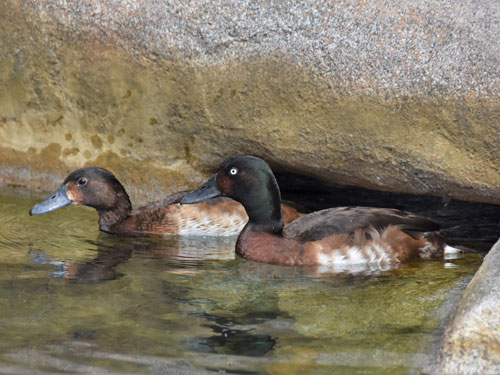
Like shelducks, a number of pochards also show dark head plumage, with Baer’s Pochard being one of the first notable examples. The species has a distinctive black head and neck that often shows a subtle green gloss in good light, giving it a smooth, velvety appearance on the water. This dark head contrasts with pale white flanks when the bird is floating, helping to separate it from similar diving ducks.
It is closely related to the Ferruginous Duck and was once considered the same species, but Baer’s Pochard is generally larger, with a more rounded head shape and clearer white flanks.
Traditionally, it bred in the Amur and Ussuri basins of Northeast China and the Russian Far East, though it has more recently expanded into parts of North and Central China. In winter, it disperses widely across southern Asia, including China south of the Yellow River, Japan, India, Southeast Asia, and occasionally appears as a rare vagrant in nearby regions.
23. Madagascar Pochard
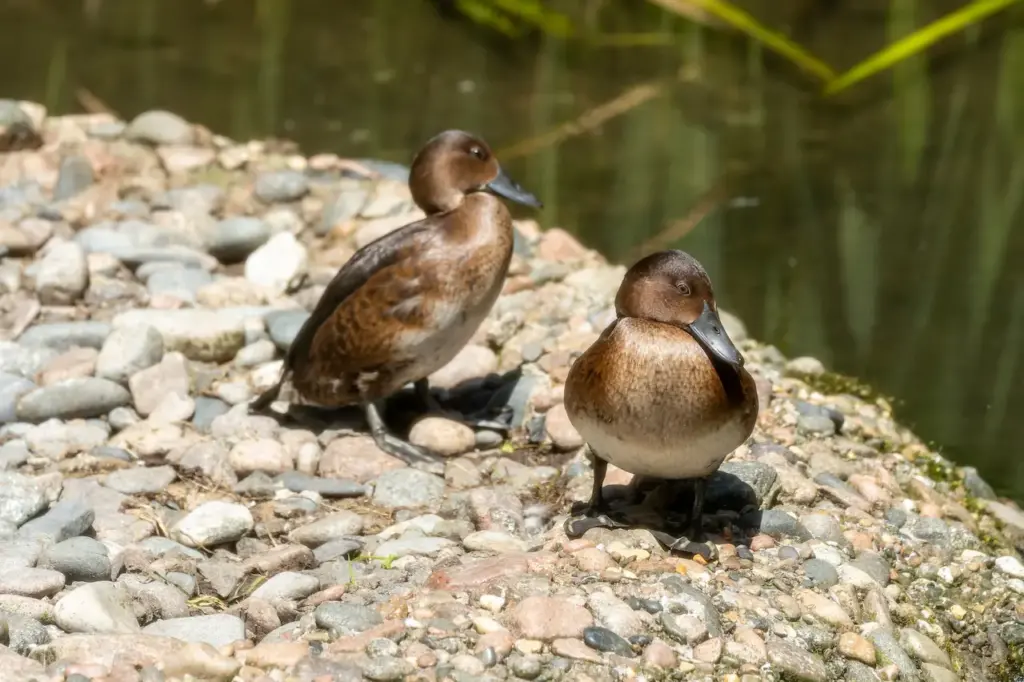
The next pochard with a dark head is the Madagascar Pochard, a rare diving duck with a strong chestnut-and-black appearance. Breeding males show rich dark chestnut coloring across the head, chin, throat, breast, and neck, while the upperparts are blackish-brown, giving the bird a deep, sombre overall tone. In younger males, the iris may turn white during their first winter, adding a striking detail to their appearance.
This species is generally considered closely related to the Hardhead, Baer’s Pochard, and Ferruginous Duck. Once thought to be extinct by the late 1990s, it was dramatically rediscovered in 2006 at Lake Matsaborimena near Bemanevika in Madagascar, making it one of the most remarkable conservation rediscoveries among waterfowl.
24. Rosy-billed Pochard
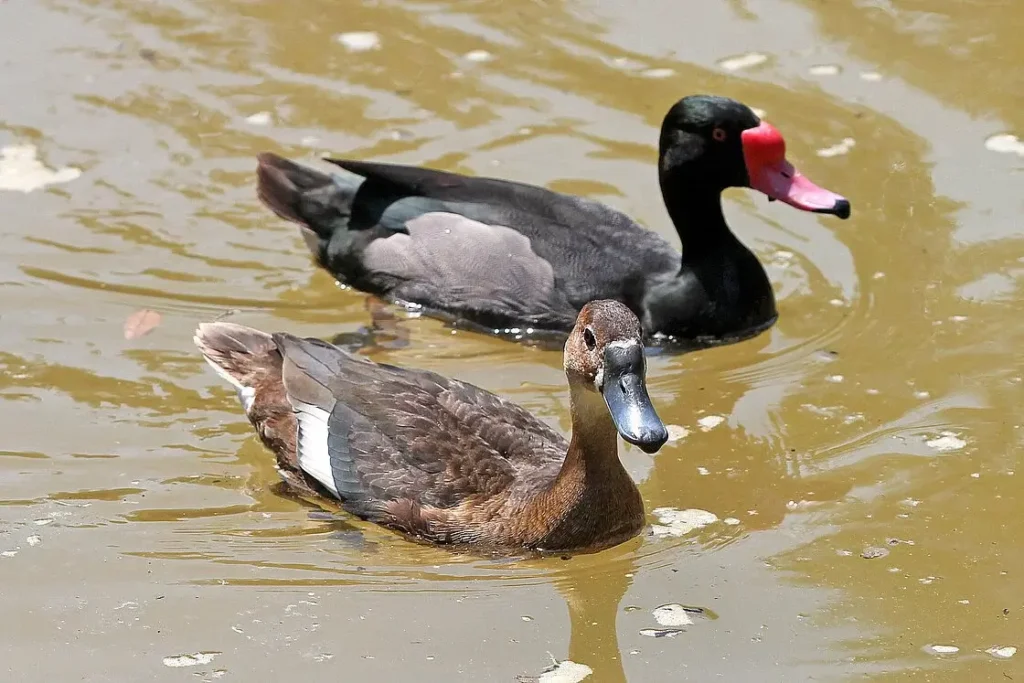
The Rosy-billed Pochard is another member of the pochard group with a dark head, but it is most easily recognized by the male’s striking bright red bill, which features a rounded knob at the base. The male shows a rich purplish-black head, neck, and breast, contrasted with grey flanks, a white patch around the crissum (the area surrounding the cloaca), and vivid red eyes that further enhance its bold appearance.
Although classified as a diving duck, this species often feeds more like a dabbling duck, grazing on seeds, roots, sedges, aquatic plants, and other grasses. It is endemic to South America, where it is found across Argentina, central Chile, Paraguay, Uruguay, and southern Brazil, typically inhabiting freshwater wetlands and marshes.
25. Southern Pochard
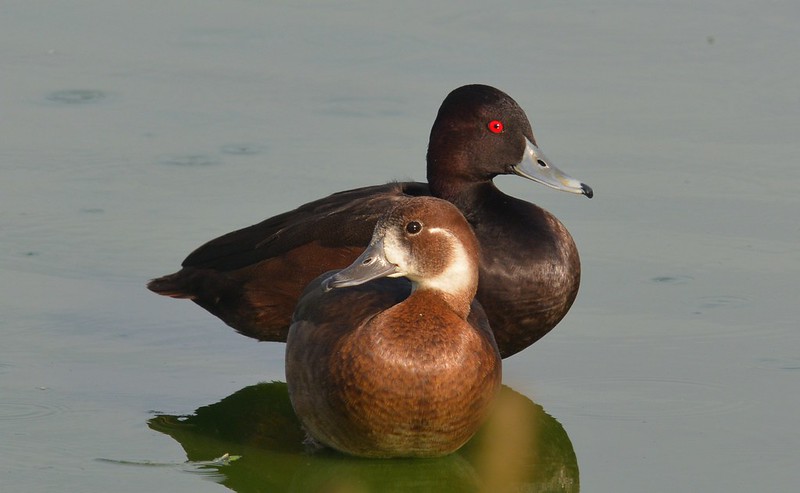
The Southern Pochard is the final pochard in this list, and like several of its relatives, it shows a distinctly dark head that can appear almost black in certain lighting. It is a medium-sized diving duck with a strong, compact build and a generally rich, dark overall appearance. The species has a fragmented distribution across two continents, occurring in South America from Colombia and Venezuela through Brazil, Ecuador, Peru, Bolivia, Argentina, and into Chile.
This is a highly social and gregarious duck, often forming large congregations that can number in the thousands. In suitable wetland habitats, it gathers in impressive flocks, making it a conspicuous presence on open water bodies.
26. Blue Duck / Whio
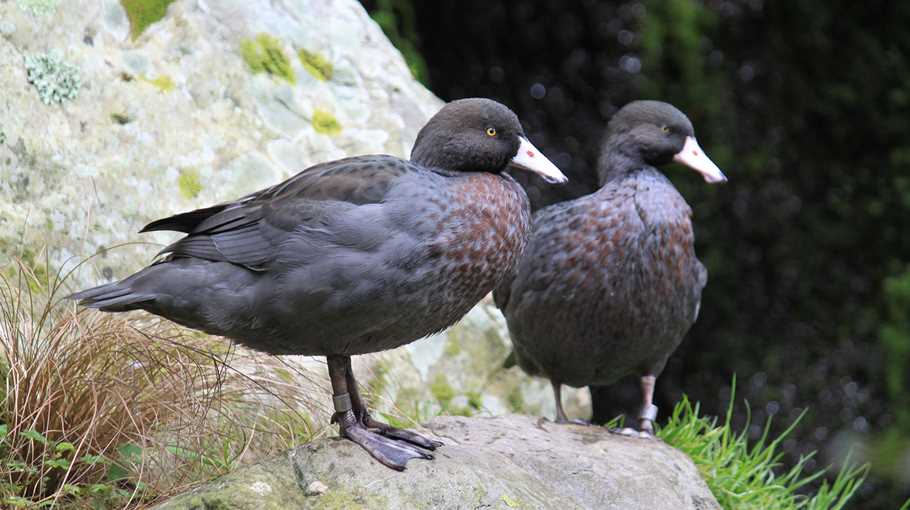
The Blue Duck, or Whio, is a distinctive New Zealand endemic duck and is even featured on the reverse side of the New Zealand $10 banknote. It has a dark slate-grey plumage overall, with the head often appearing blackish in typical field conditions, sometimes showing a subtle greenish sheen in good light. The chest is finely flecked with chestnut tones, adding warmth to its otherwise cool-toned appearance. The wings are neatly patterned, with outer secondaries tipped in white and inner feathers edged with black, giving a crisp contrast in flight.
The sexes are very similar, though females tend to show slightly less chestnut on the breast. This species is a resident breeder in New Zealand, and loves fast-flowing rivers and sheltered nesting sites such as hollow logs, small caves, and other protected riverbank locations.
27. Brazilian Merganser
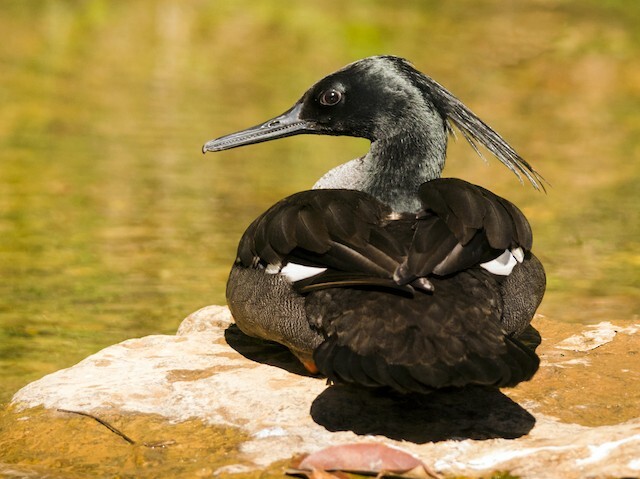
The Brazilian Merganser is one of the most threatened waterfowl species in the world, with an estimated wild population of fewer than 250 individuals, alongside a small number maintained in captivity in Brazil and Czechia. It is a sleek, dark-bodied merganser, and like many in its group, the head often appears black in typical field conditions, especially when the light does not catch its sheen.
The species is especially notable for its glossy dark-green hood, which is extended into a long crest in males, giving the bird a refined, elongated profile. In females, the crest is typically shorter and appears more worn. Overall, it is a slender and highly adapted river specialist, usually quiet in nature, though it may occasionally produce low barking calls in certain situations.
28. Stejneger’s Scoter
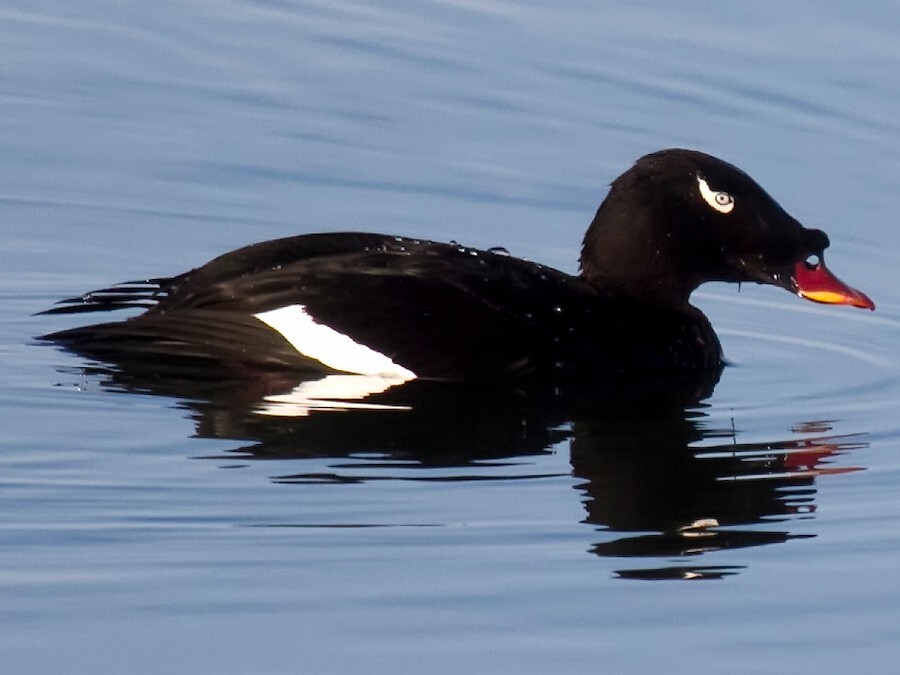
Also known as the Siberian Scoter, Stejneger’s Scoter is a large sea duck of the northern oceans. The male is particularly distinctive, with a bulky profile and a tall, prominent knob at the base of its mostly orange-yellow bill. The head often appears very dark, creating a strong contrast with the bright bill and reinforcing its bold, heavy-headed appearance.
This species breeds across the far north of Asia, east of the Yenisey Basin, and migrates southwards in winter to temperate waters. During the non-breeding season, it can be found along coastal regions of Asia, extending as far south as China, where it gathers in marine habitats to feed and overwinter.
29. Velvet Scoter
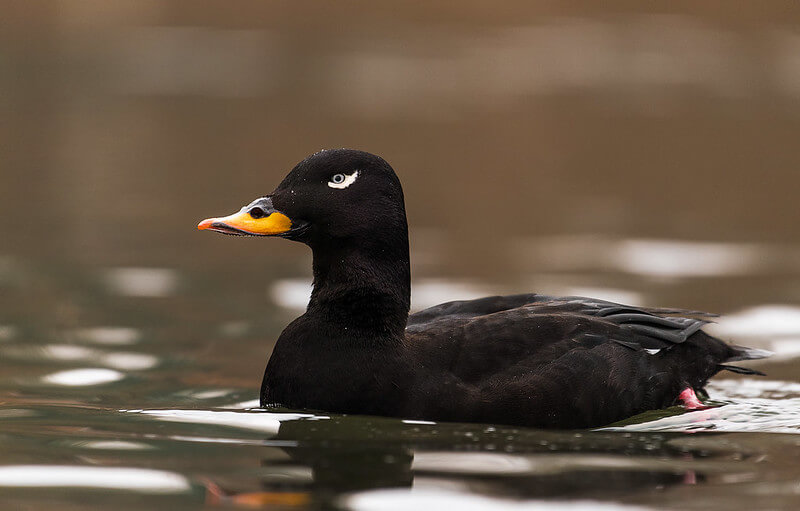
Another scoter with a dark, the Velvet Scoter is a relatively large sea duck with a thick neck, long broad bill, and a pointed tail. The male has glossy black plumage that can appear almost uniform at a distance, especially on the head, where the dark tones create a bold, solid appearance. This is broken up by large white wing patches, small white markings behind the eye, and a partly orange bill that adds contrast to its otherwise dark profile.
The female resembles the male in structure but is noticeably duller, lacking the strong gloss and appearing more brownish overall. Velvet Scoters breed across the far north of Europe and the western Palearctic, west of the Yenisey Basin, and migrate to coastal waters where they spend the non-breeding season.
30. White-winged Scoter
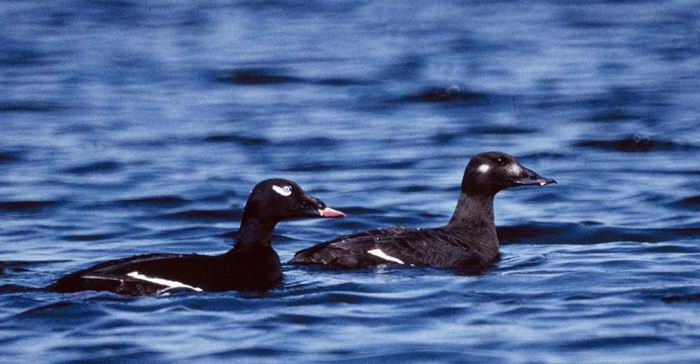
The White-winged Scoter is the largest species of scoter, instantly recognizable by its bulky build and large, heavily feathered bill at the gape, which helps distinguish it from similar sea ducks.
The male is entirely black, including a dark head that often appears uniformly so at a distance, broken only by a small white patch around the eye and a bold white wing speculum that becomes especially visible in flight. Females are more subdued, appearing brownish overall, but can be identified by their large size, robust shape, and feathered gape.
This species breeds in boreal forest lakes from Alaska through western Canada, with fewer populations extending east toward Hudson Bay and south into the Canadian Prairies. In winter, it migrates to temperate waters, including the Great Lakes and coastal regions of the northern United States and southern Canada.
31. Chestnut Teal
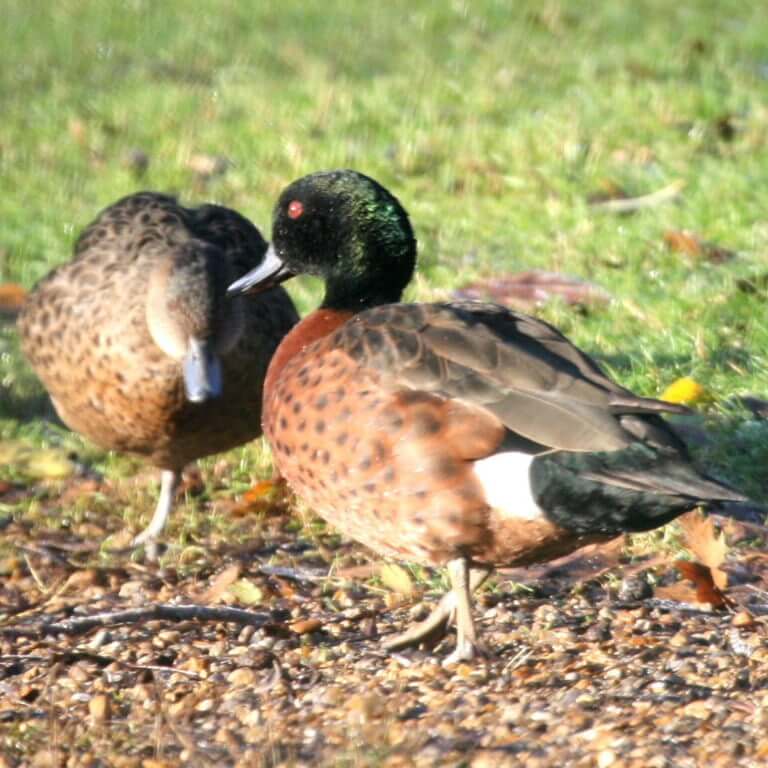
The Chestnut Teal is a dabbling duck native to Australia, commonly found in coastal estuaries and wetlands where it shows a strong tolerance for both fresh and saline water. While not a true black-headed duck, the male often appears to have a very dark, green-glossed head that can look almost black in certain lighting, especially at a distance.
The female is more uniformly brown, with a mottled body and a similarly brown head, making her more understated but well camouflaged in wetland vegetation.
This species is most common in south-eastern and south-western Australia, with strong populations in Tasmania and southern Victoria. Occasional vagrants have been recorded as far north as New Guinea and Lord Howe Island, and even as far south as New Zealand.